- Animals
- ›Arthropods
- ›Hexapods
- ›Insects
- ›Winged and Once-winged Insects
- ›Butterflies and Moths
- ›Butterflies
- ›Skippers
- ›Spread-wing Skippers
- ›Checkered-Skippers, White-Skippers, and Allies
- ›Pyrgus
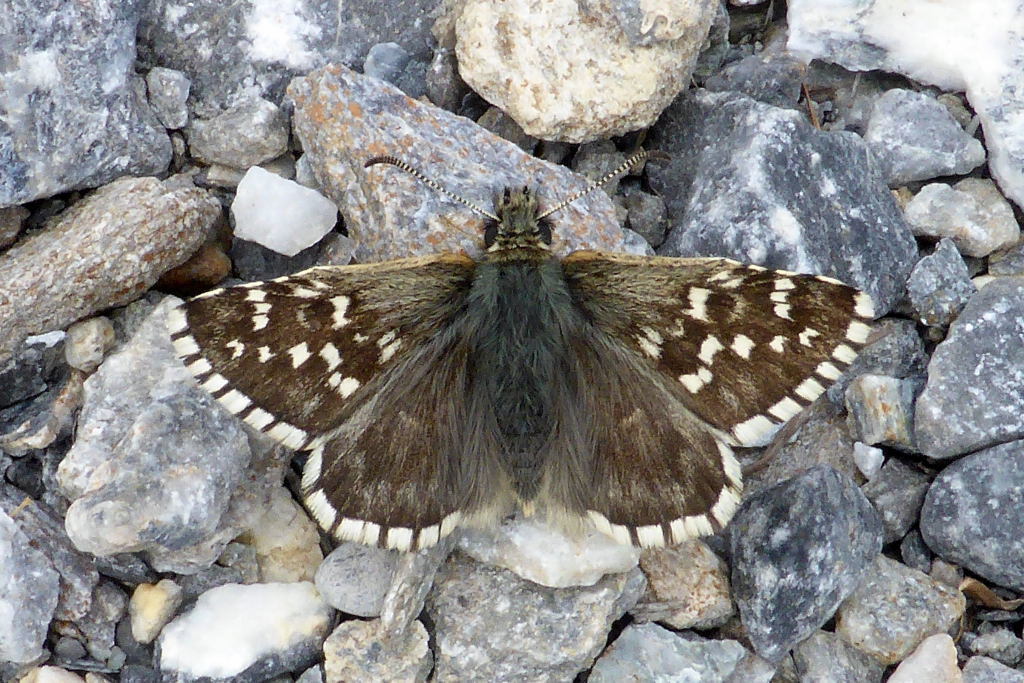
Alpine Grizzled Skipper
Pyrgus andromedae
The Alpine grizzled skipper (Pyrgus andromedae) is a species of skipper (family Hesperiidae). This species is found up to fairly high altitudes in the Alps, Pyrenees and Pirin and also at lower elevations in northern Scandinavia, where its range extends well into the Arctic Circle. It prefers damp habitats and is often found near to water.
From the article Alpine grizzled skipper on Wikipedia (CC BY-SA), quoted section by section
Description
This is a medium-sized Pyrgus skipper with a wingspan of 26–30 mm. The dark brown forewing is marked with a bold pattern of white spots; by contrast the hindwing is plain dark brown with little or no patterning. The underside of the hindwing has two distinctive pale markings close to the dorsum: an elongated streak and a round spot, often likened to an exclamation mark (!). In cases of doubt, an examination of the genitals should be carried out for a reliable determination.
Range & habitat
The Alpine Grizzled Skipper is the only boreo-alpine Pyrgus species in Europe. It is found at high altitudes in Europe. This species is found up to fairly high altitudes in the Alps, Pyrenees (rare) and Pirin and also at lower elevations in northern Scandinavia, where its range extends well into the Arctic Circle. It is also known from the Carpathians, southwest Bosnia, southwest Serbia, northwest North Macedonia, Lapland and the border between Norway and Sweden. This is a European endemic species.
Wikipedia: “Range”
What it does
P. andromedae occurs in one generation per year throughout its range. The first imagos were observed in Bavaria from mid-May. The main flight time falls from the beginning of June to mid-July, from the first week of August there is only a very small amount of evidence. The phenology is strongly dependent on the spring weather in the mountains. After winters with little snow and extremely warm springs, the phenological maximum was already reached at the end of May. In Bavaria, significantly more individuals have been observed in odd years than in even years. P. andromedae has a rapid flight, low over the ground. The imagos use various plants as sources of nectar and can also be found in subalpine tall herbaceous meadows, fatty willows or spring swamps when visiting flowers. They use stones, open soil or exposed leaves as seats. The males move into territories to find a partner, preferably on the banks of a stream or in tall herbaceous meadows. For reproduction, P. andromedae needs well-sunlit stands of Dryas octopetala, which is probably the only host plant. This mainly grows on shallow, humus-poor, base-rich stone and rock soils and is also considered a pioneer species of dormant rock rubble heaps. To lay eggs, the female looks for a suitable leaf with a curved abdomen and attaches the egg individually to the underside of the leaf. …
Wikipedia: “Ecology”
In human culture
"Andromeda" means Andromeda polifolia. As with most Pyrgus species, the species name has nothing to do with the food the caterpillars eat.
Wikipedia: “Etymology”
Listen
Looking for field recordings…
Where it lives
Recorded sightings
—
geo-referenced records in GBIF, from museums, herbaria and field observers.
Drag the globe to turn it. Dots are where records exist, not a range map; darker means more records.
In the stacks
Searching the stacks…
Every page naming Pyrgus andromedae in the Biodiversity Heritage Library →
This page is assembled live from iNaturalist, GBIF, Wikipedia, the Source Library and the Internet Archive. It is not yet part of the hand-edited codex. iNaturalist taxon 111442.