- Animals
- ›Arthropods
- ›Hexapods
- ›Insects
- ›Winged and Once-winged Insects
- ›Butterflies and Moths
- ›Butterflies
- ›Skippers
- ›Spread-wing Skippers
- ›Checkered-Skippers, White-Skippers, and Allies
- ›Pyrgus
- ›Pyrgus malvae
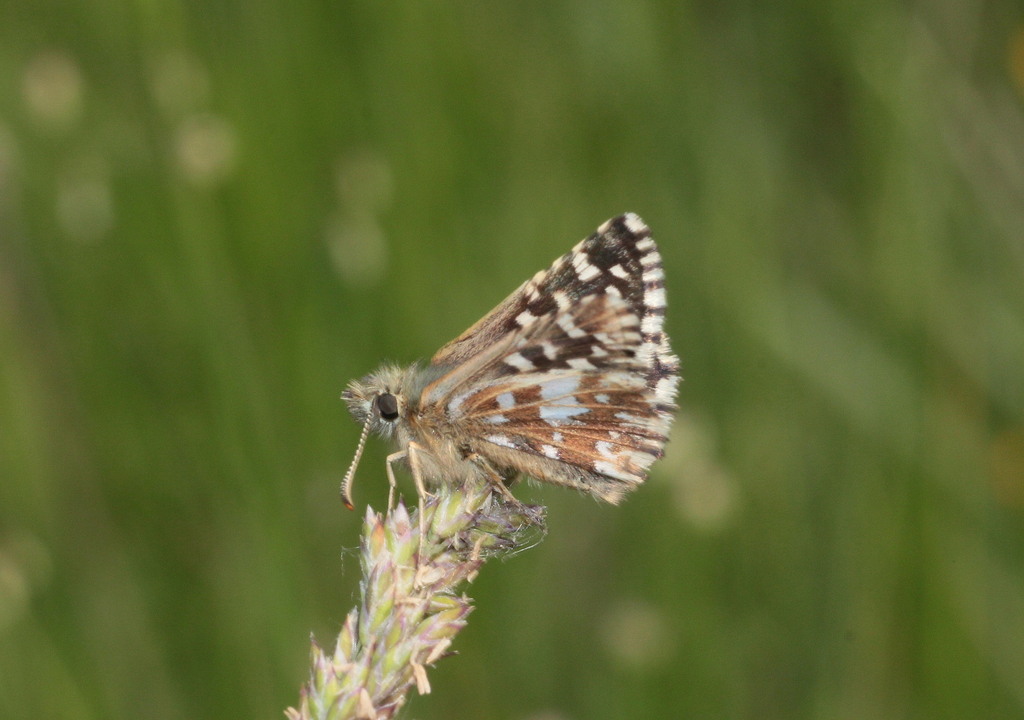
Southern Grizzled Skipper
Pyrgus malvoides
Pyrgus malvoides, the southern grizzled skipper, is a species of skipper (family Hesperiidae). The southern grizzled skipper is also very closely related to the grizzled skipper and has not been separated by significant isolation reproductive barriers. It is found from central France, southern Switzerland and Austria, south to Spain, Portugal and Italy. It is found up to heights of 2,500 meters.
From the article Pyrgus malvoides on Wikipedia (CC BY-SA), quoted section by section
Description
The wingspan of this butterfly is 24–26 mm. Pyrgus malvoides cannot be distinguished from Pyrgus malvae by external characteristics, but this is quite possible on the basis of the genital structures (H. malvoides Elw. Markings as in malvae; tergite of anal segment (male) with a tooth on each side).
From the other species of the genus Pyrgus, both species can be clearly differentiated by the presence of the mostly clear submarginal points on the upper side of the wing.
Range & habitat
Pyrgus malvoides is distributed from Portugal and Spain via southern and central France, southern Switzerland (south of the main Alpine ridge) and Austria (Vorarlberg, Tyrol) to Italy and Istria.
Wikipedia: “Range”
What it does
Adults are on wing from April to September. In Bavaria Pyrgus malvoides flies in one generation from around mid-May to mid-July. A second or even third generation per year, as described e.g. in Italy, was not observed in Bavaria. The larvae feed on Potentilla, Agrimonia and Fragaria species, but primarily Potentilla erecta. It is reported from Switzerland that the caterpillars have been found on various cinquefoil species (Potentilla neumanniana [= tabernaemontani], Potentilla pusilla, Potentilla erecta) and have eaten Fragaria vesca during breeding. Proven forage plants of the caterpillars are: Potentilla tabernaemontani (= Potentilla neumanniana, Potentilla verna) [Switzerland, France], Potentilla pusilla [Switzerland, France, Italy], Potentilla erecta [Switzerland, Spain], Potentilla aurea [Austria], Potentilla reptans [France, Italy, Spain], Potentilla rupestris [Switzerland], Potentilla argentea [France], Potentilla grandiflora [Switzerland], Potentilla hirta [France], Potentilla pensylvanica [Spain], Potentilla recta [Spain], Fragaria vesca [Spain, Switzerland], Alchemilla hybrida [Switzerland], Agrimonia eupatoria [France, Spain], Filipendula vulgaris [Spain], Geum montanum [Spain], Rubus caesius [Spain], Rubus idaeus [Switzerland, France, Italy], Rubus ulmifolius [Spain], Sanguisorba minor [Switzerland, Spain]. …
Wikipedia: “Ecology”
Listen
Looking for field recordings…
Where it lives
Recorded sightings
—
geo-referenced records in GBIF, from museums, herbaria and field observers.
Drag the globe to turn it. Dots are where records exist, not a range map; darker means more records.
In the stacks
Searching the stacks…
Every page naming Pyrgus malvoides in the Biodiversity Heritage Library →
This page is assembled live from iNaturalist, GBIF, Wikipedia, the Source Library and the Internet Archive. It is not yet part of the hand-edited codex. iNaturalist taxon 111447.