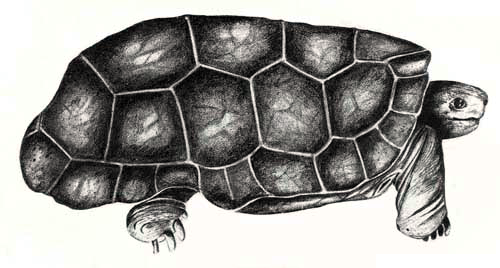
Domed Rodrigues Giant Tortoise
Cylindraspis peltastes
The domed Rodrigues giant tortoise (Cylindraspis peltastes) is an extinct species of giant tortoise in the family Testudinidae. It was endemic to Rodrigues. It appears to have become extinct around 1800, as a result of human exploitation.
From the article Domed Rodrigues giant tortoise on Wikipedia (CC BY-SA), quoted section by section
Description
The domed Rodrigues giant tortoise was one of the smallest of the giant tortoises of the Indian Ocean, reaching a length of just over 40 cm (16 in) and an estimated weight of around 12 kg (26 lb). A low grazer of grasses, it shared Rodrigues Island with its much larger relative, the saddle-backed Rodrigues giant tortoise, which browsed the taller vegetation. Both species were descended from an ancestral species on Mauritius (an ancestor of Cylindraspis inepta), which colonised Rodrigues by sea many millions of years ago, and then differentiated into the two Rodrigues species.
What it does
Leguat gave an account of the behaviour of the tortoises on Rodrigues in 1708:
Every one knows that these animals in general are hatch’d in eggs. The landturtles lay theirs in the sand, and cover them, that they may be hatch’d. The scale of it, or rather the shell, is soft, and the substance within good to eat. There are such plenty of land-turtles in this Isle, that sometimes you see two or three thousand of them in a flock; so that one may go above a hundred paces on their backs; or, to speak more properly on their carapaces, without setting foot to the ground. They meet together in the evening in shady places, and lie so close, that one wou’d think those places were pav’d with them.There’s one thing very odd among them; they always place sentinels at some distance from the troop, at the four corners of the camp, to which the sentinels turn their backs, and look with their eyes, as if they were on watch. This we have always observ’d of them; and this mystery seems the more difficult to be comprehended, for that these creatures are incapable to defend themselves, or to fly.
Wikipedia: “Behaviour and ecology”
Where it lives
Recorded sightings
—
geo-referenced records in GBIF, from museums, herbaria and field observers.
Drag the globe to turn it. Dots are where records exist, not a range map; darker means more records.
In the stacks
Searching the stacks…
Every page naming Cylindraspis peltastes in the Biodiversity Heritage Library →
This page is assembled live from iNaturalist, GBIF, Wikipedia, the Source Library and the Internet Archive. It is not yet part of the hand-edited codex. iNaturalist taxon 121114.