- Plants
- ›Vascular Plants
- ›flowering plants
- ›Dicots
- ›Legumes, Milkworts, and Allies
- ›Legumes
- ›Faboideae
- ›Bossiaeeae
- ›Bossiaea
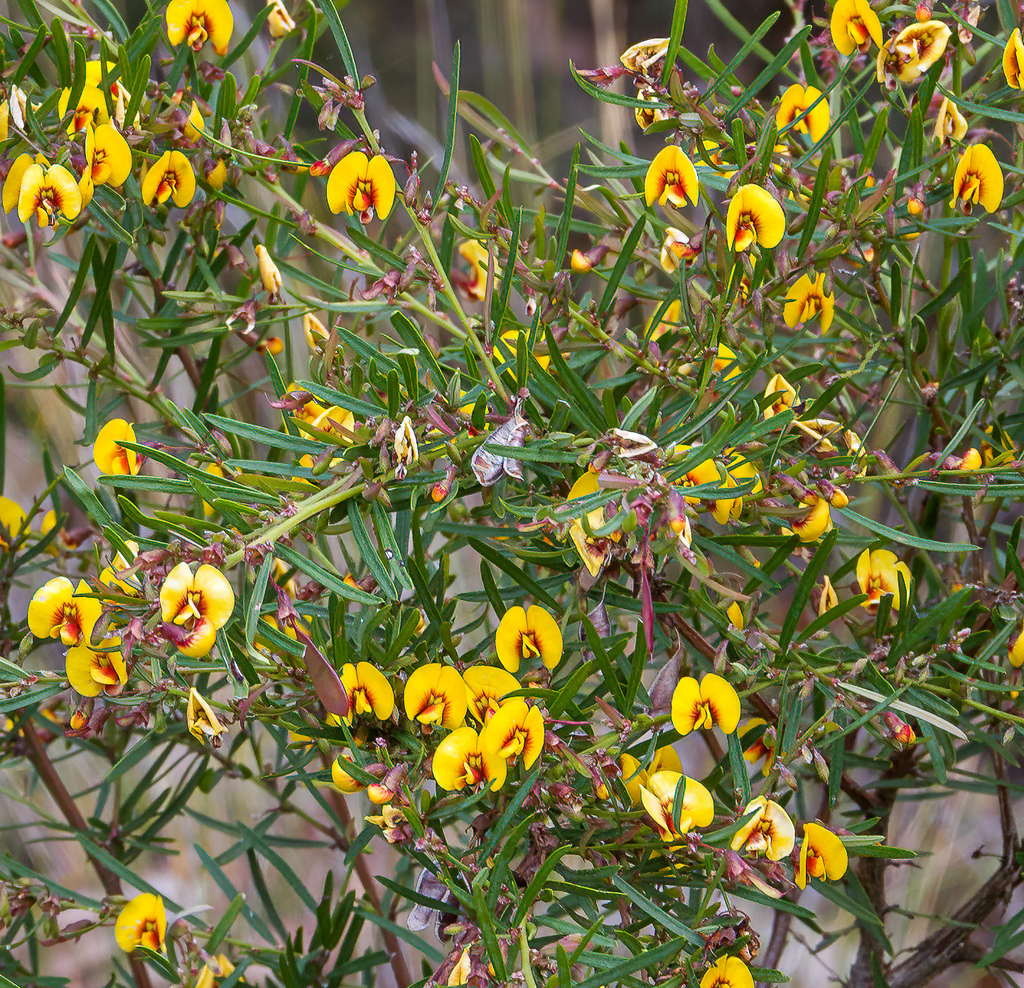
Yellow Bossiaea
Bossiaea linophylla
Bossiaea linophylla is a species of the plant family Fabaceae, first described by Robert Brown in 1812. It is a shrub, erect in habit, either low in height or reaching over two metres. Yellow and red flowers appear between July and December. The species is an endemic of the southwest botanical province, occurring through the high rainfall zone south of Bridgetown, Western Australia and to the east of Albany. The preference is for sandy soils at...
From the article Bossiaea linophylla on Wikipedia (CC BY-SA), quoted section by section
Description
Bossiaea linophylla is a spreading shrub, usually with a weeping habit, that typically grows up to a height of up to 3 m (9.8 ft) and has branchlets that are flattened to oval in cross-section. The leaves are linear to oblong or egg-shaped, 13–30 mm (0.51–1.18 in) long and 0.9–2 mm (0.035–0.079 in) wide on a petiole up to 1 mm (0.039 in) long with tapering stipules 0.7–2.2 mm (0.028–0.087 in) long at the base. The flowers are arranged singly or in small groups, each flower on a thread-like pedicel 0.5–1.4 mm (0.020–0.055 in) long with linear bracteoles 0.7–2.2 mm (0.028–0.087 in) long on the pedicel. There is a single egg-shaped bract up to 0.5–1 mm (0.020–0.039 in) long but that falls off at the early bud stage. The five sepals are joined at the base forming a tube 2.0–3.2 mm (0.079–0.126 in) long, the two upper lobes 1.0–1.5 mm (0.039–0.059 in) long, and the lower lobes slightly shorter. The standard petal is bright yellow to orange or apricot with a red base and 6.6–9.7 mm (0.26–0.38 in) long, the wings 6.4–8.3 mm (0.25–0.33 in) long, and the keel red, sometimes with a greenish base and 4.8–6.4 mm (0.19–0.25 in) long. Flowering occurs from July to December.
Range & habitat
This bossiaea is found between Collie, Augusta, Albany and the Stirling Range in the Avon Wheatbelt, Esperance Plains, Jarrah Forest, Swan Coastal Plain and Warren biogeographic regions where it grows in forest, woodland and heath and is often the dominant understorey species.
Wikipedia: “Distribution and habitat”
What it does
The plant attracts moyadong, parrot subspecies Platycercus icterotis icterotis, which eat their fruit.
== References ==
Wikipedia: “Ecology”
Where it lives
Recorded sightings
—
geo-referenced records in GBIF, from museums, herbaria and field observers.
Drag the globe to turn it. Dots are where records exist, not a range map; darker means more records.
In the stacks
Searching the stacks…
Every page naming Bossiaea linophylla in the Biodiversity Heritage Library →
This page is assembled live from iNaturalist, GBIF, Wikipedia, the Source Library and the Internet Archive. It is not yet part of the hand-edited codex. iNaturalist taxon 121645.