- Animals
- ›Arthropods
- ›Hexapods
- ›Insects
- ›Winged and Once-winged Insects
- ›Butterflies and Moths
- ›Owlet Moths and Allies
- ›Underwing, Tiger, Tussock, and Allied Moths
- ›Hypocalinae
- ›Hypocala
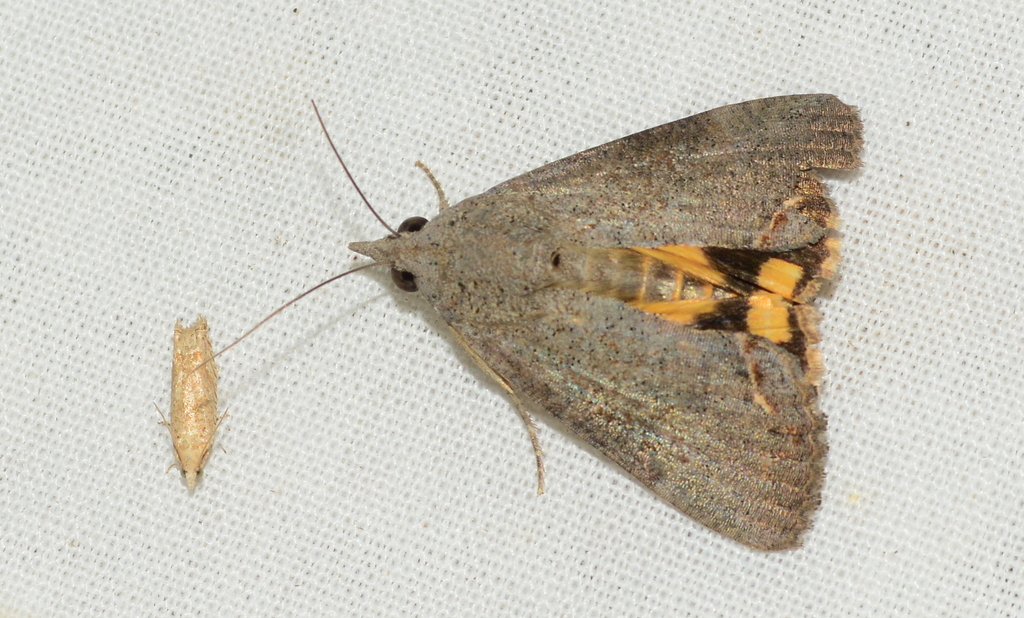
Variable Yellow Underwing
Hypocala deflorata
Hypocala deflorata is a moth of the family Erebidae. It was first described by Johan Christian Fabricius in 1794. It is widespread from India, Sri Lanka to Africa and to Australia and many Pacific islands. Records include China, Borneo, Queensland, Vanuatu, New Caledonia, Rotuma, Fiji, Samoa, Hawaii, Norfolk Island and New Zealand.
From the article Hypocala deflorata on Wikipedia (CC BY-SA), quoted section by section
Description
Full-grown larvae are about 45 mm. The pupa is about 22 mm in length and is medium dark brown. In the adult, the head, thorax and forewings are pale violaceous grey. Hindwings with large orange area. Marginal black area reduced and the two orange spots conjoined. Ventral side black on forewing reduced to two bars, and that on hindwing also much reduced.
What it does
The larvae feed on Diospyros pallens, Diospyros villosa, Diospyros dichrophylla, Diospyros lycioides, Maba sandwicensis, Royena and Sapota species.
Wikipedia: “Ecology”
Listen
Looking for field recordings…
Where it lives
Recorded sightings
—
geo-referenced records in GBIF, from museums, herbaria and field observers.
Drag the globe to turn it. Dots are where records exist, not a range map; darker means more records.
In the stacks
Searching the stacks…
Every page naming Hypocala deflorata in the Biodiversity Heritage Library →
This page is assembled live from iNaturalist, GBIF, Wikipedia, the Source Library and the Internet Archive. It is not yet part of the hand-edited codex. iNaturalist taxon 121858.