- Animals
- ›Arthropods
- ›Hexapods
- ›Insects
- ›Winged and Once-winged Insects
- ›Butterflies and Moths
- ›Calliduloidea
- ›Old World Butterfly Moths
- ›Tetragonus
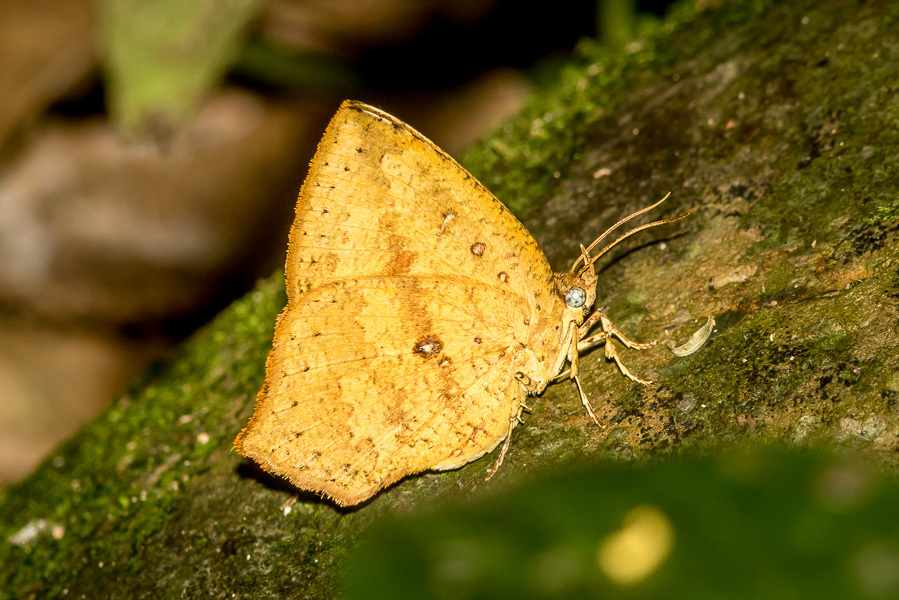
Common Butterfly Moth
Tetragonus catamitus
Tetragonus catamitus, the common butterfly moth, or Philippine callidulid moth, is a moth of the family Callidulidae. It was first described by Carl Geyer in 1832. Noted from Taiwan, north-eastern India, south-west India, the Andaman and Nicobar Islands, Sri Lanka, the Tenasserim Hills of Myanmar and from Java. They are day-flying moths that can be easily mistaken for a butterfly due to the position in which they hold their wings.
From the article Tetragonus catamitus on Wikipedia (CC BY-SA), quoted section by section
Description
The head, thorax and abdomen are dark yellowish and reddish brown. The wings are yellowish and reddish brown. The hindwings are more uniform reddish brown. On the underside, there are dark striations and both the forewing and hindwing have three grey spots in the discal cell. There are four pale rufous bands along the medial, postmedial, submarginal region.
Range & habitat
This species ranges throughout the east and south-east Asian lowland of seasonal or tropical forests where the host fern species are abundant. Kobes (1990) recognized three subspecies, but Holloway (1998) treated all of them as the junior synonyms of the nominotypical subspecies and indicated there is great variation in size and colouration.
Wikipedia: “Range”
What it does
This species occurs in lowland forests, along the boggy areas where the feeding and host plants are dense. Shady, bushy habitats are preferable in day time but unusually can see outside the habitats. Rainy conditions, just after evening dark lights or early mornings are the most active time.
Wikipedia: “Habitat and ecology”
Listen
Looking for field recordings…
Where it lives
Recorded sightings
—
geo-referenced records in GBIF, from museums, herbaria and field observers.
Drag the globe to turn it. Dots are where records exist, not a range map; darker means more records.
In the stacks
Searching the stacks…
Every page naming Tetragonus catamitus in the Biodiversity Heritage Library →
This page is assembled live from iNaturalist, GBIF, Wikipedia, the Source Library and the Internet Archive. It is not yet part of the hand-edited codex. iNaturalist taxon 121881.