- Plants
- ›Vascular Plants
- ›flowering plants
- ›monocots
- ›Agaves, Orchids, Irises, and Allies
- ›Orchids
- ›Orchidoid Orchids
- ›Orchideae
- ›Orchidinae
- ›Ophrys
- ›Araniferae
- ›Ophrys bertolonii
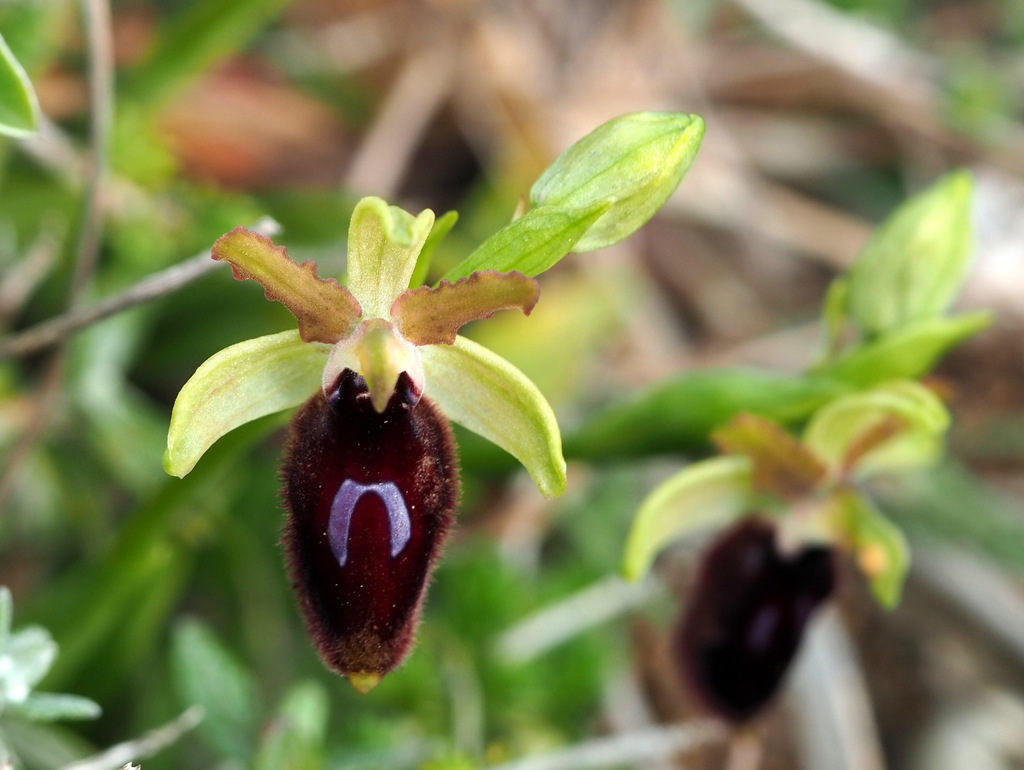
Maltese Spider Orchid
Ophrys melitensis
Ophrys sphegodes, commonly known as the early spider-orchid, is a species of sexually-deceptive orchid (through Pouyannian mimicry) native to Europe and the Middle East. It is a highly varied species with many subspecies recognised.
From the article Ophrys sphegodes on Wikipedia (CC BY-SA), quoted section by section
Description
Plant height varies with latitude. In the UK the maximum height is around 20 cm (8 in), but around the Mediterranean a height of 70 cm (28 in) may be reached. Flowers March–May (April–May in northern latitudes). Each shoot may carry between 2 and 18 flowers. The flowers have yellow-green sepals and a velvety red-brown labellum with a distinctive silvery-blue H marking so that the flowers much resemble an arthropod and especially a spider. Similar to Ophrys fuciflora and Ophrys apifera but flowers differ in that late spider orchid and bee orchid have much smaller petals than sepals; in early spider orchid petals and sepals are a similar size. They are also distinguished by patches of colour on the labellum; late spider orchid has a yellow point at the centre of the distal end of the labellum, while bee orchid has a red patch at the proximal end of the labellum.
Range & habitat
Found on unimproved alkaline meadows, woodland edges, as well as slopes, banks and waste land. It is widespread across most of Europe and the middle East from Britain south to Portugal and east to Iran. In Britain, it is restricted to parts of Dorset, Hampshire, Kent and Sussex and is regarded as rare although where it is found it may be in stands of many hundreds of plants. It is classified as a British Red Data Book plant. Despite its apparent vulnerability, it has very successfully colonised the chalk spoil dumping grounds created near Dover at Samphire Hoe from the excavations of the Channel Tunnel. Worldwide, the IUCN conservation status of this species is least concern as of 2018.
Wikipedia: “Distribution and habitat”
What it does
In the UK Ophrys sphegodes is pollinated by the miner bee Andrena nigroaenea, a polylectic pollinator (i.e. one that visits many different species of flower), a bee species which requires dry sandy soils. Different subspecies have evolved to attract different pollinators. This orchid species is able to form symbiotic relationships with a range of species of mycorrhizal fungi.
Wikipedia: “Ecology”
Where it lives
Recorded sightings
—
geo-referenced records in GBIF, from museums, herbaria and field observers.
Drag the globe to turn it. Dots are where records exist, not a range map; darker means more records.
In the stacks
Searching the stacks…
Every page naming Ophrys melitensis in the Biodiversity Heritage Library →
This page is assembled live from iNaturalist, GBIF, Wikipedia, the Source Library and the Internet Archive. It is not yet part of the hand-edited codex. iNaturalist taxon 1225259.