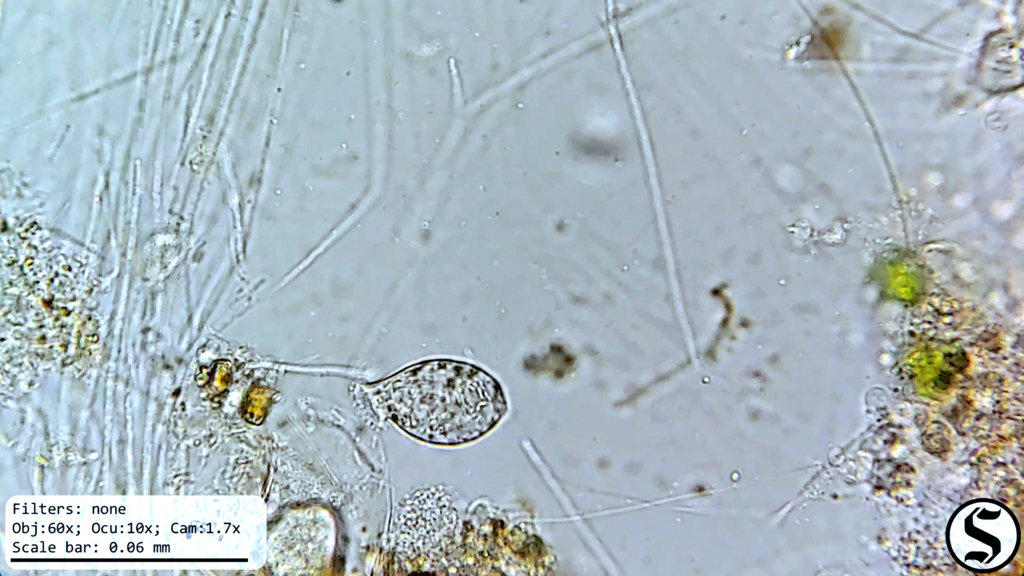
Urceolus cyclostomus
Urceolus cyclostomus is a species of heterotrophic flagellates. It was initially described by Friedrich Stein in 1878 as Phialonema cyclostomum, from an unknown location. Due to its morphological similarities to Urceolus alenizini, the author of the latter, Konstantin Mereschkowsky, transferred it to the genus Urceolus in 1881. Like other species of the genus, its cells have a neck and a wide aperture to a canal that hosts a single flagellum and its feeding apparatus. It is distinguished from other species by a significantly more rigid cell shape, among other traits. It can be found in the bottom sediment of freshwater and brackish water bodies, as a consumer of algae.
From the article Urceolus cyclostomus on Wikipedia (CC BY-SA), quoted section by section
Description
Urceolus cyclostomus is a species of flagellate, a single-celled protist that exhibits an emergent flagellum for movement. Members of the genus Urceolus are distinguished by the presence of a 'neck' at the anterior end of their oval-shaped cell, followed by a wide aperture or 'mouth' into a deep canal where the feeding groove and the flagellum originate. In addition, like other euglenids, the cell surface or pellicle is spiral-striped. In particular, U. cyclostomus is distinguished from other species of the genus by its more or less rigid and regular body shape, a less developed 'ingestive organelle' or feeding apparatus, and a more conspicuous 'hatching' (i.e. more pronounced stripes) of the pellicle. The posterior end of the cell is narrow, as is common in other euglenids. The cells are ovate, measuring 14–30 μm long and 4–18 μm wide. The cells move by crawling through the substrate, with the posterior end raised. The flagellum is around 1.5 times longer than the cell itself, 40–50 μm.
Range & habitat
Urceolus cyclostomus inhabits the bottom sediment of freshwater bodies with a wide distribution. It has been recorded in bogs of the Central Russian forest-steppe region and numerous ponds in the Czech Republic, where it feeds on epipelic cyanobacteria and other kinds of algae. It is also present in brackish waters, such as salt marshes and intertidal sand of England.
Wikipedia: “Distribution and habitat”
Where it lives
Recorded sightings
—
geo-referenced records in GBIF, from museums, herbaria and field observers.
Drag the globe to turn it. Dots are where records exist, not a range map; darker means more records.
In the stacks
Searching the stacks…
Every page naming Urceolus cyclostomus in the Biodiversity Heritage Library →
This page is assembled live from iNaturalist, GBIF, Wikipedia, the Source Library and the Internet Archive. It is not yet part of the hand-edited codex. iNaturalist taxon 1234345.