- Animals
- ›Arthropods
- ›Hexapods
- ›Insects
- ›Winged and Once-winged Insects
- ›Butterflies and Moths
- ›Hawk, Sphinx, Silk, Emperor, and Allied Moths
- ›Emperor and Giant Silk Moths
- ›Emperor Moths
- ›Attacini
- ›Samia
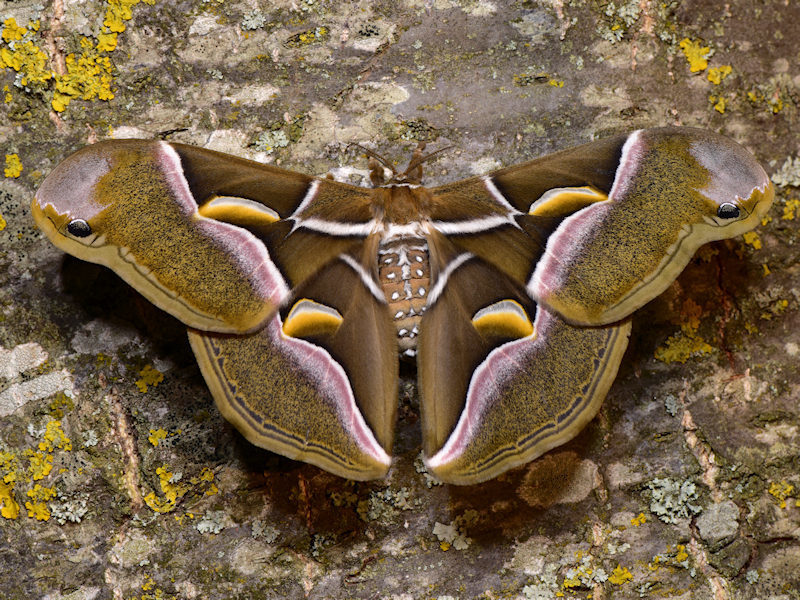
Ailanthus Silkmoth
Samia cynthia
Samia cynthia, the ailanthus silkmoth, is a saturniid moth, used to produce silk fabric but not as domesticated as the silkworm, Bombyx mori. The moth has very large wings of 113–125 mm (4.4–4.9 in), with a quarter-moon shaped spot on both the upper and lower wings, whitish and yellow stripes and brown background. There are eyespots on the outer forewings. The species was first described by Dru Drury in 1773.
From the article Samia cynthia on Wikipedia (CC BY-SA), quoted section by section
Range & habitat
Peigler & Naumann (2003), in their revision of the genus Samia, listed material of true Samia cynthia examined as follows:
Indigenous populations. Asia: China (Zhejiang, Shanghai, Jiangxi, Jiangsu, Shandong, Beijing, Shanxi, Liaoning, Heilongjiang); Korea (North Pyongan, South Pyongan, Pyongyang, Kangwon, South Kyongsan, Chungcheongnam-do province)
Introduced populations. These include moths that have escaped from cultivation or were introduced and naturalized:
Asia: Japan; India; Philippines; Thailand Australasia: Australia America: Canada; United States; Venezuela; Uruguay; Brazil Africa: Tunisia Europe: France; Austria; Switzerland; Germany; Spain; Bulgaria; Italy
Wikipedia: “Range”
At the table
Larvae will feed on other trees and shrubs, but all eggs are laid on the "tree of heaven" (Ailanthus altissima) and growth is best on it. This tree is commonly grown as an ornamental in cities, but is considered a noxious weed and vigorous invasive species and is one of the worst invasive plant species in Europe and North America. The subspecies S. cynthia ricini feeds upon castor bean.
Wikipedia: “Food plants”
Listen
Looking for field recordings…
Where it lives
Recorded sightings
—
geo-referenced records in GBIF, from museums, herbaria and field observers.
Drag the globe to turn it. Dots are where records exist, not a range map; darker means more records.
In the stacks
Searching the stacks…
Every page naming Samia cynthia in the Biodiversity Heritage Library →
This page is assembled live from iNaturalist, GBIF, Wikipedia, the Source Library and the Internet Archive. It is not yet part of the hand-edited codex. iNaturalist taxon 125073.