- Animals
- ›Arthropods
- ›Hexapods
- ›Insects
- ›Winged and Once-winged Insects
- ›Butterflies and Moths
- ›Owlet Moths and Allies
- ›Underwing, Tiger, Tussock, and Allied Moths
- ›Tiger Moths and Allies
- ›Tiger Moths
- ›Callimorphina
- ›Utetheisa
- ›Utetheisa
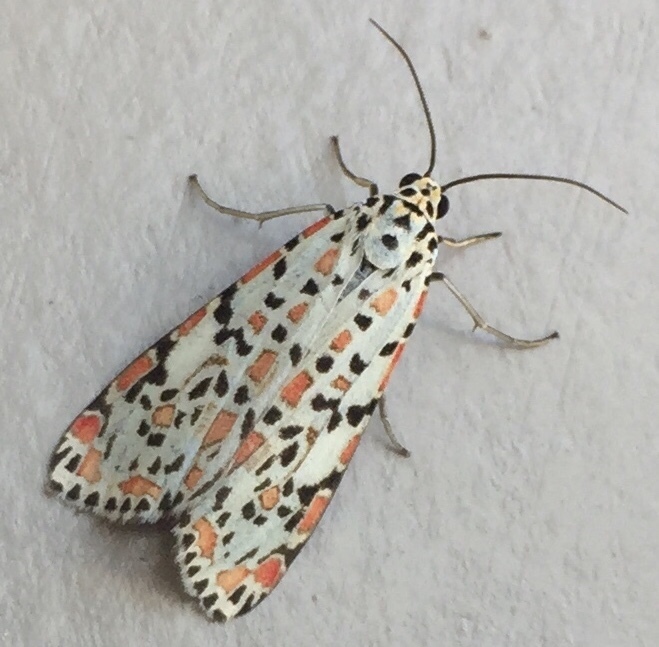
Heliotrope Moth
Utetheisa pulchelloides
Utetheisa pulchelloides, the heliotrope moth, is a moth of the family Erebidae. It is found in the Indo-Australian region including Borneo, Hong Kong, New Zealand, Papua, Seychelles, most of Australia, Tenerife, La Línea de la Concepción [Cádiz] and Greece. The species was first described by George Hampson in 1907.
Adults undertake extensive and frequent migratory flights and can reach the most remote oceanic islands, such as Henderson Island and Ducie Island.
From the article Utetheisa pulchelloides on Wikipedia (CC BY-SA), quoted section by section
Description
Hindwing of male with no fold or glandular tuft on inner margin. Head and thorax yellowish. Collar and tegula each with two black spots. Each thoracic segment with one each black spot. Third joint of palpi black and abdomen whitish. Forewing white with five interrupted scarlet bands with series of black spots between them. A marginal series of black spots present. Hindwings are semi-diaphanous white, but some specimen with black on the discocellulars. A very irregular black sub-marginal band, broad at apical area and between veins 1b and 3. Larva dark grey with a dorsal white band and sub-dorsal series of red spots. Head yellow. It pupates in a loose cocoon that spun in the leaf litter on the ground below the food plant.
What it does
The larvae feed on Argusia argentea, Echium plantagineum, Heliotropium arborescens and Myosotis arvensis.
Wikipedia: “Ecology”
Listen
Looking for field recordings…
Where it lives
Recorded sightings
—
geo-referenced records in GBIF, from museums, herbaria and field observers.
Drag the globe to turn it. Dots are where records exist, not a range map; darker means more records.
In the stacks
Searching the stacks…
Every page naming Utetheisa pulchelloides in the Biodiversity Heritage Library →
This page is assembled live from iNaturalist, GBIF, Wikipedia, the Source Library and the Internet Archive. It is not yet part of the hand-edited codex. iNaturalist taxon 125231.