- Animals
- ›Arthropods
- ›Hexapods
- ›Insects
- ›Winged and Once-winged Insects
- ›Ants, Bees, Wasps, and Sawflies
- ›Narrow-waisted Wasps, Ants, and Bees
- ›Ants, Bees, and Stinging Wasps
- ›Formicoidea
- ›Ants
- ›Myrmicine Ants
- ›Higher Myrmicine Ants
- ›Fungus-growing Ants
- ›Atta
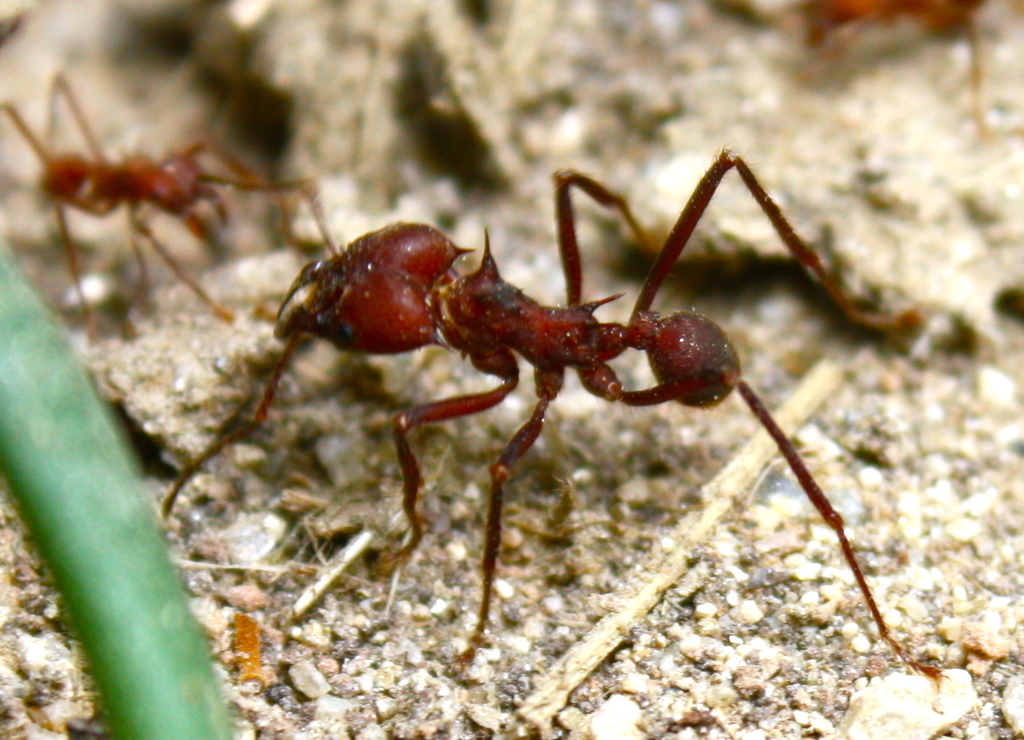
Colombian Leafcutter Ant
Atta colombica
Atta colombica (often misspelled Atta columbica) is one of 47 species of leafcutter ants. This species is part of the Attini tribe (the fungus-growing ants).
From the article Atta colombica on Wikipedia (CC BY-SA), quoted section by section
Description
Workers of this species are maroon in colour, and are entirely matte, with no shiny spots.
Range & habitat
This species ranges from Guatemala to Colombia, and can also be found in Costa Rica and Panama.
Wikipedia: “Distribution”
What it does
A colony of A. colombica harvests, on average, 85–470 kg (187–1,036 lb) of plant biomass per year (dry weight), meaning they harvest a leaf area of about 835–4,550 m2 (8,990–48,980 ft2) annually. The average number of different active males in each colony is believed to be less than three. Due to the variation of shared paternity, though, colonies effectively contain two fathers. Unlike the majority of Atta spp., that respond to colony threats from other ants with many small worker ants, A. colombica appears to recruit majors, or soldiers, for defense.
Wikipedia: “Behavior”
Listen
Looking for field recordings…
Where it lives
Recorded sightings
—
geo-referenced records in GBIF, from museums, herbaria and field observers.
Drag the globe to turn it. Dots are where records exist, not a range map; darker means more records.
In the stacks
Searching the stacks…
Every page naming Atta colombica in the Biodiversity Heritage Library →
This page is assembled live from iNaturalist, GBIF, Wikipedia, the Source Library and the Internet Archive. It is not yet part of the hand-edited codex. iNaturalist taxon 126711.