- Animals
- ›Arthropods
- ›Chelicerates
- ›Arachnids
- ›Spiders
- ›Typical Spiders
- ›Entelegyne Spiders
- ›RTA Clade Spiders
- ›Oval calamistrum clade spiders
- ›Wolf Spiders and Allies
- ›Lynx Spiders
- ›Peucetia
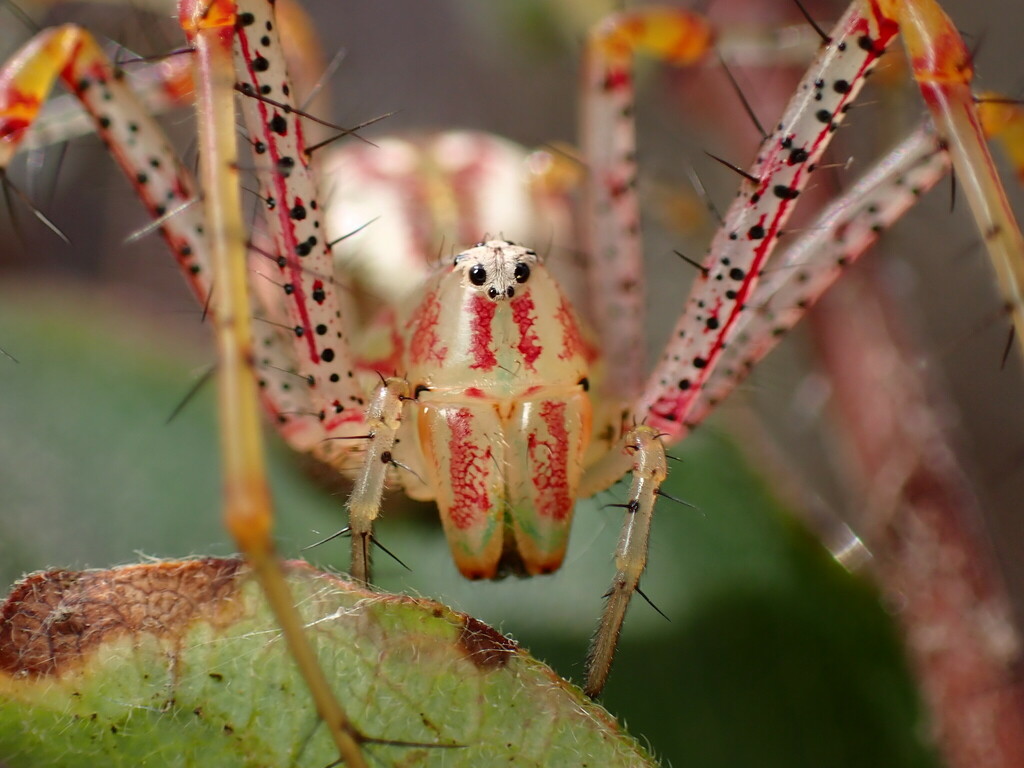
Green Lynx Spider
Peucetia viridans
Peucetia viridans, the green lynx spider, is a bright-green lynx spider usually found on green plants. This spider is common in the southern U.S., Mexico, Central America, and in many West Indies islands, especially Jamaica. Lynx spiders are hunters specialized for living on plants. This species does not use a web to capture its prey. It pounces on its prey in a cat-like manner, which is the reason for the name lynx. It is active during the day.
From the article Peucetia viridans on Wikipedia (CC BY-SA), quoted section by section
Description
The body of the female may be as much as 22 millimeters (0.87 in) long. The male is smaller, being more slender and averaging 12 millimeters (0.47 in) in length. There often is a red patch between the eyes, with a few red spots on the body. The eye region is clothed with white appressed hairs. The dorsal surface of the abdomen bears about six Chevron-like marks with the centres pointing forward. The legs are green to yellow, bearing long black spines such as appear on the legs of most species of Oxyopidae, and with a generous scattering of black spots. Peucetia viridans is confusingly similar to Peucetia longipalpis, the other Peucetia species to occur in the United States, but Peucetia longipalpis tends to have a shorter, fatter, more domed abdomen, with less pronounced markings in its upper surface.
Late in the season Peucetia viridans is prone to change its colour from predominantly green to paler yellow, typically with streaks of reddish, suggesting degradation of the tetrapyrrole pigment in the blood. Gravid females may change their color to fit their background. This takes about 16 days.
Range & habitat
This species occurs in the southern United States, California, Mexico, Central America, the West Indies, and Venezuela.
Wikipedia: “Distribution”
Where it lives
Recorded sightings
—
geo-referenced records in GBIF, from museums, herbaria and field observers.
Drag the globe to turn it. Dots are where records exist, not a range map; darker means more records.
In the stacks
Searching the stacks…
Every page naming Peucetia viridans in the Biodiversity Heritage Library →
This page is assembled live from iNaturalist, GBIF, Wikipedia, the Source Library and the Internet Archive. It is not yet part of the hand-edited codex. iNaturalist taxon 126777.