- Animals
- ›Arthropods
- ›Hexapods
- ›Insects
- ›Winged and Once-winged Insects
- ›Butterflies and Moths
- ›Butterflies
- ›Brush-footed Butterflies
- ›Fritillaries and Longwings
- ›Longwings
- ›Heliconius
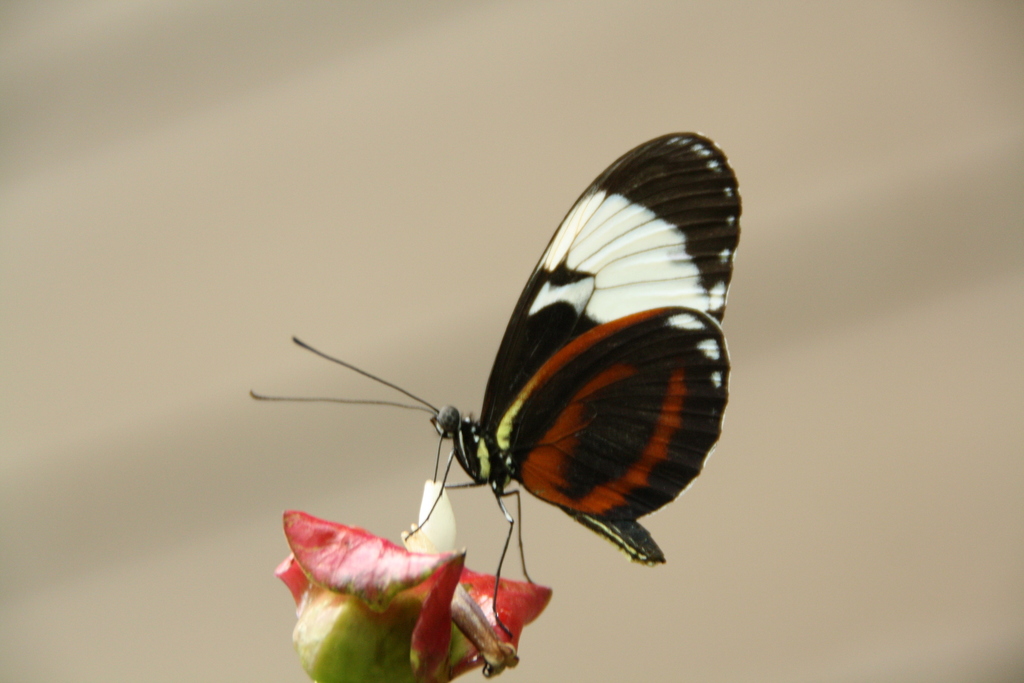
Cydno Longwing
Heliconius cydno
Heliconius cydno, the cydno longwing, is a nymphalid butterfly that ranges from Mexico to northern South America. It is typically found in the forest understory and deposits its eggs on a variety of plants of the genus Passiflora. It is a member of the Heliconiinae subfamily of Central and South America, and it is the only heliconiine that can be considered oligophagous. H. cydno is also characterized by hybridization and Müllerian mimicry. Wing coloration plays a key role in mate choice and has further implications in regards to sympatric speciation. Macrolide scent gland extracts and wing-clicking behavior further characterize this species.
From the article Heliconius cydno on Wikipedia (CC BY-SA), quoted section by section
Range & habitat
H. cydno ranges from southern Mexico to western Ecuador in northern South America. H. cydno is considered to be non-migratory, or sedentary. H. cydno lives in closed-forest habitats, specifically in the forest understories. They live at elevations from sea level to 2000 meters. Their most common host plants are in the genus Passiflora, and at night, adults roost in twigs or tendrils from two to ten meters above the forest floor. Males generally tend to fly higher than females, who are found lower in the forest understory.
Wikipedia: “Distribution and habitat”
What it does
In an experiment by Mirian Medina Hay-Roe and Richard W. Mankin, field-collected H. cydno females were found to produce wing clicks when interacting with members of the same species. Wing clicks are made in short sequences of three to ten clicks, at a speed of approximately ten clicks per second. They demonstrated this behavior during the day and at roosting time, when individuals came close to one another so as to almost touch one another's head or wings. This behavior was also observed during aggressive interactions with H. erato females. When an experimental group of H. cydno were moved to a greenhouse and allowed to reproduce, the first generation of adults born in the greenhouses did not demonstrate wing-clicking behavior. The frequency of wing clicking peaked at 1075 Hz, which is close to the 1200-Hz frequency peak of auditory sensitivity in H. erato. This further suggests that communication both between and within species may be facilitated through this behavior.
== References ==
Wikipedia: “Social behavior”
Listen
Looking for field recordings…
Where it lives
Recorded sightings
—
geo-referenced records in GBIF, from museums, herbaria and field observers.
Drag the globe to turn it. Dots are where records exist, not a range map; darker means more records.
In the stacks
Searching the stacks…
Every page naming Heliconius cydno in the Biodiversity Heritage Library →
This page is assembled live from iNaturalist, GBIF, Wikipedia, the Source Library and the Internet Archive. It is not yet part of the hand-edited codex. iNaturalist taxon 127157.