- Animals
- ›Cnidarians
- ›Sea Anemones and Corals
- ›Hexacorallians
- ›Sea Anemones
- ›Enthemonae
- ›Actinioidea
- ›Actiniid Sea Anemones
- ›Urticina
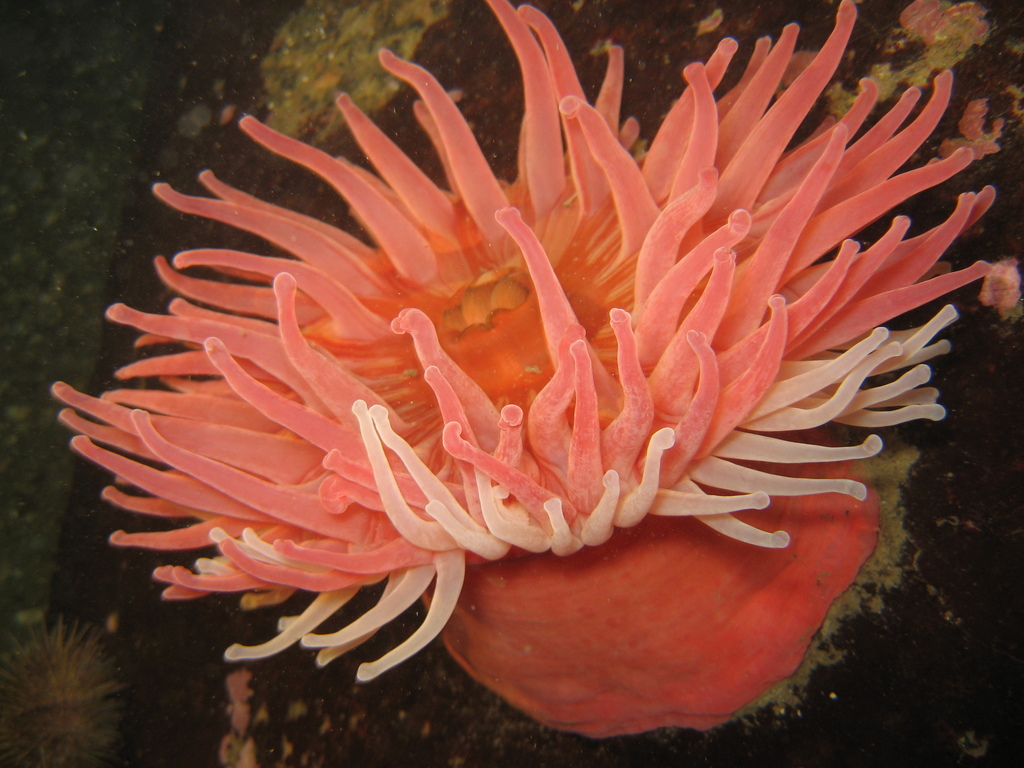
Christmas Anemone
Urticina crassicornis
The mottled anemone (Urticina crassicornis; formerly, Tealia crassicornis), also known as painted anemone or Christmas anemone, is a large and common intertidal and subtidal sea anemone. Its habitat includes a large portion of the coastal areas of the northern hemisphere, mainly polar regions, and it lives a solitary life for up to 80 years of age. Mottled anemones are similar to Dahlia anemones (U. felina) and both are commonly referred to as northern red anemones.
From the article Urticina crassicornis on Wikipedia (CC BY-SA), quoted section by section
Description
Urticina crassicornis is biradially symmetrical and ranges from 2 - 12.7 cm tall with a width of 1 - 7.6 cm. This sea anemone has a solid basal plate which is always flat. Its column can be olive green with or without red spots, solid red, cream, or brown. It always has small, inconspicuous tubercles but no acontia. Its tubercles are not white and do not usually accumulate bits of sand, gravel and shell. The tentacles, superior of the column and usually 100 in number, are green to opaque cream with red and white striations and semi-transparent when extended. The tentacles are conical, thick and blunt and arranged in 3 - 5 circular rings around the oral disc. The oral disc has no white striations and usually has the same color scheme as the tentacles.
Range & habitat
Urticina crassicornis is found in the north Pacific Ocean (along coasts of both Asia and North America), north Atlantic Ocean (North America and Europe) and Arctic Ocean (Asia, Europe and North America). In the northeastern Pacific Ocean, it ranges from intertidal and subtidal zones of the Pribilof Islands, Alaska to Monterey, California. In the Atlantic Ocean, it is found in intertidal and subtidal zones ranging from the Arctic Ocean above Newfoundland, Canada to Cape Cod, Massachusetts (USA), and also along the coasts of northwestern Europe. In the state of Washington this sea anemone more commonly frequents the Puget Sound compared to the Pacific Ocean front. It is found in a lower intertidal, upper subtidal zone - 30 m deep, inhabiting well protected and shaded areas. Urticina crassicornis is a benthic and sessile organism, firmly attached only to hard substrata. This sea anemone is frequently found on docks, wood pilings, and under large rock outcroppings.
Wikipedia: “Geographical range and habitat”
What it does
A non-selective and opportunistic predator, Urticina crassicornis, may feed on crabs, sea urchins, mussels, gastropods, chitons, barnacles, fish, and sometimes sea stars and stranded jellies. A peculiar prey, the sun star, Pycnopodia helianthoides commonly known as the "Sunflower Star", is found in Washington state and has a size much greater than U. crassicornis, sometimes ranging up to 3 ft. in armspan. This anemone exhibits both intracellular and extracellular digestion. Food is caught within the tentacles which then move the prey towards the oral disc.
Wikipedia: “Feeding”
Where it lives
Recorded sightings
—
geo-referenced records in GBIF, from museums, herbaria and field observers.
Drag the globe to turn it. Dots are where records exist, not a range map; darker means more records.
In the stacks
Searching the stacks…
Every page naming Urticina crassicornis in the Biodiversity Heritage Library →
This page is assembled live from iNaturalist, GBIF, Wikipedia, the Source Library and the Internet Archive. It is not yet part of the hand-edited codex. iNaturalist taxon 127236.