- Plants
- ›Vascular Plants
- ›flowering plants
- ›monocots
- ›Agaves, Orchids, Irises, and Allies
- ›Orchids
- ›Orchidoid Orchids
- ›Diurideae
- ›Caladeniinae
- ›Cyanicula
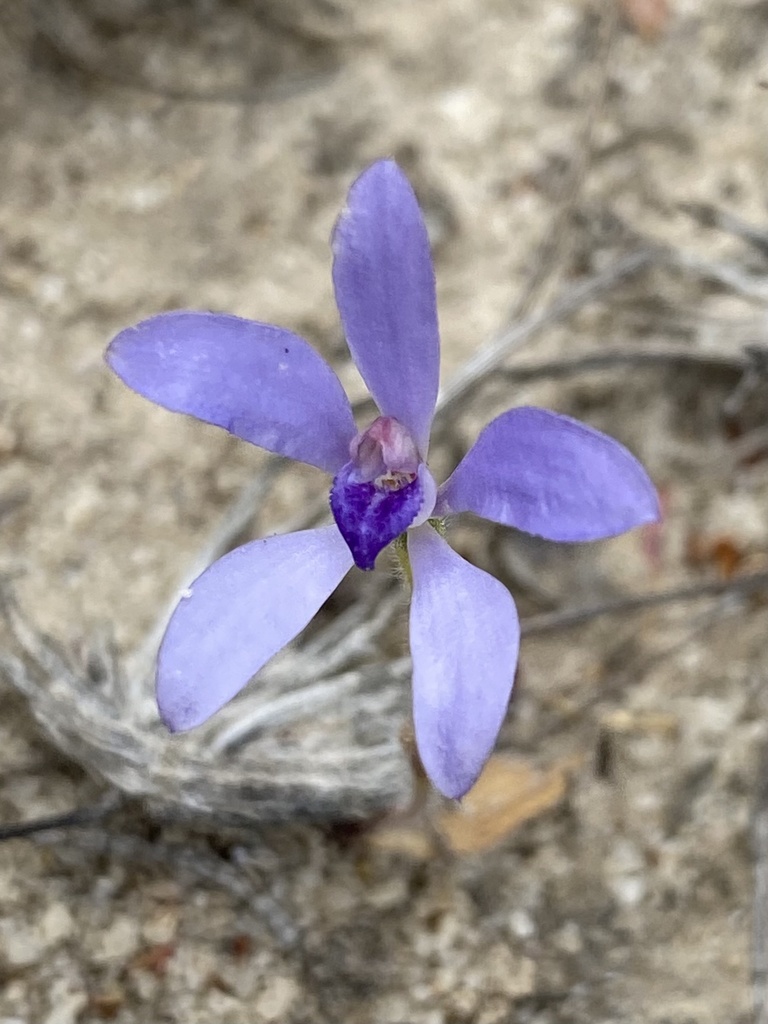
Cyanicula ashbyae
Cyanicula ashbyae, commonly known as the powder-blue china orchid, is a plant in the orchid family Orchidaceae and is endemic to Western Australia. It has a relatively short, broad leaf and one or two pale bluish-mauve flowers.
From the article Cyanicula ashbyae on Wikipedia (CC BY-SA), quoted section by section
Description
Cyanicula ashbyae is a terrestrial, perennial, deciduous, herb with an underground tuber and a single flat leaf, 20–40 mm (0.8–2 in) long, 10–15 mm (0.4–0.6 in) wide which is often withered when the flower opens. One or two pale bluish-mauve flowers 20–30 mm (0.8–1 in) long and wide are borne on a stalk 80–150 mm (3–6 in) tall. The flowers are strongly scented and on rare occasions they are white. The dorsal sepal is erect, 15–30 mm (0.6–1 in) long and 4–8 mm (0.2–0.3 in) wide. The lateral sepals are 17–25 mm (0.7–1 in) long and 5–8 mm (0.2–0.3 in) wide and the petals are 15–25 mm (0.6–1 in) long and 5–10 mm (0.2–0.4 in) wide. The labellum is 5–8 mm (0.2–0.3 in) long, 3–5 mm (0.1–0.2 in) wide, bluish-mauve and relatively flat apart from a down-curved tip. The sides of the labellum have minute teeth and there are many scattered, bead-like calli scattered over the labellum. Flowering occurs from October to early November.
Range & habitat
The powder-blue china orchid grows on and near granite outcrops between Pingrup and Beacon in the Avon Wheatbelt, Coolgardie and Mallee biogeographic regions.
Wikipedia: “Distribution and habitat”
Where it lives
Recorded sightings
—
geo-referenced records in GBIF, from museums, herbaria and field observers.
Drag the globe to turn it. Dots are where records exist, not a range map; darker means more records.
In the stacks
Searching the stacks…
Every page naming Cyanicula ashbyae in the Biodiversity Heritage Library →
This page is assembled live from iNaturalist, GBIF, Wikipedia, the Source Library and the Internet Archive. It is not yet part of the hand-edited codex. iNaturalist taxon 1275586.