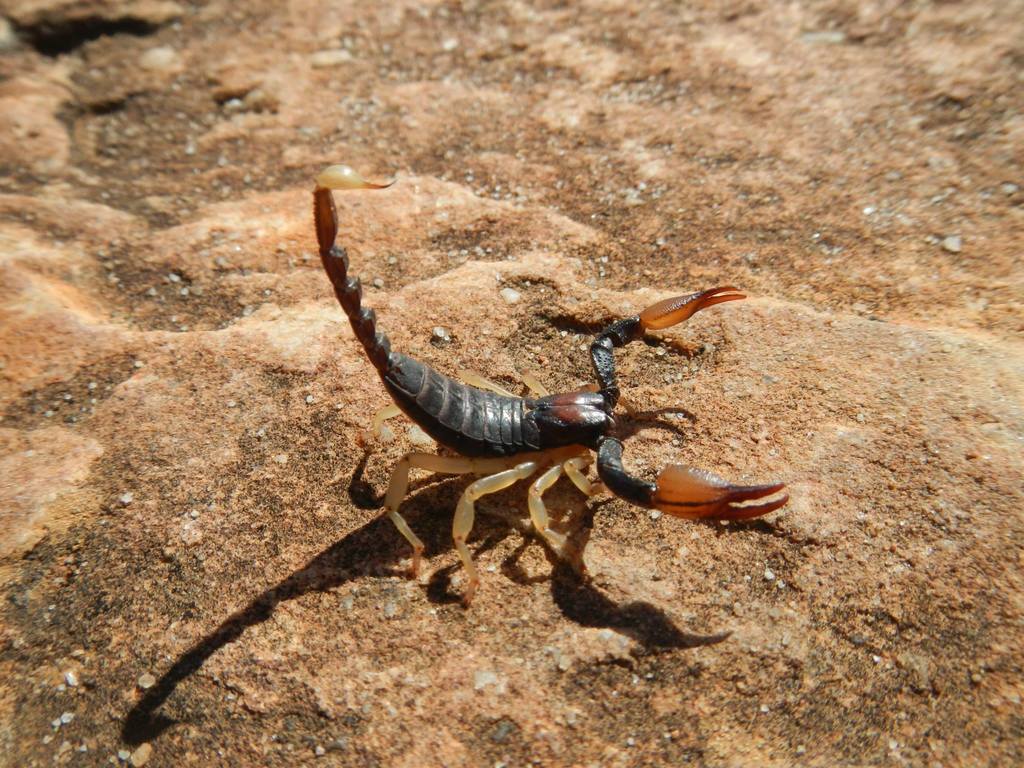
Scorpionoidea
Scorpions (order Scorpiones) are predatory arachnids with eight legs, a pair of grasping pincers and a narrow, segmented tail, often carried in a characteristic forward curve over the back and always ending with a stinger. The evolutionary history of scorpions goes back to the Silurian Period, approximately 430 million years ago. They mainly live in deserts but have adapted to a wide range of environmental conditions, and can be found on all continents except Antarctica. There are over 2,500 described species, with 22 extant (living) families recognized to date. Their taxonomy is being revised to account for 21st-century genomic studies.
Scorpions primarily prey on insects and other invertebrates, but some species hunt vertebrates. They use their pincers to restrain and kill prey, or to prevent their own predation. The scorpion's sting is venomous and used for offense and defense. During courtship, the male and female grasp each other's pincers and dance while the male tries to move the female onto his sperm packet. All known species give live birth and the female cares for the young as their exoskeletons harden, transporting them on her back. The exoskeleton contains fluorescent chemicals and glows under ultraviolet light.
7 branches of this superfamily, most-observed first

Largeclaw Scorpions
familyScorpionidae

Hormuridae
familyHormuridae

Urodacidae
familyUrodacidae

Spinysting Scorpions
familyDiplocentridae

Hemiscorpiidae
familyHemiscorpiidae

Heteroscorpionidae
familyHeteroscorpionidae
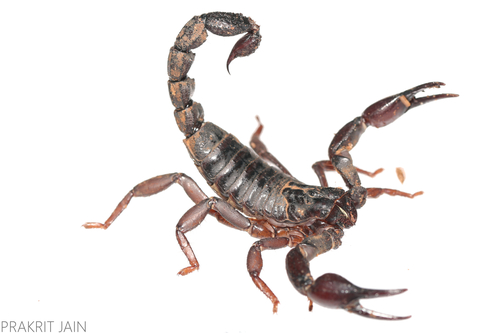
Rugodentidae
familyRugodentidae
Where it lives
Recorded sightings
—
geo-referenced records in GBIF, from museums, herbaria and field observers.
Drag the globe to turn it. Dots are where records exist, not a range map; darker means more records.
In the stacks
Searching the stacks…
Every page naming Scorpionoidea in the Biodiversity Heritage Library →
This page is assembled live from iNaturalist, GBIF, Wikipedia, the Source Library and the Internet Archive. It is not yet part of the hand-edited codex. iNaturalist taxon 127715.