 NL·0130
Herbarium of the Nature Library
- Name
- Saccharum officinarum
- Family
- Poaceae
- Native to
- New Guinea (derived from Saccharum robustum); modern canes are hybrids with S. spontaneum; grown throughout the tropics and subtropics
- Habitat
- Tropical lowlands, Plantations
Sugarcane
Saccharum officinarum
Also calledGanna / Ikh (Hindi/Urdu) · Ikṣu (Sanskrit) · Qaṣab al-sukkar (Arabic) · Nayshakar (Persian) · Gānzhe (Chinese) · Tebu (Malay/Indonesian) · Caña de azúcar (Spanish) · Miwa (Swahili)
A giant perennial grass domesticated in New Guinea about 8,000 years ago whose stems store sucrose at up to 20% of their weight. Its spread shaped world history — from Indian sugar crystallisation in the Gupta era to the Atlantic slave trade and Caribbean plantations.
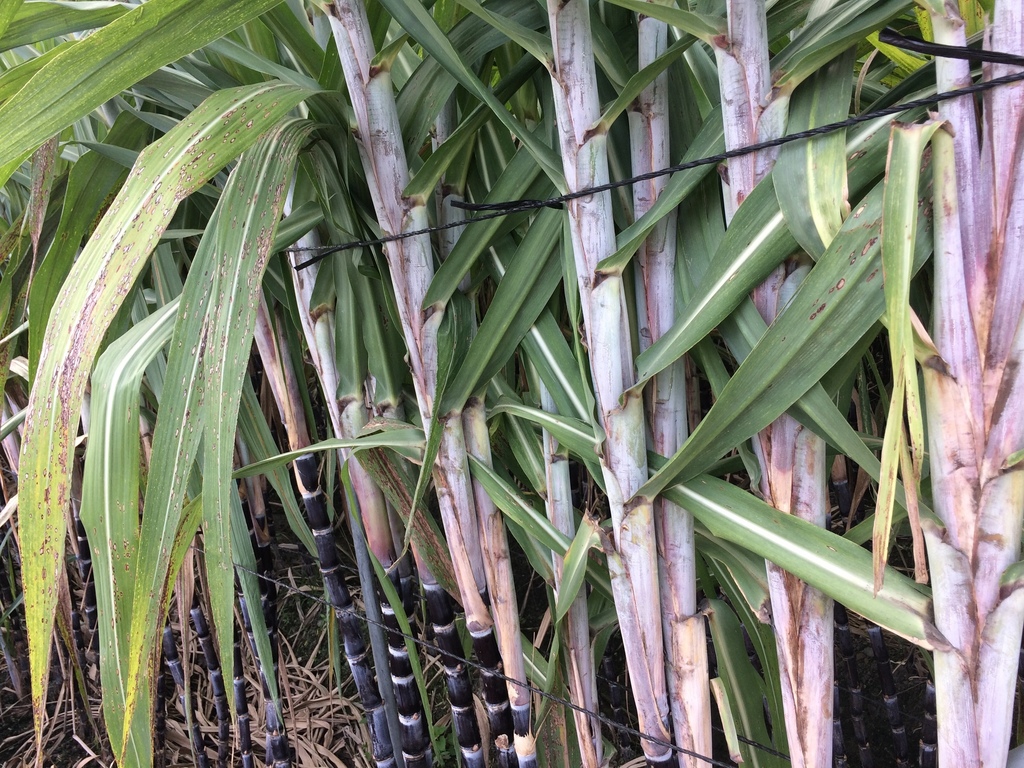
Saccharum officinarum is a large, strong-growing species of grass in the sugarcane genus. Its stout stalks are rich in sucrose, a disaccharide sugar which accumulates in the stalk internodes. It originated in New Guinea, and is now cultivated in tropical and subtropical countries worldwide for the production of sugar, ethanol and other products. It is one of the most productive and most intensively cultivated kinds of sugarcane. Wikipedia
What it can do
- iC4 photosynthesis makes it one of the most efficient converters of sunlight into biomass
- iiStems store sucrose at up to about 20% of fresh weight
- iiiGrows 3–6 m tall and regrows from the stubble ('ratoon') for several harvests
- ivCrushed fibre (bagasse) fuels the mills that process it
At the table
Eatenstem juice (fresh, boiled into jaggery, panela, sugar, molasses, fermented to rum) · peeled stem (chewed)
Juice and chewed stems are safe. Refined sugar in excess is linked to tooth decay, obesity and type 2 diabetes.
In the medicine cabinet
| Tradition | Use |
|---|---|
| Ayurveda | Fresh cane juice and jaggery (guḍa) as a cooling tonic and for jaundice; jaggery as the sweet base of many remedies |
| Cuban medicine | Policosanol from cane wax developed as a cholesterol-lowering drug (later trials outside Cuba were negative) |
Weight of evidence
Traditional. Long historical use; little or no modern clinical evidence.
Active compounds
sucrose, policosanol (wax), polyphenols
Fruit & seed
Fruit
Caryopsis
Ripens: Flowers in the short days of late autumn–winter in the tropics (rarely sets seed)
A large, silky, silvery-plumed panicle (arrow) up to 1 m long; most commercial canes rarely set seed.

Seed
~1 mm
Minute, brown, oblong grains about 1–1.5 mm, enclosed in fluffy hairy spikelets; produced mostly in breeding stations
- Dispersal
- Wind (hairy spikelets); vegetatively by humans
- Germination
- Breeding only: surface-sow fuzz at 30 °C under high humidity; farmers plant stem cuttings ('setts')
Photographs from Wikimedia Commons under open licences; hover for the photographer, click for the file.
How to grow it
Hardiness (USDA zones)
USDA 9–11 (best 10–11; frost kills top growth). Survives winters down to about -7 °C.
- Light
- Full sun
- Water
- High (1,500–2,500 mm over the season)
- Soil
- Deep, fertile, well-drained loam, pH 6–7.5
- Propagation
- Stem cuttings (setts) of 2–3 nodes
- To harvest
- 10–18 months; ratoon crops each year after
- Climates
- Tropical, Humid subtropical
- 1Cut mature, healthy canes into setts of 2–3 nodes (buds).
- 2Lay setts horizontally in furrows 10–15 cm deep, 1–1.5 m apart, buds to the sides, and cover with 5 cm of soil.
- 3Keep moist and feed with nitrogen and potassium; earth up soil around the base as shoots grow to prevent lodging.
- 4Harvest when the cane is mature (sweet tasting at the top as well as the base, 10–18 months), cutting close to the ground.
- 5Crush canes to extract juice — drink fresh or boil down slowly into jaggery or syrup. New shoots (ratoons) regrow for 3–5 years.
Can it grow where you are?
Where it lives
Recorded sightings
—
geo-referenced records in GBIF, from museums, herbaria and field observers.
Native range
New Guinea (derived from Saccharum robustum); modern canes are hybrids with S. spontaneum; grown throughout the tropics and subtropics
Drag the globe to turn it. Dots are where records exist, not a range map; darker means more records.
In Gerard's Herball, 1597

First Booke · Chap. 25 · p. 34 · read the page →
Of Sugar Cane.
John Gerard, The Herball, or Generall Historie of Plantes, London, 1597. What England's best-known herbal said of sugarcane, in its own spelling.
- The vertues
- The Sugar or iuice of this Reede is of a temperate qualitie: it drieth and clenseth the stomacke, maketh smooth the roughnesse of the breast and lungs, cleereth the voice, and putteth away hoarsnes, the cough, and all sowrenes and bitternes, as Isaac saith in Dictis. The use. Of the iuice of this Reede is made the most pleasant and profitable sweete, called Sugar, whereof is made infinite confections, confectures, sirupes, and such like, as also preseruing and conseruing of sundrie fruits, herbes and flowres; as Roses, Violets, Rosemary, flowres, and such like, which still retaine with them the name of Sugar, as Sugar Roset, Sugar Violet, &c. The which to write of would require a peculiar volume, and not pertinent vnto this historie, for that it is not my purpose to make of my booke a confectionarie, a Sugar bakers furnace, a gentlewomans preseruing pan, nor yet an apothecaries shop or dispensatorie, but onely to touch the chiefest matter that I purposed to handle in the beginning; that is, the nature, properties, and descriptions of plants.
- The place
- The sugar Cane groweth in many parts of Europe at this day, as Spaine, Portugale, Olbia and in Prouence. It groweth also in Barbarie, generally almost euery where in the Canarie Ilands, and in those of Madera, in the east & west Indies, and manie other places.
- The time
- This Cane is planted at any time of the yeere in those hot countries where it doth naturally growe, by reason they feare no frostes to hurt the yoong shootes at their first planting.
- The names
- The Latines haue called this plant Arundo Saccharina, with this additament Indica: bicause it was first known, or brought from India. Of some it is called Calamus Saccharatus: in English Sugar Cane: in Dutch Suijckerriet.
Gerard wrote within Galenic humoral medicine, and his opinions, including about the peoples of the Americas and their crops, are those of 1590s London. His “vertues” are history, not advice. Transcription: Source Library (CC BY-SA 4.0). The whole chapter in the Herball Room.
In the old herbals & bestiaries
Woodcuts and engravings matched from the Source Library’s scanned books by name. Plates marked “relative” show a close kin rather than this exact species. Click a plate to read the page it came from, with translation.

De medicinali materia libri sex
Dioscorides · 1552 · p.847

History of Plants in Four Books
Valerius Cordus · 1561 · p.444

Compendium of Materia Medica
李時珍 · 1596 · p.90

Illustrated Herbal Primer
Chen Jiamo (陳嘉謨) · 1628 · p.253

Historia naturalis Brasiliae
Willem Piso / Georg Marcgraf · 1648 · p.228

De Indiae utriusque re naturali et medica
Willem Piso · 1658 · p.137

Illustrated Investigation of the Names and Realities of Plants
吳其濬 · 1848 · p.54

Sancai Tuhui (Vol. 105)
王圻, 王思義 · 1609 · p.52
In the stacks
Searching the stacks…
Every page naming Saccharum officinarum in the Biodiversity Heritage Library →
Marginalia
Alexander's admiral Nearchus reported Indian 'reeds that make honey without bees' in 325 BCE, and the word 'sugar' comes from Sanskrit 'śarkarā' via Persian and Arabic. Columbus carried cane to Hispaniola on his second voyage in 1493.
Curiosity
Sugarcane is the world's largest crop by harvested weight, about 1.9 billion tonnes a year.
Kinship


Photographs: iNaturalist contributors under the licences shown. Records: GBIF.org. Historical plates: Source Library (CC BY-SA 4.0; originals public domain). Summary text: Nature Library editors and Wikipedia (CC BY-SA). Medicinal and edibility notes are historical and educational, not advice. iNaturalist taxon 128270.