- Animals
- ›Arthropods
- ›Hexapods
- ›Insects
- ›Winged and Once-winged Insects
- ›Butterflies and Moths
- ›Butterflies
- ›Skippers
- ›Grass Skippers
- ›Hesperiini
- ›Thymelicina
- ›Thymelicus
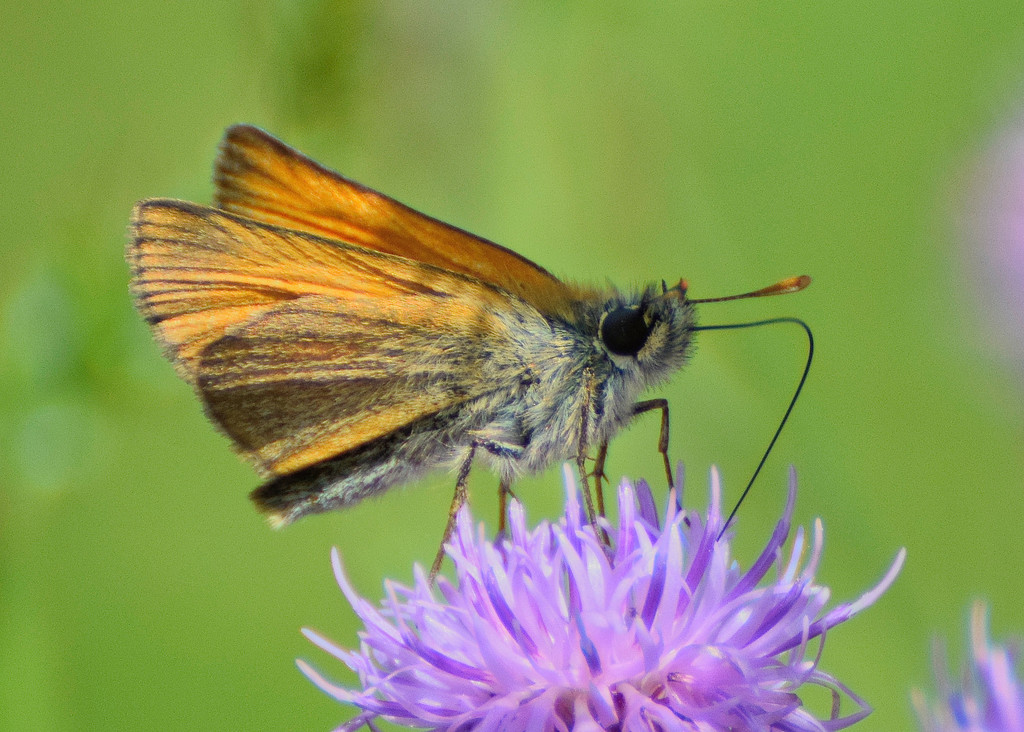
Small Skipper
Thymelicus sylvestris
The small skipper (Thymelicus sylvestris) is a butterfly of the Hesperiidae family.
From the article Small skipper on Wikipedia (CC BY-SA), quoted section by section
Description
It has a rusty orange colour to the wings, upper body, and the tips of the antennae. The body is silvery white below, and it has a wingspan of 25–30 mm (0.98–1.18 in). This butterfly is very similar in appearance to the Essex skipper (Thymelicus lineola). In the small skipper, the undersides of the tips of the antennae are yellow orange, whereas they are black in the Essex skipper. The black area on the lower edge of the upper wings also differs. Like the other orange grass skippers, the male has a distinctive black stripe made up of scent scales.
Wikipedia: “Appearance”
Range & habitat
This butterfly's range includes much of Europe (east to the Urals, including Ireland, Britain and Scandinavia), north Africa and the Middle East. It is typically occurring where grass has grown tall.
Wikipedia: “Distribution”
What it does
Eggs are laid loosely inside grass sheaths of the caterpillars food plants from July to August. The newly hatched caterpillars eat their own eggshell before entering hibernation individually in a protective cocoon of a grass sheath sealed with silk. In the spring the caterpillar begins feeding. The favoured food plant is Yorkshire fog (Holcus lanatus), although other recorded food plants include timothy (Phleum pratense), creeping soft grass (Holcus mollis), false brome (Brachypodium sylvaticum), meadow foxtail (Alopecurus pratensis) and cock's foot (Dactylis glomerata). The caterpillars pupate near the base of the food plant in June with the first adults on the wing at the end of June, a week or two before the first Essex skippers. They are strongly attracted to purple flowers such as thistles and knapweeds.
Wikipedia: “Life cycle and food plants”
Listen
Looking for field recordings…
Where it lives
Recorded sightings
—
geo-referenced records in GBIF, from museums, herbaria and field observers.
Drag the globe to turn it. Dots are where records exist, not a range map; darker means more records.
In the stacks
Searching the stacks…
Every page naming Thymelicus sylvestris in the Biodiversity Heritage Library →
This page is assembled live from iNaturalist, GBIF, Wikipedia, the Source Library and the Internet Archive. It is not yet part of the hand-edited codex. iNaturalist taxon 128544.