- Animals
- ›Arthropods
- ›Hexapods
- ›Insects
- ›Winged and Once-winged Insects
- ›Dragonflies and Damselflies
- ›Damselflies
- ›Coenagrionoid Damselflies
- ›Narrow-winged Damselflies
- ›Coenagrion
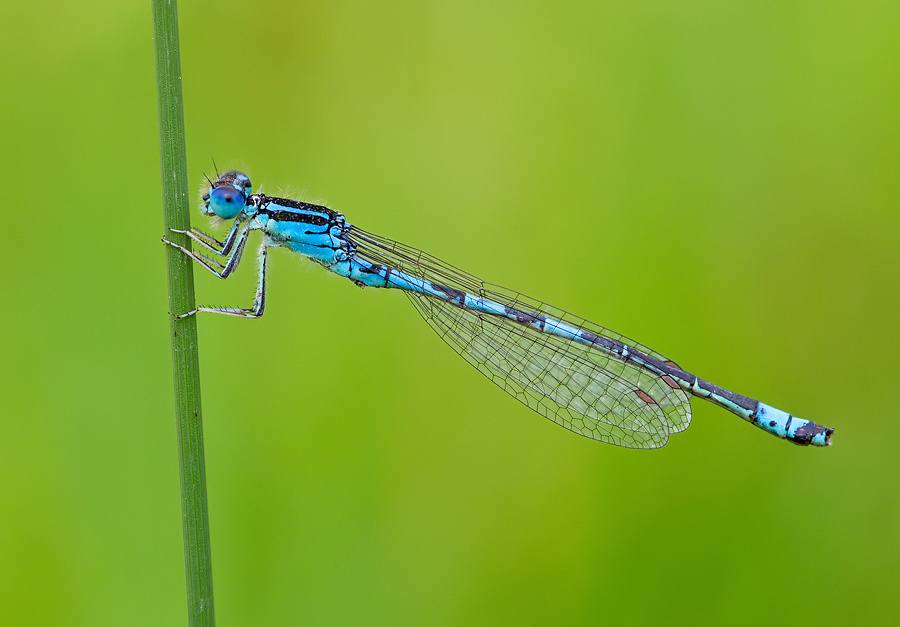
Dainty Damselfly
Coenagrion scitulum
The dainty damselfly (Coenagrion scitulum), also known as the dainty bluet, is a blue damselfly of the family Coenagrionidae. This is a scarce species found mainly in southern Europe, northern Africa, southwest Asia, and Central America. C. scitulum are Odonata (dragonflies & damselflies) predators that can reach a length of 30–33 mm at maturity and have hind-wing lengths of 15–20 mm. The males and females do exhibit differing features through their colouration making them easily distinguishable. As shown in the photo to the left, segment eight is blue in colour followed by black markings on segment nine, whereas the females are mostly black near the rear with smaller blue markings. Although they are relatively simple to sex, they are easily confused with the common blue damselfly.
From the article Dainty damselfly on Wikipedia (CC BY-SA), quoted section by section
Range & habitat
C. scitulum are found in large and generally stagnant, ponds with abundant vegetation including water-milfoil and hornwort, they can also be found in flooded ditches. It has also been discovered that constructed wetlands are an important habitat and sanctuary for C. scitulum. This is because these areas lack fish that prey on insects giving the dainty damselfly a safe habitat to live and reproduce in. They are most easily spotted during the months of June and July and males can be most easily observed perched on floating vegetation in open water. Although dainty damselflies are quite small they do have the ability to travel distances between ponds if resources become sparse and if the benefits outweighs the cost. We also see evidence of their movement through the recolonization of the lost population in Britain.
Wikipedia: “Habitat”
What it does
C. scitulum exhibits unique mating habits compared to other Odonates. In damselfly reproduction there is indirect insemination. The male damselfly will pass their sperm from the testes to the penis in order for the female to obtain it from them. This translocation of sperm only happens once in all other species of damselflies. In C. scitulum this process happens upwards to six times during the copulation cycle. There are a few hypotheses as to why this process may occur, one of them being that several sperm translocations may be needed to achieve full insemination. After this process is done and the female has successfully fertilized her eggs, she then lays them. The male is usually still attached to the female at this point to stop other males from removing their sperm, although sperm removal is harder in C. scitulum as they do not have the spines on the horns of their penis as other damselflies do. The dainty damselfly seems to be univoltine in their core populations and in their expansion populations, this was exhibited when ponds were sampled and they showed that each was a separate population.
Wikipedia: “Reproduction”
Listen
Looking for field recordings…
Where it lives
Recorded sightings
—
geo-referenced records in GBIF, from museums, herbaria and field observers.
Drag the globe to turn it. Dots are where records exist, not a range map; darker means more records.
In the stacks
Searching the stacks…
Every page naming Coenagrion scitulum in the Biodiversity Heritage Library →
This page is assembled live from iNaturalist, GBIF, Wikipedia, the Source Library and the Internet Archive. It is not yet part of the hand-edited codex. iNaturalist taxon 129033.