- Animals
- ›Arthropods
- ›Hexapods
- ›Insects
- ›Winged and Once-winged Insects
- ›Butterflies and Moths
- ›Pyralid and Crambid Snout Moths
- ›Pyralid Snout Moths
- ›Knot-horn Moths
- ›Anerastiini
- ›Maliarpha
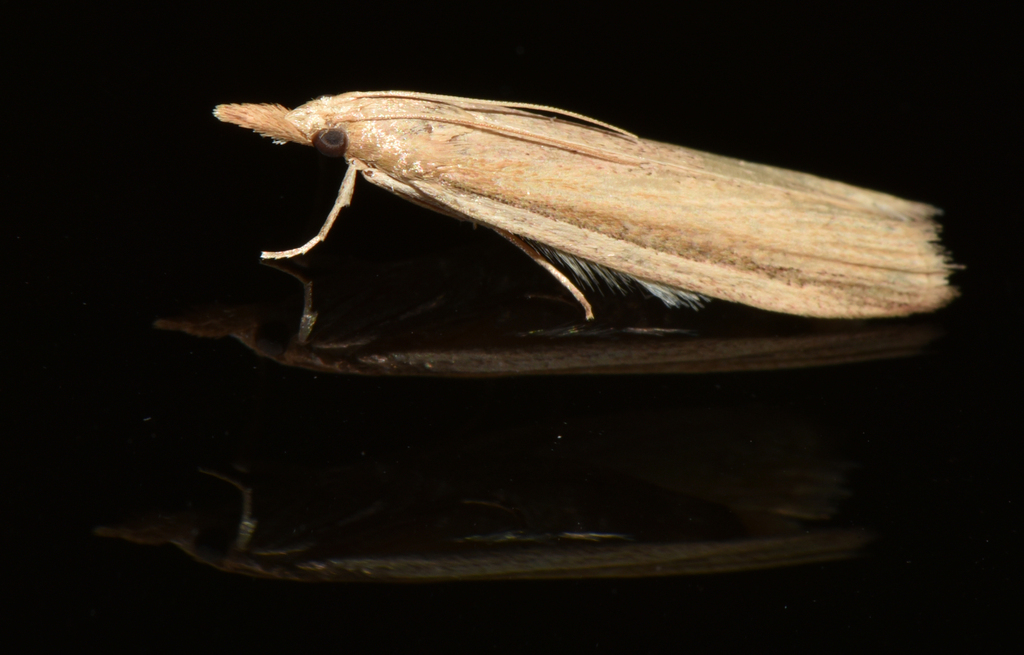
Maliarpha separatella
Maliarpha separatella, the African white stemborer, is a species of moth of the family Pyralidae. A worldwide paddy pest, it is found throughout African countries of Cameroon, Mali, Réunion, Madagascar, South Africa, and many Asian paddy cultivating countries such as Myanmar, India, and Sri Lanka. Though they are reported from China and Papua New Guinea, they are also known to attack sugarcane.
From the article Maliarpha separatella on Wikipedia (CC BY-SA), quoted section by section
Description
The wingspan is about 20–30 mm. Palpi of male with second joint hollowed out to receive the brush-like maxillary palpi. Antennae with a sinus at base of shaft containing a ridge of scales. Palpi porrect. Male has rufous head and thorax. Abdomen ochreous. Forewings suffused with rufous, darkest below the broad pale costal fascia, which does not reach apex. Hindwings yellowish white. Female moth is much reddish, with a costal fascia often deeply suffused with red.
What it does
The larvae feed on various grasses, including Zea mays, Andropogon tectorum, Oryza species, Saccharum sp., and Sorghum species.
Wikipedia: “Ecology”
Listen
Looking for field recordings…
Where it lives
Recorded sightings
—
geo-referenced records in GBIF, from museums, herbaria and field observers.
Drag the globe to turn it. Dots are where records exist, not a range map; darker means more records.
In the stacks
Searching the stacks…
Every page naming Maliarpha separatella in the Biodiversity Heritage Library →
This page is assembled live from iNaturalist, GBIF, Wikipedia, the Source Library and the Internet Archive. It is not yet part of the hand-edited codex. iNaturalist taxon 1291015.