- Animals
- ›Arthropods
- ›Hexapods
- ›Insects
- ›Winged and Once-winged Insects
- ›Butterflies and Moths
- ›Curved-horn Moths
- ›Concealer Moths
- ›Oecophorinae
- ›Oecophorini
- ›Hofmannophila
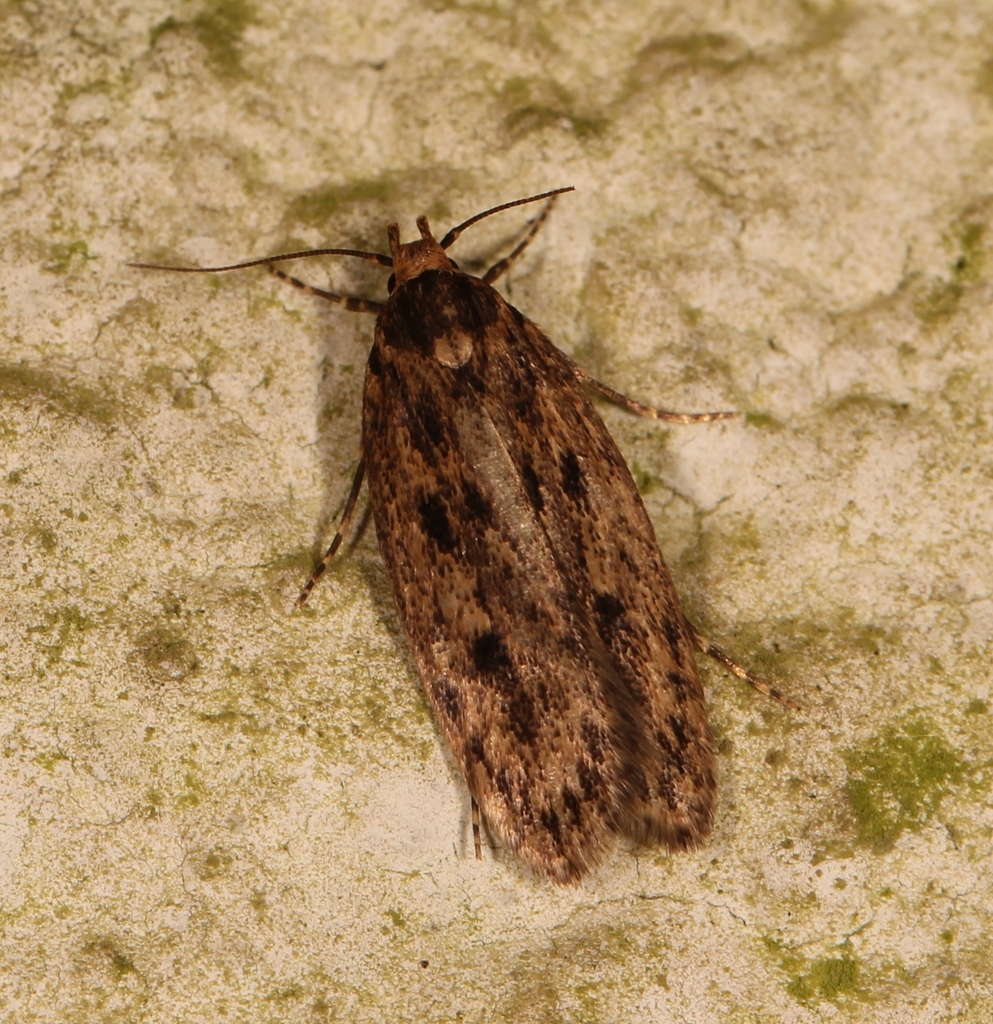
Brown House Moth
Hofmannophila pseudospretella
Hofmannophila pseudospretella, the brown house moth, is a species of the concealer moth family (Oecophoridae), wherein it belongs to subfamily Oecophorinae. It is the only known member of its genus Hofmannophila, and as is often the case for such monotypic taxa, the genus' distinctness remains to be conclusively proven. However that may be, it seems to be a close relative of Borkhausenia.
From the article Hofmannophila on Wikipedia (CC BY-SA), quoted section by section
Range & habitat
This species was introduced from Asia to Europe and other continents in the 1840s. It is now found almost worldwide and is especially common in Britain. This is a synanthropic species that lives in private houses and commercial buildings. Smaller numbers of individuals also occur outside human settings, with larvae being found in birds’ nests, feeding on droppings and detritus.
Wikipedia: “Distribution and habitat”
What it does
Usually up to 260 ova are laid by a female during one life cycle, either singly or in batches. Large females have been reported to lay 400 – 500 ova. Under favourable conditions, eggs hatch 10 – 20 days after being laid. Larvae are active June – April, during which they spin silken tubes with the food they eat, leaving behind deposits of frass and silk. They require relatively high humidity for successful development to maturity, and the duration of their pupal stage is shortened by a higher ambient temperature. Although they can enter diapause under unfavourable conditions, they are killed by severe frost. Before pupation, larvae leave their natal feeding site and may travel for 2 – 3 days before finding a new suitable place to pupate. Adults are active May – September, although they can be found all year round in heated buildings. They are especially attracted to light and can fly all year round. The mite species Cheyletus eruditus appears to be a significant predator of this moth.
Wikipedia: “Reproduction and life history”
Listen
Looking for field recordings…
Where it lives
Recorded sightings
—
geo-referenced records in GBIF, from museums, herbaria and field observers.
Drag the globe to turn it. Dots are where records exist, not a range map; darker means more records.
In the stacks
This page is assembled live from iNaturalist, GBIF, Wikipedia, the Source Library and the Internet Archive. It is not yet part of the hand-edited codex. iNaturalist taxon 129570.