- Animals
- ›Arthropods
- ›Hexapods
- ›Insects
- ›Winged and Once-winged Insects
- ›Dragonflies and Damselflies
- ›Damselflies
- ›Lestoidea
- ›Spreadwings and allies
- ›Lestes
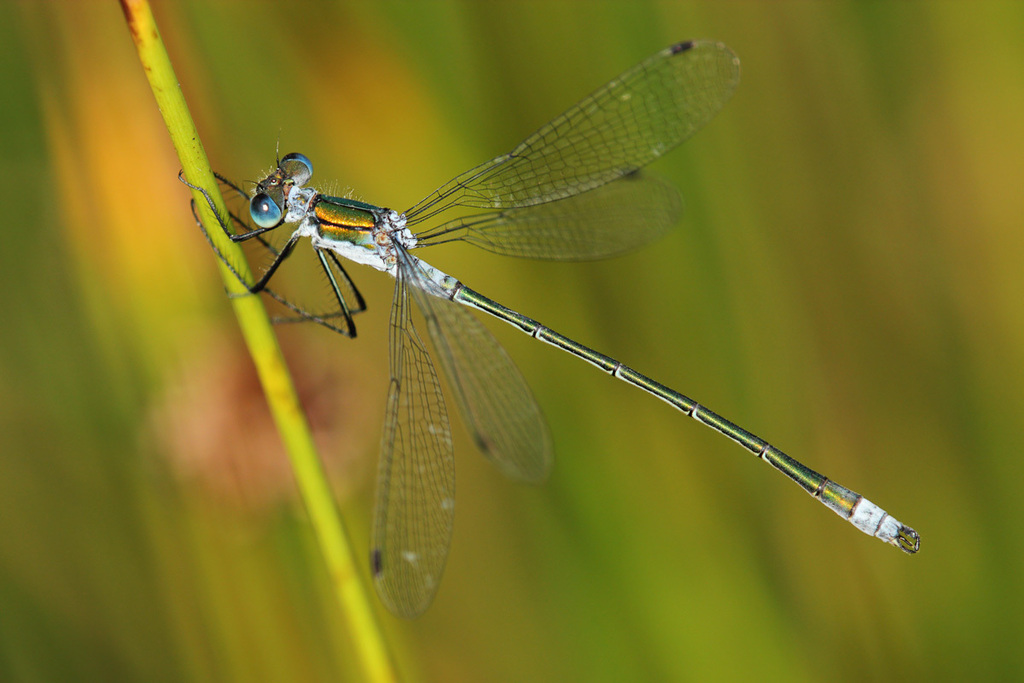
Common Spreadwing
Lestes sponsa
Lestes sponsa is a damselfly with a wide Palaearctic distribution. It is known commonly as the emerald damselfly or common spreadwing. Both males and females have a metallic green colour and brown wing spots. It resides near pools with aquatic plants. When resting its wings are usually half opened.
From the article Lestes sponsa on Wikipedia (CC BY-SA), quoted section by section
Description
All species in the genus Lestes are very similar and are hard to separate in the field. The shapes of the anal appendages are characteristic. In L. sponsa the anal appendage is black with the superior appendage (which are the ones on the outside) with two internal teeth. The inferior appendage is elongated and cylindrical. In northern Europe five species of Lestes occur whilst in Europe as a whole there are six species, so identification can be problematical and it is best to look at as many features as possible. L. sponsa is a typical member of the genus with a green metallic body and wings held away from the body at rest. The abdomen is 26–33 mm (1.0–1.3 in) long and the wings are 19–23 mm (0.75–0.91 in) long. Mature males have a powder blue colour on the prothorax and on segments 1–2 and 9–10 of the abdomen. Mature males have blue eyes. Females lacks the blue colour. Immature males also lack the blue pruinescence and have greeny brown eyes. The pterostigmata of immature males are almost white.
Range & habitat
Preferred habitats of this species are pools, ponds and moorlands, it is a species of still or very slow flowing water. The emerald damselfly has a large Palaeartic distribution, and is found in a band across central Europe and Asia from Spain to the Pacific. It is not found in the far north in Europe and Asia or in the extreme south, being absent from southern Spain, southern Italy and Greece. It probably occurs in some areas of north Africa; where it occurs around the Mediterranean it is found at altitude. In Great Britain it is the only Lestes species that is common.
Wikipedia: “Habitat and distribution”
What it does
One of the larger damselflies, this species is most common in July and August. It is often found by ponds and lakes, and is very rarely seen along flowing water. Emerald damselflies like to perch among reeds, their colour providing good camouflage. They are not as strong fliers when compared to other common damselflies such as the common blue or large red damselflies, but they are more likely to be seen on misty, rainy days than those species. When disturbed they usually do not fly very far away, landing on another perch a few yards away. Their habit of perching with their wings half open is characteristic of the family Lestidae and gives rise to their other common name of spreadwings. A population can consist of several hundred insects. L. sponsa mate in the usual dragonfly manner and will form tandem pairs away from water. Copulation lasts from 30–60 minutes and after mating they stay paired for egg-laying. However, at high latitudes where the breeding season is brief, the copulation is finished within a shorter time and in general the mating is more intense than at lower latitudes with longer breeding season (i.e., short season compensation in mating behaviour). The female usually lays eggs in submerged vegetation and whilst egg-laying the female can remain submerged for 30 min. The female pierces the tissue of aquatic plants and inserts her eggs. …
Wikipedia: “Behaviour”
Listen
Looking for field recordings…
Where it lives
Recorded sightings
—
geo-referenced records in GBIF, from museums, herbaria and field observers.
Drag the globe to turn it. Dots are where records exist, not a range map; darker means more records.
In the stacks
Searching the stacks…
Every page naming Lestes sponsa in the Biodiversity Heritage Library →
This page is assembled live from iNaturalist, GBIF, Wikipedia, the Source Library and the Internet Archive. It is not yet part of the hand-edited codex. iNaturalist taxon 130408.