- Plants
- ›Vascular Plants
- ›flowering plants
- ›monocots
- ›Agaves, Orchids, Irises, and Allies
- ›Orchids
- ›Orchidoid Orchids
- ›Orchideae
- ›Orchidinae
- ›Gymnadenia
- ›Gymnadenia
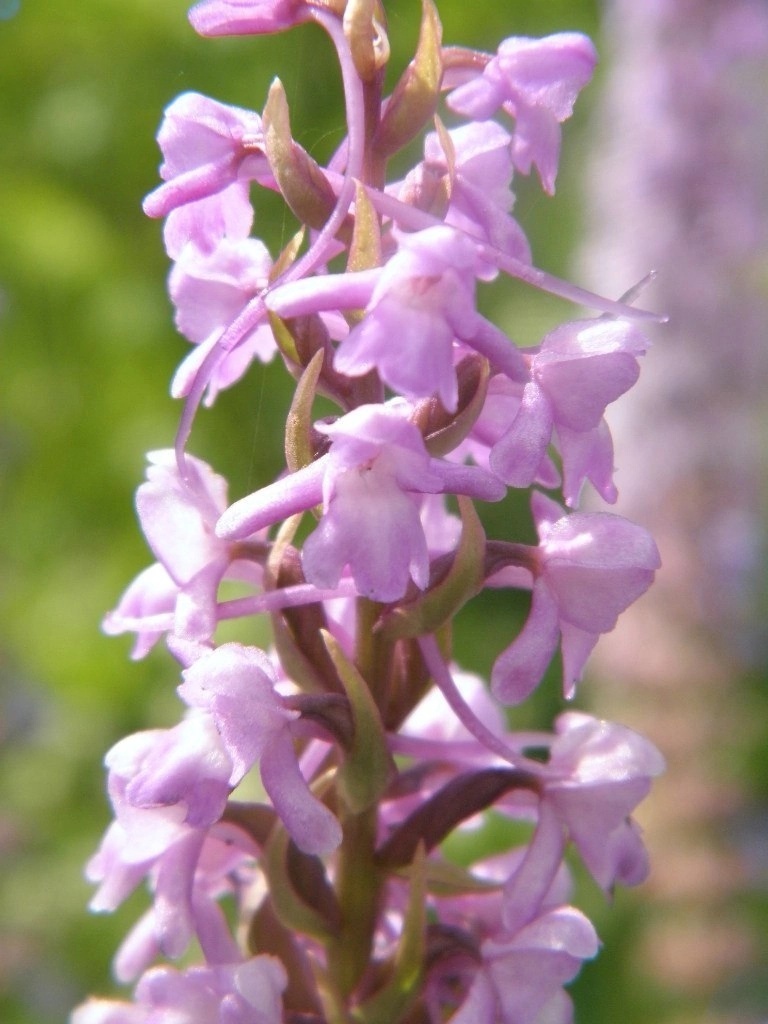
Fragrant Orchid
Gymnadenia conopsea
Gymnadenia conopsea, commonly known as the fragrant orchid or chalk fragrant orchid, is a herbaceous plant of the family Orchidaceae native to northern Europe.
From the article Gymnadenia conopsea on Wikipedia (CC BY-SA), quoted section by section
Description
Gymnadenia conopsea reaches on average 20–60 centimetres (7.9–23.6 in) of height, with a maximum of 80 centimetres (31 in). These plants are tuberous geophytes, as they bring their buds in underground tuber, organs that annually produce new stems, leaves and flowers. These orchids are "terrestrial" because unlike "epiphytic" species, they do not grow on other plants of major sizes. The stem is leafy and robust, with a striated surface. The leaves are long, narrow and lanceolate and vary from 3 to 7. The leaf color is gray-green. Size of leaf: width 1 to 2 cm, length 10 – 25 cm. These orchids have two ovoidal bulbs, deeply webbed and with many small and short lobes. Size of tubers: 1 to 3.5 cm. The inflorescence is 5–25 centimetres (2.0–9.8 in) long and it is composed of flowers gathered in dense cylindrical spikes (up to 50 flowers per spike). These inflorescences are scented and genes underlying eugenol (a volatile scent compound) production have been identified in Gymnadenia conopsea, G. odoratissima and G. densiflora. The flowers are petiolated, placed in the axils of long bracts and reach on average 0.8–1.4 centimetres (0.31–0.55 in). They have a distinctive three lobed lip and long spurs. Their light scent is similar to cloves. Their colors vary from white and pink to pink-purple, more rarely white. These flowers bloom in the Summer, from June to July. …
Range & habitat
This plant is quite common throughout northern Europe with the exception of the Dinaric Alps. In Asia it is common in areas to the north of the Himalayas. Gymnadenia conopsea ssp. borealis has been recorded from Co. Donegal, Ireland in 2004.
Wikipedia: “Distribution”
What it does
The species is almost exclusively pollinated by moths (Lepidoptera). The most common pollinators are the small elephant hawk-moth (Deilephila porcellus), hummingbird hawk-moth (Macroglossum stellatarum), silver Y (Autographa gamma), burnished brass (Diachrysia chrysitis) and large yellow underwing (Noctua pronuba). Fruit set is high with an average of 73%. The seed's germination is conditioned by the presence of mycorrhizal fungi. Gymnadenia conopsea is held to be a mycorrhizal generalist, able to form associations with a variety of different fungal species including species in the Tulasnellaceae, Ceratobasidiaceae and Pezizales.
Wikipedia: “Ecology”
In human culture
The name of the genus Gymnadenia is formed from Greek words γυμνός (gymnós, "nude") and ἀδήν (adēn, "gland") and refers to the characteristics of the organs for secreting nectar. The specific Latin name "conopsea" derives from the Greek κώνωψ (kónops), literally meaning "mosquito-like", probably because of the similarity of the long spur of the flower with the mouthparts of a mosquito. The scientific binomial name of this plant was initially Orchis conopsea, proposed by the Swedish naturalist and botanist Carl von Linné (1707–1778) in his Species Plantarum of 1753. The name has been subsequently amended to the one currently accepted (Gymnadenia conopsea), by the British botanist Robert Brown (1773–1858) in 1813. In German, this plant is called Mücken-Händelwurz or Mücken Nacktdrüse; in French, is called gymnadénie moucheron or orchis moucheron; in Italy, it is called manina rosea ("pink hand"); in Croatian, it is known under mrežasti vranjak.
Wikipedia: “Etymology”
Where it lives
Recorded sightings
—
geo-referenced records in GBIF, from museums, herbaria and field observers.
Drag the globe to turn it. Dots are where records exist, not a range map; darker means more records.
In the stacks
Searching the stacks…
Every page naming Gymnadenia conopsea in the Biodiversity Heritage Library →
This page is assembled live from iNaturalist, GBIF, Wikipedia, the Source Library and the Internet Archive. It is not yet part of the hand-edited codex. iNaturalist taxon 131610.