- Animals
- ›Arthropods
- ›Hexapods
- ›Insects
- ›Winged and Once-winged Insects
- ›Butterflies and Moths
- ›Owlet Moths and Allies
- ›Cutworm Moths and Allies
- ›Cutworms and Dart Moths
- ›Glottulini
- ›Brithys
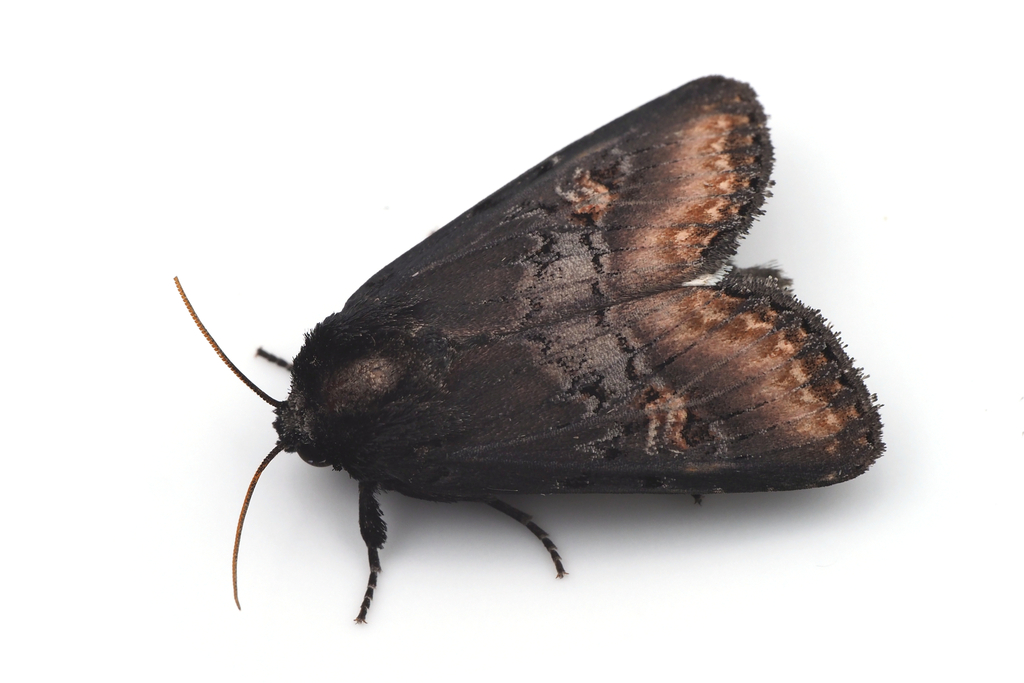
Lily Borer
Brithys crini
The Amaryllis borer, Crinum borer, Lily borer or Kew arches (Brithys crini) is a moth of the Noctuidae family. It is a garden pest in parts of its range, as their larvae damage the stems and leaves of lilies, especially lilies of the family Amaryllidaceae.
From the article Brithys crini on Wikipedia (CC BY-SA), quoted section by section
Description
The wingspan of the moth is about 40 mm. Its head, thorax and forewings are very dark brown, but paler toward the wingtips. Sub-basal, median and postmedial indistinct waved lines are black. A curved submarginal ochreous line with ferrous colored lunules found on each side of it. There is a marginal black lunule series. The hindwings are practically white. Tarsi bear black and white stripes. In Europe the adults are on the wing in July.
Range & habitat
It is found in the coastal areas of Southern Europe and North Africa, south to South Africa. Furthermore, it is found in Japan and in Queensland and Northern Territory in Australia towards India and Sri Lanka.
Wikipedia: “Range”
At the table
The larvae feed on all species of Crinum, Clivia and Hippeastrum, including Crinum angustifolium, Haemanthus species, Hippeastrum procerum, Pancratium maritimum, Zephyranthes candida, Crocus tommasinianus, Narcissus spp., and Amaryllis belladonna. Commonly they bore into thick leaves or even into the bulbs; Mature larvae are likely to feed externally, especially on thin-leaved plants. Heavy infestations of the caterpillars may kill plants.
Wikipedia: “Food plants”
Listen
Looking for field recordings…
Where it lives
Recorded sightings
—
geo-referenced records in GBIF, from museums, herbaria and field observers.
Drag the globe to turn it. Dots are where records exist, not a range map; darker means more records.
In the stacks
Searching the stacks…
Every page naming Brithys crini in the Biodiversity Heritage Library →
This page is assembled live from iNaturalist, GBIF, Wikipedia, the Source Library and the Internet Archive. It is not yet part of the hand-edited codex. iNaturalist taxon 132092.