- Plants
- ›Vascular Plants
- ›flowering plants
- ›monocots
- ›grasses, sedges, cattails, and allies
- ›grasses
- ›bamboos, canes, and allies
- ›Bambuseae
- ›Bambusinae
- ›Dendrocalamus
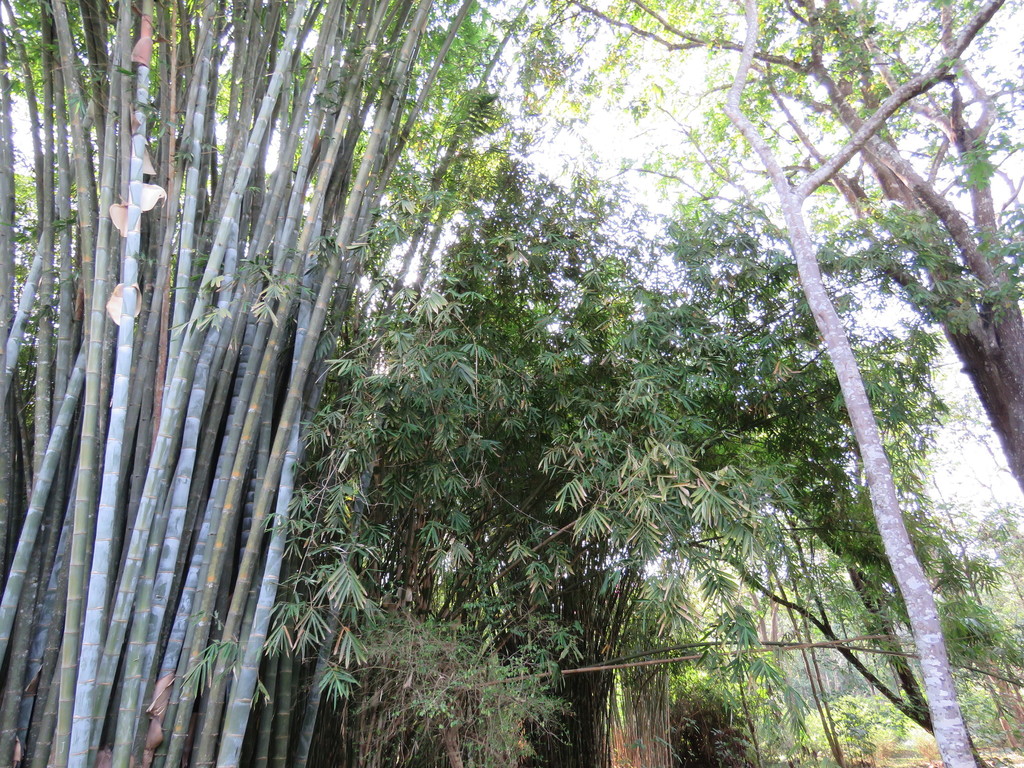
Giant Bamboo
Dendrocalamus giganteus
Dendrocalamus giganteus, commonly known as giant bamboo, is a giant tropical and subtropical, dense-clumping species native to mainland Southeast Asia, India, and China's Yunnan province. It is one of the largest bamboo species in the world.
From the article Dendrocalamus giganteus on Wikipedia (CC BY-SA), quoted section by section
Description
A very tall, large-culmed, greyish-green bamboo, it grows in clumps consisting of a large number of closely growing culms, and typically reaches a height of 30 m (98 ft), but one clump in Arunachal Pradesh, India reached a height of 42 m (138 ft); the culms can also be up to 28 cm (11 in) thick, measurements exceeded only by Dendrocalamus sinicus. Under favourable conditions, it can grow up to 40 cm (16 in) per day. The record for the species, 46 cm (18 in) in 24 hours, was set on July 29–30 of 1903 at Peradeniya Royal Botanical Gardens in Ceylon (Sri Lanka). There have been reports of growth up to 1 m (3 ft 3 in) in 24 hours. In subtropical climates, it does not grow as tall, usually reaching a height of 20 m (66 ft). The culms are straight, and greyish-green with a powdery appearance, becoming brownish-green on drying, with a smooth surface. The young shoots are blackish purple. Internode length is 25–40 cm, and diameter is 10–35 cm. Culm walls are thin, rarely exceeding 2.5 cm (0.98 in) in thickness branching only at the top. Aerial roots occur up to the eighth node. The rootstock is stout. The culm sheath is greenish when young, becoming dark brown when mature. Sheaths are large and broad, length of sheath proper 24–30 cm, and width is 40–60 cm. The blade is triangular, 7–10 cm long. The top of the sheath is rounded. Auricles are small, equal, and crisped. …
Range & habitat
Dendrocalamus giganteus is native to India, Myanmar, Thailand and China's Yunnan province. Its habitat is in forests and on river banks, from sea level to 2,000 metres (6,600 ft) altitude.
Wikipedia: “Distribution and habitat”
At the table
Dendrocalamus giganteus is used in construction and weaving. The shoots are edible.
Wikipedia: “Uses”
Where it lives
Recorded sightings
—
geo-referenced records in GBIF, from museums, herbaria and field observers.
Drag the globe to turn it. Dots are where records exist, not a range map; darker means more records.
In the stacks
Searching the stacks…
Every page naming Dendrocalamus giganteus in the Biodiversity Heritage Library →
This page is assembled live from iNaturalist, GBIF, Wikipedia, the Source Library and the Internet Archive. It is not yet part of the hand-edited codex. iNaturalist taxon 133125.