- Plants
- ›Vascular Plants
- ›flowering plants
- ›Dicots
- ›nightshades, bindweeds, gooseweeds, and allies
- ›nightshade family
- ›nightshades and allies
- ›nightshades and jaltomatas
- ›Solanum
bugweed
Solanum mauritianum
Solanum mauritianum is a small tree or shrub native to South America, including Northern Argentina, Southern Brazil, Paraguay and Uruguay. It has become a widespread invasive weed in Azores Islands, Cook Islands, Fiji, Hawai‘i, New Caledonia, Norfolk Island, Solomon Islands, Tonga, Réunion Island, Mauritius, Madagascar, Australia, New Zealand, India, Sri Lanka and several southern African countries. Its common names include earleaf nightshade (or "ear-leaved nightshade"), woolly nightshade, flannel weed, bugweed, tobacco weed, tobacco bush, wild tobacco...
From the article Solanum mauritianum on Wikipedia (CC BY-SA), quoted section by section
Description
The woolly nightshade is a multi-branched shrub or small tree between 2 and 4 meters high (but can grow up to 10 m (33 ft) tall in the right conditions). The plant has a strong odor and a life span of up to thirty years. The simple, entire, ovate-elliptical large leaves are up to 40 centimeters long, 30 centimeters wide and are grey-green in color. The tip of the leaf is pointed, the base is wedge-shaped. They sit on 3 to 9 centimeters long petioles. They are dense, tomentose with hairy yellowish, long-stemmed, star-shaped trichomes.
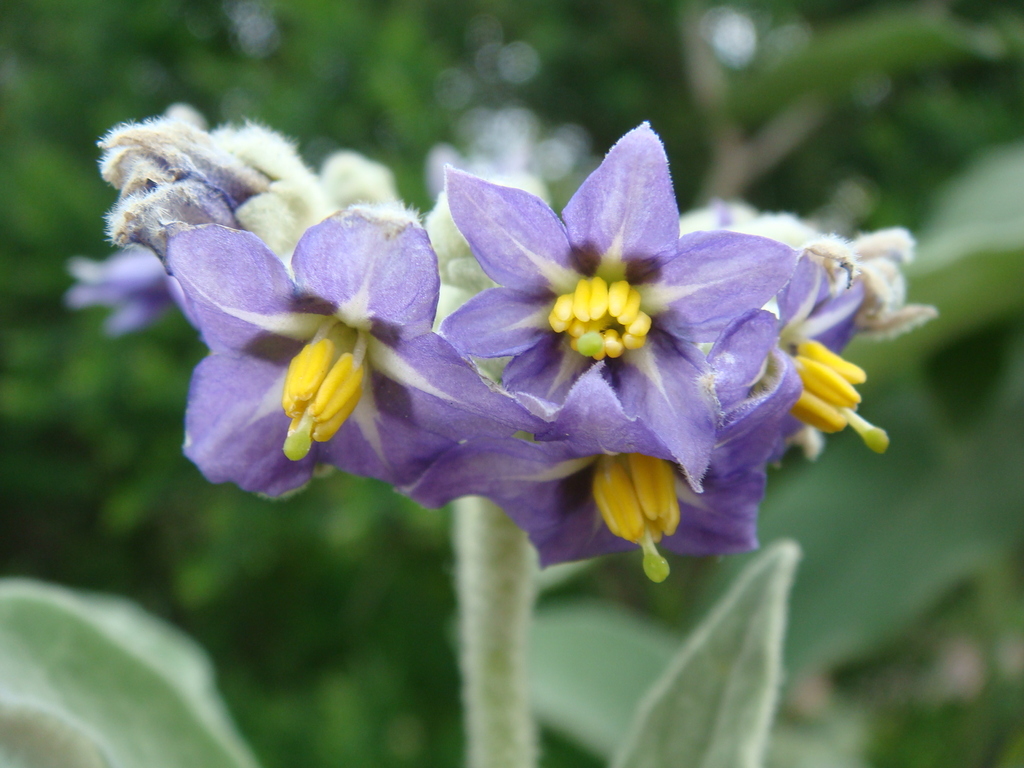
Inflorescence. The slightly scented inflorescences are cymes of purple single flowers with a yellow center and sit on 15 centimeter long inflorescence axes. The sepals are fused into a 2 to 3 millimeter long calyx tube with 1 to 2 millimeter long lobes. The crown is star-shaped and measures between 1.5 and 2.5 centimeters. The five stamens sit on 1 millimeter long filaments. The anthers are egg-shaped and 2 to 3.5 millimeters long. The plant can flower year round but fruiting occurs in late spring to early summer. After flowering, spherical yellow berries up to 2 cm in size with numerous, flattened seeds 1.5 to 2 millimeters long form.
Toxicity
It is alleged that all parts of the Solanum mauritianum plant are poisonous to humans, especially the unripe berries, and furthermore that human fatalities have resulted from the consumption of the berries, and cases of fatal poisoning in pigs and illness in cattle have been reported in Queensland. However, mountain possums appear to eat it without ill effect, and stripping of bark, leaves, and terminal shoots has destroyed pure stands of S.mauritianum. Watt & Brandwijk state that horses, domestic chickens and all birds eat the fruit with impunity, and further state that no records of poisoning in children exist, casting doubt on contrary published accounts. The main toxic compound is the alkaloid, solasodine, with the highest content in the unripe green berry (2–3.5% dry weight). Solauricine, solauricidine, and solasodamine have also been found in Solanum mauritianum.
Where it lives
Recorded sightings
—
geo-referenced records in GBIF, from museums, herbaria and field observers.
Drag the globe to turn it. Dots are where records exist, not a range map; darker means more records.
In the stacks
Searching the stacks…
Every page naming Solanum mauritianum in the Biodiversity Heritage Library →
This page is assembled live from iNaturalist, GBIF, Wikipedia, the Source Library and the Internet Archive. It is not yet part of the hand-edited codex. iNaturalist taxon 133287.