- Animals
- ›Arthropods
- ›Hexapods
- ›Insects
- ›Winged and Once-winged Insects
- ›Butterflies and Moths
- ›Owlet Moths and Allies
- ›Underwing, Tiger, Tussock, and Allied Moths
- ›Fruit-piercing Moths
- ›Ophiderini
- ›Eudocima
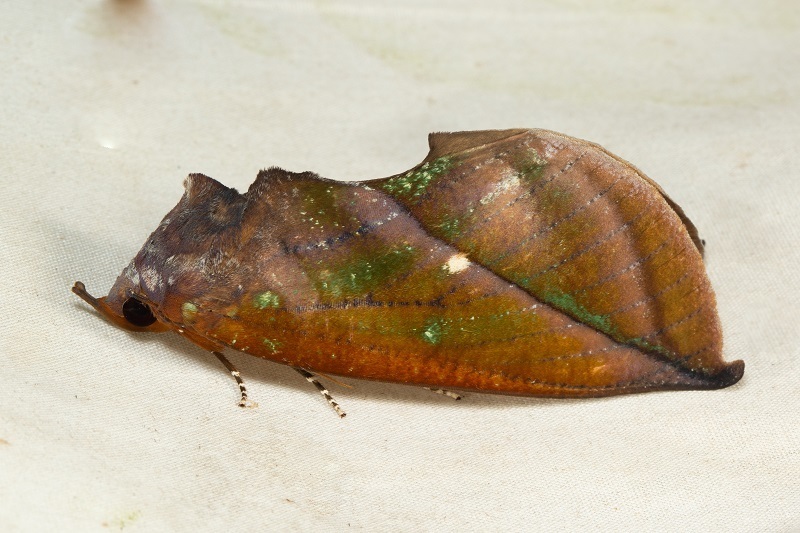
Eudocima aurantia
Eudocima aurantia, the fruit-sucking moth, is a moth of the family Erebidae. The species was first described by the British entomologist Frederic Moore in 1877. It is found across south-east Asia, from Sri-Lanka to northern Queensland, Australia. It is also present on the Andamans.
From the article Eudocima aurantia on Wikipedia (CC BY-SA), quoted section by section
Description
The wingspan is about 90–120 mm. Palpi with third joint long and spatulate at extremity. Forewings with produced apex to a rounded lobe. Head and thorax ferrous colored, with plum-color suffusion. Abdomen orange. Forewing ferrous with dark stria and slight purple bloom. The veins speckled with blue. Reniform green and indistinct. There is a dark line runs from apex to center of inner margin, sometimes with green patches beyond it. Hindwings orange with a large black lunule beyond lower angle of cell. A submarginal patch can be seen between veins 1 and 2. Ventral side orange. Forewings with black mark below angle of cell and beyond the cell between veins 3 and 5. Hindwings with lunule and patch of upperside.
What it does
Larva has pinkish grey dorsal surface suffused darker to a V-shaped yellow band. It has black spiracles and marbled white-ringed rufous-orange ocellate marks with three ferrous lines crossing them. The larvae feed on Cocculus species. The moth resembles a leaf, which fools predators such as birds. Both adults and caterpillars are pests of various fruits. They pierce the fruit in order to suck the juice and in the case of the caterpillar eat the flesh. Fruits may show pre-mature fall due to the attack. Parasitoids such as Telenomus lucullus and Euplectrus melanocephalus are used as controlling measures.
Wikipedia: “Ecology”
Listen
Looking for field recordings…
Where it lives
Recorded sightings
—
geo-referenced records in GBIF, from museums, herbaria and field observers.
Drag the globe to turn it. Dots are where records exist, not a range map; darker means more records.
In the stacks
Searching the stacks…
Every page naming Eudocima aurantia in the Biodiversity Heritage Library →
This page is assembled live from iNaturalist, GBIF, Wikipedia, the Source Library and the Internet Archive. It is not yet part of the hand-edited codex. iNaturalist taxon 134093.