- Animals
- ›Arthropods
- ›Hexapods
- ›Insects
- ›Winged and Once-winged Insects
- ›Butterflies and Moths
- ›Butterflies
- ›Swallowtails and Parnassians
- ›Swallowtails
- ›Fluted Swallowtails
- ›Papilio
- ›Menelaides
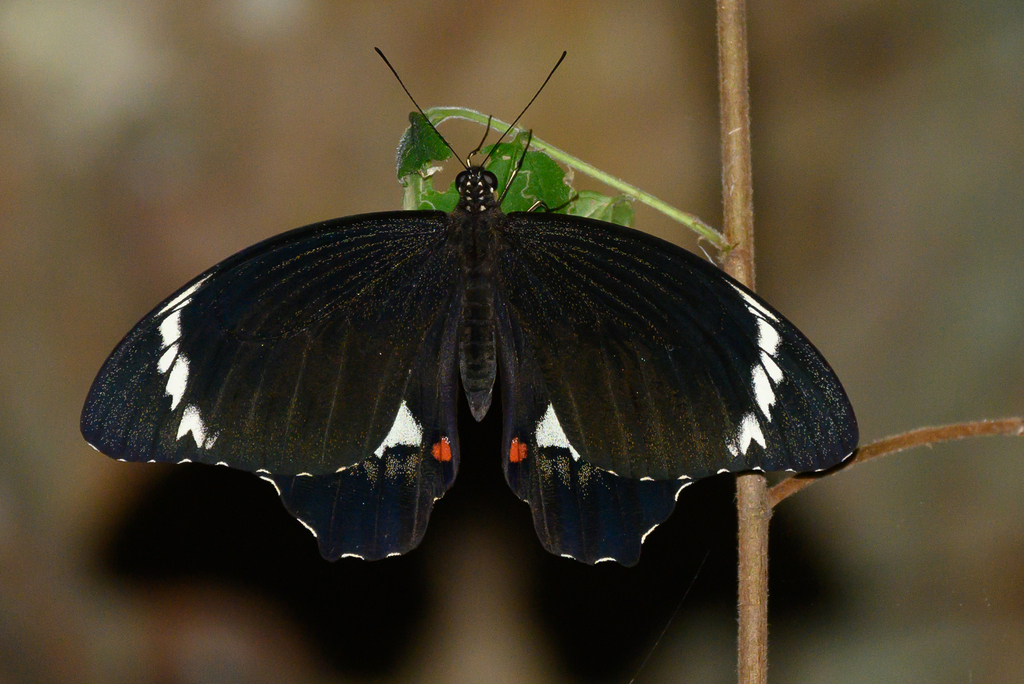
Orchard Swallowtail
Papilio aegeus
Papilio aegeus, the orchard swallowtail butterfly or large citrus butterfly is a species of butterfly from the family Papilionidae, that is found in eastern Australia and Papua New Guinea.
The larvae of this species are sometimes considered a pest, due to their feeding on citrus leaves in suburban gardens.
From the article Papilio aegeus on Wikipedia (CC BY-SA), quoted section by section
Description
Both male and female have black forewings with a white stripe, though there is more white overall on the female forewing. The hindwing is again black, and there is a white swath through the middle. Here the markings differ in that the female has chains of red to orange and blue crescents toward the edge. The markings on the underside are similar to those on top. The body is black. The wingspan is about 140 millimetres (5.5 in) in females and 120 millimetres (4.7 in) in males, making it rather large overall and the largest butterfly commonly seen in at least part of its range. Despite being a swallowtail, which group derives its name from the distinctive tails on the hindwing, this characteristic is entirely absent.
Range & habitat
Papilio aegeus can be found in every state in Australia except Tasmania. Western Australia has well established colonies in the Albany region. Some people are promoting the controlled propagation of eggs and caterpillars in Western Australia, but it is generally found in eastern Australia. It is especially common in Queensland and is the largest butterfly commonly found in Brisbane where there are many citrus trees, on which the larvae feed. During summer, the distribution is temporarily extended to Victoria. Adults are more abundant during late summer and autumn in cc. NSW. The subspecies P. a. ormenus is found on Papua New Guinea and Thursday Island. A differentiating feature between males of P. a. aegeus and P. a. ormenus is that P. a. aegeus males have a red spot on the above side of each hindwing, which is absent in the males of P. a. ormenus. Other subspecies occur on islands in the Banda Sea and the Bismarck Sea.
Wikipedia: “Distribution”
Listen
Looking for field recordings…
Where it lives
Recorded sightings
—
geo-referenced records in GBIF, from museums, herbaria and field observers.
Drag the globe to turn it. Dots are where records exist, not a range map; darker means more records.
In the stacks
Searching the stacks…
Every page naming Papilio aegeus in the Biodiversity Heritage Library →
This page is assembled live from iNaturalist, GBIF, Wikipedia, the Source Library and the Internet Archive. It is not yet part of the hand-edited codex. iNaturalist taxon 134226.