- Plants
- ›Vascular Plants
- ›flowering plants
- ›monocots
- ›Agaves, Orchids, Irises, and Allies
- ›Orchids
- ›Orchidoid Orchids
- ›Diurideae
- ›Acianthinae
- ›Corybas
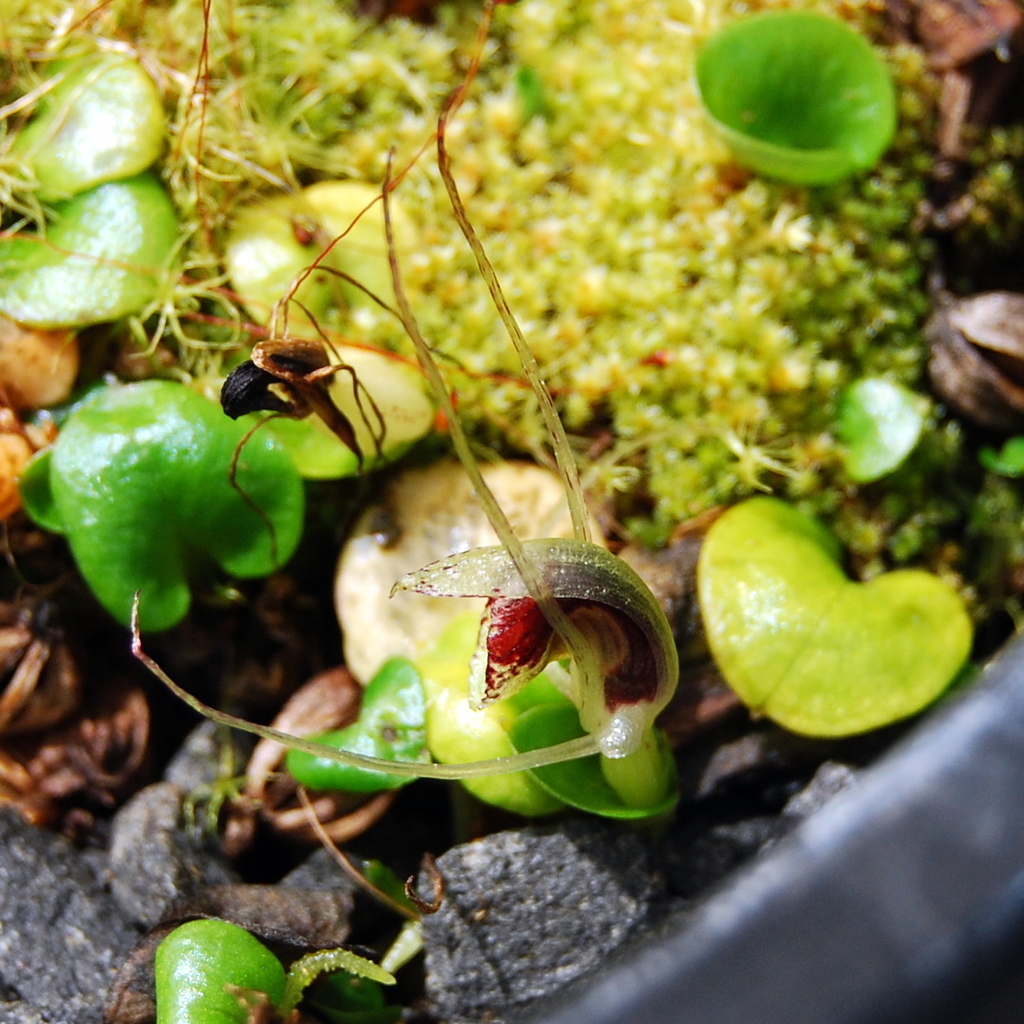
Corybas dienemus
Nematoceras dienemum, also known as the windswept helmet-orchid, is one of two helmet orchids endemic to Australia's subantarctic Macquarie Island, and the first orchid to be found there. It is a relatively small orchid with green flowers which have purplish-red markings and was discovered in 1978.
From the article Corybas dienemus on Wikipedia (CC BY-SA), quoted section by section
Description
The windswept helmet-orchid is a relatively small (30–50 mm tall), terrestrial, tuberous, herbaceous plant that forms clonal colonies. The leaves are flattish, fleshy and solitary, dark green above and silvery-green underneath. The flower is erect, nestling in the leaf base, green with purplish-red markings, 25–30 mm long and 20–25 mm wide. It can be distinguished from its congener and the only other orchid on the island, the grooved helmet-orchid Corybas sulcatus, by its predominantly green flowers, compared with the predominantly dark red ones of C. sulcatus.
Range & habitat
The orchid is known from ten sites on the northern half of Macquarie Island, where it inhabits the lower coastal terraces, not more than 30 m above sea level, where the vegetation is dominated by mosses that float on a substrate of waterlogged peat with a water table very close to the soil surface. The total known population comprises about 7500 plants.
Wikipedia: “Distribution and habitat”
What it does
The flowering period of the orchid is from November to January. It produces seeds annually but also reproduces vegetatively through the production of daughter root-tubers on lateral underground stolons. Its leaves die off in autumn, with new leaves emerging in spring. Although the life expectancy and age of sexual maturity of the orchid are unknown, it is likely that some clonal colonies have existed for several decades. The pollination method is unknown, though one possible pollinator is the Black Fungus Gnat (Bradysia watsoni), which is common on the coastal terraces where the orchid is found.
Wikipedia: “Reproduction”
Where it lives
Recorded sightings
—
geo-referenced records in GBIF, from museums, herbaria and field observers.
Drag the globe to turn it. Dots are where records exist, not a range map; darker means more records.
In the stacks
Searching the stacks…
Every page naming Corybas dienemus in the Biodiversity Heritage Library →
This page is assembled live from iNaturalist, GBIF, Wikipedia, the Source Library and the Internet Archive. It is not yet part of the hand-edited codex. iNaturalist taxon 140711.