- Animals
- ›Arthropods
- ›Chelicerates
- ›Arachnids
- ›Spiders
- ›Typical Spiders
- ›Entelegyne Spiders
- ›Salticoid Spiders
- ›Jumping Spiders
- ›Spiny-legged Jumpers
- ›Spartaeini
- ›Spartaeina
- ›Portia
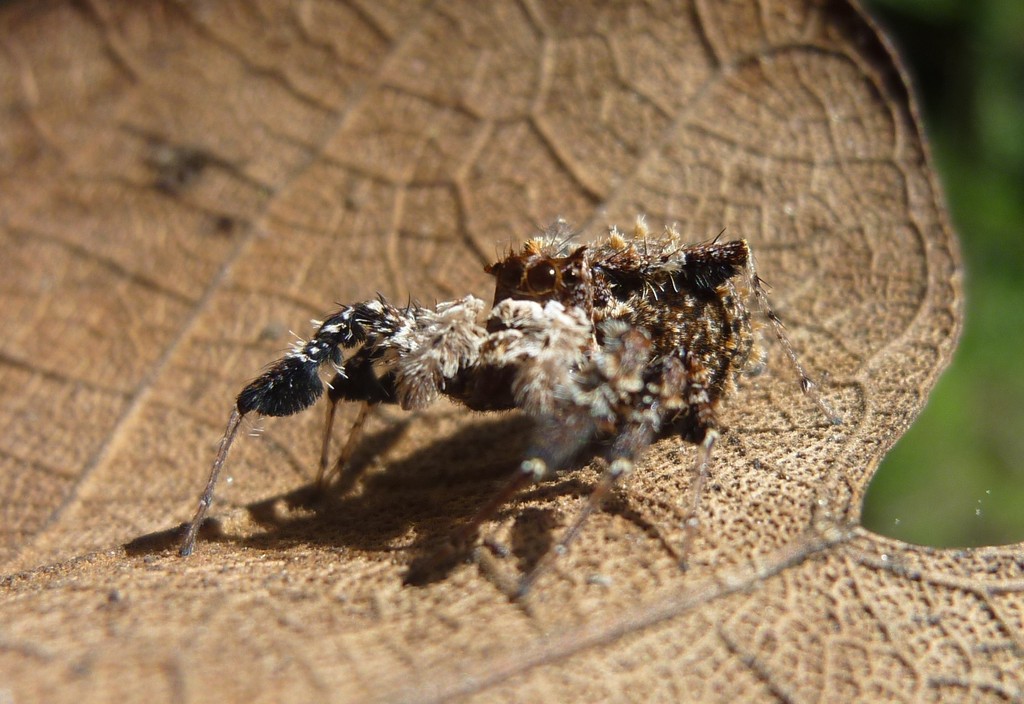
African Dandy
Portia africana
Portia africana is a jumping spider (family Salticidae) found in Angola, Cameroon, the Central African Republic, Gabon, Ghana, the Ivory Coast, Sierra Leone, Zaire and Zambia. Its conspicuous main eyes provide vision more acute than a cat's during the day and 10 times more acute than a dragonfly's, and this is essential in P. africana′s navigation, hunting and mating.
Like other species of the genus Portia, P. africana prefers to hunt web-based spiders, jumping spiders and other types in that order. When hunting web-based spiders, Portias use trial and error to find a way to mislead the prey until the Portia is in a position to bite the victim. While other Portias live and hunt as individuals, P. africana forms large populations both in savanna areas and in the dense "cities" which social jumping spiders build in vegetation near the shoreline of lakes. In the savanna, groups of P. africana, generally consisting of small juveniles, delay the prey until one juvenile bites the victim, and sometimes the juvenile shares the food with other. In vegetation near shorelines, P. africana hunts in the social jumping spiders' cities. There, two species of assassin bug prey on P. africana, and one also preys on the other.
From the article Portia africana on Wikipedia (CC BY-SA), quoted section by section
What it does
Most species of jumping spiders appear to be cursorial (adapted to run), allowing them to hunt insects without using webs. However, species of the genus Portia prefer to hunt other spiders, often invading their victims' webs. Some Portia species including P. africana, also efficiently hunt other jumping spiders.
Tactics specific to Portia africana. In Kenya's Kimumu region, a savanna area which is dry and hot throughout the year, P. africana forms large numbers in the webs of other spiders, in the nest complexes of other jumping spiders, around solitary nests of other jumping spiders, and around the nests of oecobiid spiders. While most aggregations of P. africana there include adult and also juvenile of all stages, most groups consist only of small juveniles. A group of small juveniles can prevent jumping spiders and oecobiids from entering or leaving its nest. One of the juveniles will lunge and bite the victim, and sometimes others of the group join in feeding. In vegetation near the shoreline of Lake Victoria, social jumping spiders build nest complexes, in which P. africana hunts, apparently without building capture-webs. The assassin bugs Nagusta sp. indet. ("not identified") and Scipinnia repax prey on P. africana and on social jumping spiders and other types of prey in the complexes. Nagusta usually hunts in groups of two to three, apparently catches P. …
Wikipedia: “Hunting and feeding”
Where it lives
Recorded sightings
—
geo-referenced records in GBIF, from museums, herbaria and field observers.
Drag the globe to turn it. Dots are where records exist, not a range map; darker means more records.
In the stacks
Searching the stacks…
Every page naming Portia africana in the Biodiversity Heritage Library →
This page is assembled live from iNaturalist, GBIF, Wikipedia, the Source Library and the Internet Archive. It is not yet part of the hand-edited codex. iNaturalist taxon 143185.