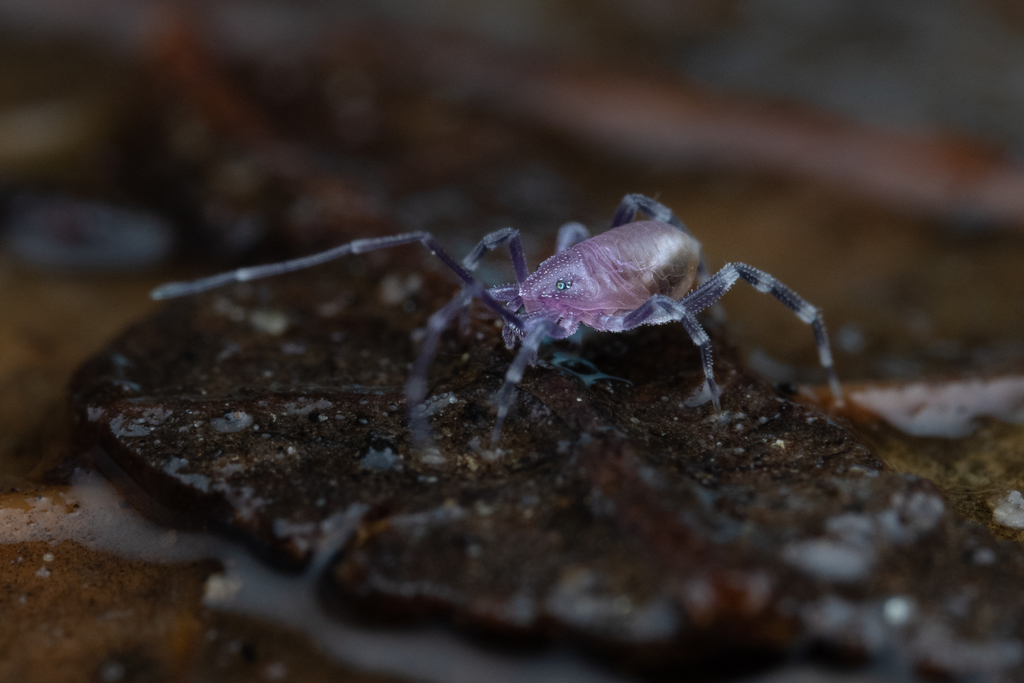
Opilioacarida
Opilioacaridae is the sole family of mites in the order Opilioacarida, made up of about 14 genera. The mites of this family are rare, large (1.5 to 2.5 mm) mites, and are widely considered primitive, as they retain six pairs of eyes, and abdominal segmentation. They have historically been considered separate from other mites belonging to Acariformes and Parasitiformes, but are now generally considered a subgroup of Parasitiformes based on molecular phylogenetics.
The first member of the Opilioacarida to be discovered was the Algerian species Opilioacarus segmentatus, which was described by Carl Johannes With in 1902, followed by the Sicilian Eucarus italicus and Eucarus arabicus from Aden, both in 1904. Two fossil specimens are known, one of which was discovered in Baltic amber from the Eocene, while the other one was discovered in the Burmese amber from the Late Cretaceous (Cenomanian) around 99 million years old, tentatively assigned to the living genus Opilioacarus.
1 branches of this order, most-observed first
See this branch on the Wheel of Life →
Where it lives
Recorded sightings
—
geo-referenced records in GBIF, from museums, herbaria and field observers.
Drag the globe to turn it. Dots are where records exist, not a range map; darker means more records.
In the stacks
Searching the stacks…
Every page naming Opilioacarida in the Biodiversity Heritage Library →
This page is assembled live from iNaturalist, GBIF, Wikipedia, the Source Library and the Internet Archive. It is not yet part of the hand-edited codex. iNaturalist taxon 144132.