- Animals
- ›Arthropods
- ›Hexapods
- ›Insects
- ›Winged and Once-winged Insects
- ›Ants, Bees, Wasps, and Sawflies
- ›Narrow-waisted Wasps, Ants, and Bees
- ›Ants, Bees, and Stinging Wasps
- ›Formicoidea
- ›Ants
- ›Odorous Ants
- ›Leptomyrmecini
- ›Linepithema
- ›Linepithema fuscum
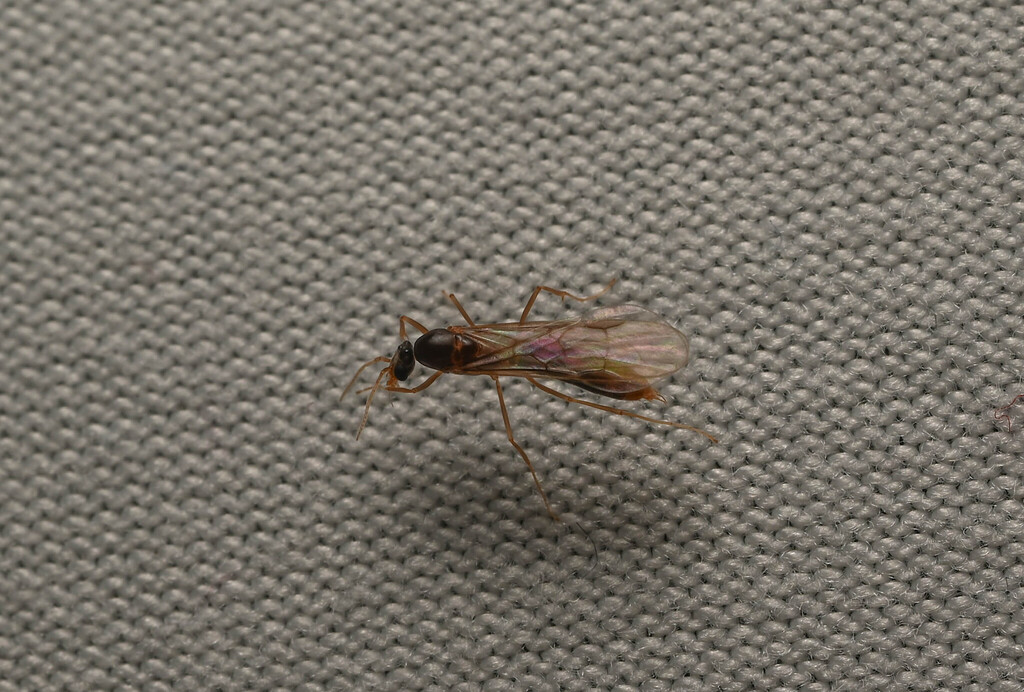
Linepithema fuscum
Linepithema fuscum is a species of ant in the genus Linepithema. Described by Mayr in 1866, the species is endemic to South America. Linepithema fucsum was the first species-level name assigned to genus Linepithema by Mayr. It is related to L. angulatum, L. keiteli, L. piliferum and L. tsachila. However, only Linepithema fuscum remains without a worker association and it could be possible that males of Linepithema fuscum actually belong to the workers of L. angulatum. Little is known about Linepithema fuscum due to the scarcity of the collected samples.
From the article Linepithema fuscum on Wikipedia (CC BY-SA), quoted section by section
Description
Little is known about the biology of L. fuscum. The species has been collected from 200 to nearly 3000 meters in elevation. One sample was collected from a "shrubby pasture" and another sample was collected inside a laboratory building in Madre de Dios in Peru. From the 2 samples, the researchers were able to determine the haploid chromosome number to be N=9 but could not find other differences.
Castes. Little is known about the caste system of L. fuscum. Similar to most ant species, the caste system consists of workers, male, and a queen.
Males. Compared to other species in the Linepithema genus, males of L. fuscum have a smaller, more rounded propodeum with a straight to the convex posterior face. Furthermore, the wing venation pattern of the males is similar to that of the queens and consists of two elongate submarginal cells. This is in contrast to other males in the Linepithema genus which have only one submarginal cell. The volsella, a male reproductive appendage, is strongly extruding in L. fuscum males. The leg of the males is relatively short compared to other species (<70 mm). The head, body, and appendages of the male are medium brown in color.
Workers. Smaller in size. Some of the key characteristics useful for diagnosis of L. …
Range & habitat
Linepithema fuscum is native to Argentina, Ecuador, Peru, and Venezuela. But they have been also found in the Colombian inter-Andean valley.
Wikipedia: “Distribution”
Listen
Looking for field recordings…
Where it lives
Recorded sightings
—
geo-referenced records in GBIF, from museums, herbaria and field observers.
Drag the globe to turn it. Dots are where records exist, not a range map; darker means more records.
In the stacks
Searching the stacks…
Every page naming Linepithema fuscum in the Biodiversity Heritage Library →
This page is assembled live from iNaturalist, GBIF, Wikipedia, the Source Library and the Internet Archive. It is not yet part of the hand-edited codex. iNaturalist taxon 1491531.