- Animals
- ›Arthropods
- ›Chelicerates
- ›Arachnids
- ›Spiders
- ›Typical Spiders
- ›Entelegyne Spiders
- ›Salticoid Spiders
- ›Jumping Spiders
- ›Typical Jumping Spiders
- ›Aelurillini
- ›Aelurillina
- ›Phlegra
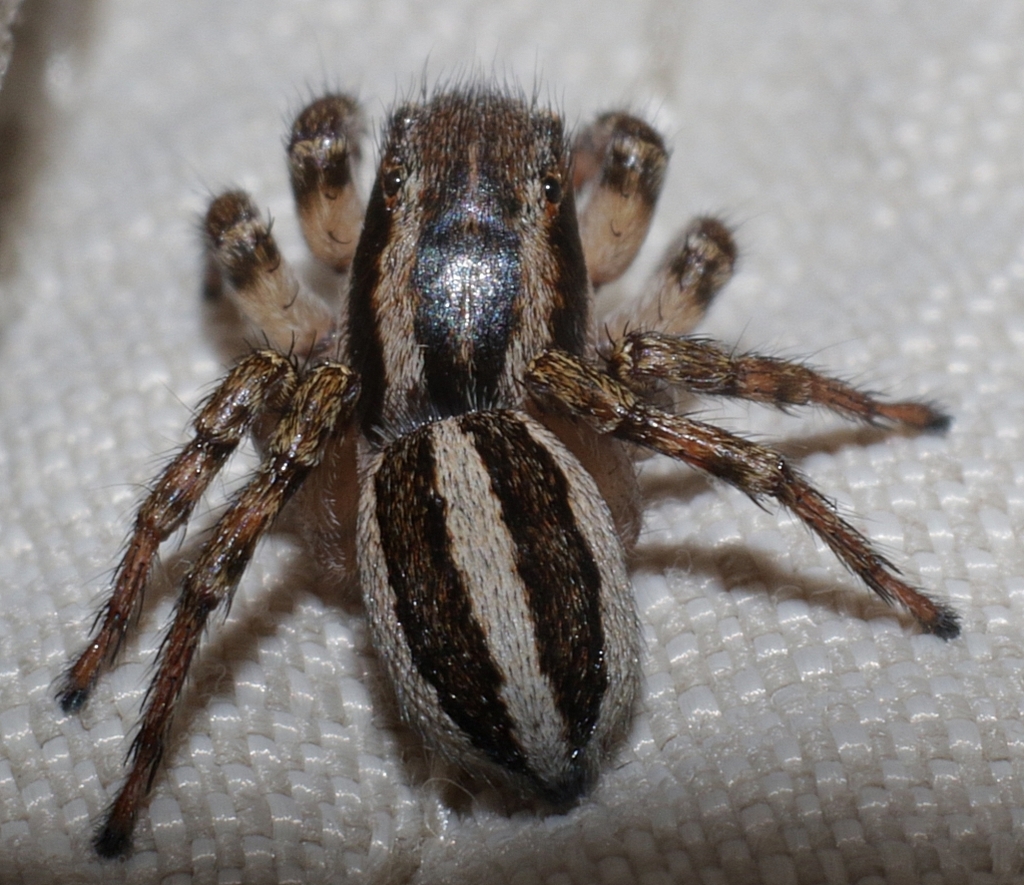
Phlegra fasciata
Phlegra fasciata is a species of jumping spider in the family Salticidae. The species is widely distributed across the Palearctic region.
From the article Phlegra fasciata on Wikipedia (CC BY-SA), quoted section by section
Description
Like many jumping spiders, Phlegra fasciata exhibits distinct sexual dimorphism in both size and coloration. Females are larger than males, measuring 6–8 mm in body length, while males are 5–6 mm long. The female has a golden brown to black cephalothorax with two white bands on the dorsal surface and a white border along the margins. The opisthosoma is golden brown to black with a distinctive white median band running longitudinally and white stripes along the sides. White hairs are present beneath the anterior eyes, and the legs and pedipalps show annulated (ringed) patterns. Males are almost entirely golden brown to black in coloration. While they possess markings similar to females, these are much fainter and more difficult to distinguish, giving males a generally darker appearance.
Range & habitat
P. fasciata has an extensive range across the Palearctic region, including Europe, Turkey, the Caucasus, Russia (from European regions to the Far East), Kazakhstan, Central Asia, Iran, Afghanistan, India, China, Mongolia, Korea, and Japan.
Wikipedia: “Distribution”
In human culture
The specific epithet fasciata comes from the Latin word meaning "banded" or "striped", describing the characteristic white bands across the spider's dark body.
Wikipedia: “Etymology”
Where it lives
Recorded sightings
—
geo-referenced records in GBIF, from museums, herbaria and field observers.
Drag the globe to turn it. Dots are where records exist, not a range map; darker means more records.
In the stacks
Searching the stacks…
Every page naming Phlegra fasciata in the Biodiversity Heritage Library →
This page is assembled live from iNaturalist, GBIF, Wikipedia, the Source Library and the Internet Archive. It is not yet part of the hand-edited codex. iNaturalist taxon 153536.