- Animals
- ›Arthropods
- ›Chelicerates
- ›Arachnids
- ›Spiders
- ›Typical Spiders
- ›Entelegyne Spiders
- ›Orbweavers and Allies
- ›Long-jawed Orbweavers
- ›Tetragnathinae
- ›Tetragnatha
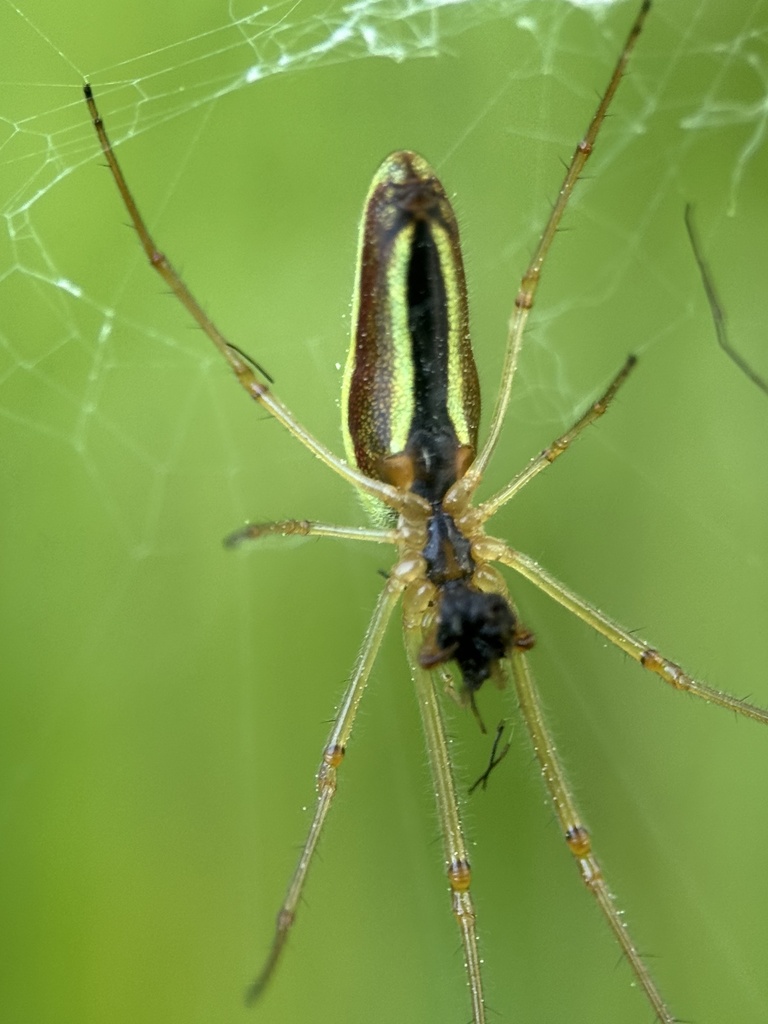
Common Stretch Spider
Tetragnatha extensa
Tetragnatha extensa is a species of spider found across the Northern Hemisphere. It has an elongate body, up to 11 mm (0.43 in) long, and adopts a straight line posture when alarmed. It lives on low vegetation in damp areas, and feeds on flying insects which it catches in its web.
From the article Tetragnatha extensa on Wikipedia (CC BY-SA), quoted section by section
Description
T. extensa has an elongated, cream-coloured body. Males are smaller than females, at around 9 millimetres (0.35 in) body length, compared to 11 mm (0.43 in) for females. The four pairs of legs are very long, and are dark yellow. The carapace, which is around 1.8–2.6 mm long and 1.1–1.7 mm wide, is orange or dark yellow. The colouring of T. extensa is quite variable, ranging from creamy-yellow to green. On the underside, there is a thick black central band, with a silvery band on either side.
T. extensa is distinguished from other members of the genus Tetragnatha by the minute curved tip of the male's conductor (part of the pedipalp), and the form of the female's spermatheca.
Range & habitat
T. extensa has a wide distribution across the Northern Hemisphere (Holarctic). In North America, it is found from Alaska to Newfoundland, and its range extends south to Washington, Colorado and Pennsylvania. The species has a broad ecological range, having been found at the tree line in the Rocky Mountains. It is found in coastal vegetation in Europe. T. extensa is found throughout the United Kingdom, where it is the commonest species of Tetragnatha, and one of the commonest spiders. It is also found in Madeira.
Wikipedia: “Distribution”
What it does
Tetragnatha extensa is found on low-growing vegetation, usually in damp areas. It feeds on insects, including mosquitos, midges and moths, which it catches in its loosely constructed web. When alarmed, it will sit along a plant stem, a blade of grass or the central vein of a leaf, with its four front legs pointing forwards, and its four back legs pointing backwards for camouflage. T. extensa is able to walk on the surface of water, where it can move faster than on land.
Wikipedia: “Ecology and behaviour”
In human culture
Tetragnatha extensa was first given a binomial by Carl Linnaeus in his Systema Naturae of 1758, the starting point of zoological nomenclature. In that work, it was included in the genus Aranea (now Araneus). T. extensa is a very common, widespread and variable species, and a number of synonyms have been published:
Wikipedia: “Taxonomic history”
Where it lives
Recorded sightings
—
geo-referenced records in GBIF, from museums, herbaria and field observers.
Drag the globe to turn it. Dots are where records exist, not a range map; darker means more records.
In the stacks
Searching the stacks…
Every page naming Tetragnatha extensa in the Biodiversity Heritage Library →
This page is assembled live from iNaturalist, GBIF, Wikipedia, the Source Library and the Internet Archive. It is not yet part of the hand-edited codex. iNaturalist taxon 153757.