- Plants
- ›Vascular Plants
- ›flowering plants
- ›Dicots
- ›Nances, Willows, and Allies
- ›Spurge Family
- ›Crotonoideae
- ›Crotoneae
- ›Croton
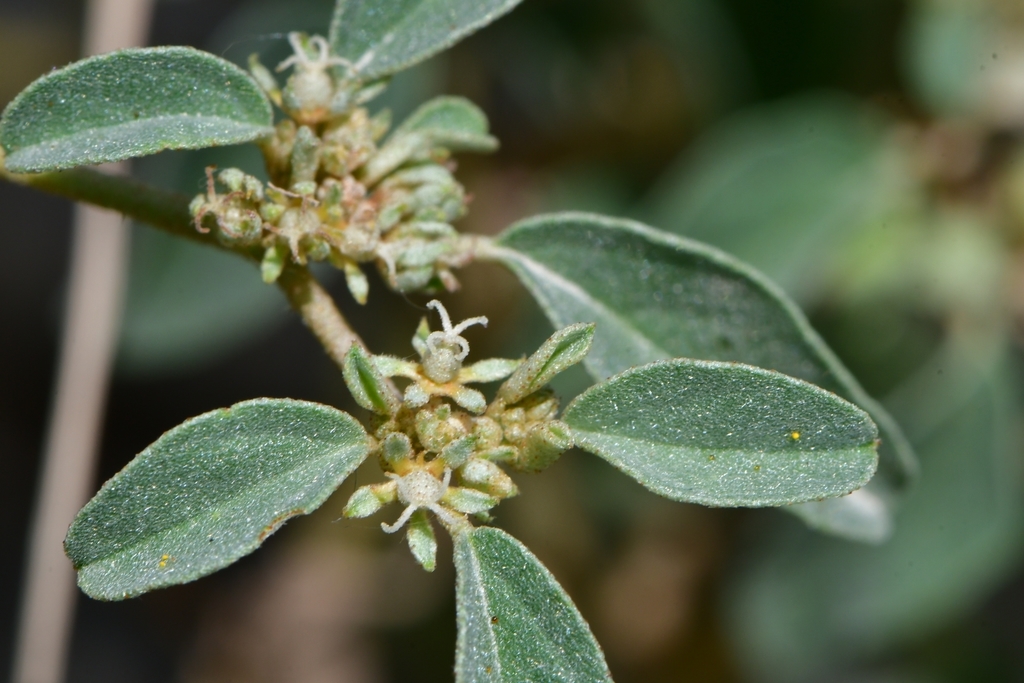
Prairie Tea
Croton monanthogynus
Croton monanthogynus is a species of flowering plant in the spurge family. The undersides are gray. It is a summer annual that produces small, inconspicuous flowers. The plant is monoecious and has both male and female reproductive organs in separate clusters on the same plant. Its leaves are alternate. It is native to the southeastern United States and the southern Great Plains. It is considered adventive in more northern states. AL, AR, AZ, GA, IA, IL, IN, KS, KY, LA, MD, MI, MO, MS, NC, NE, OH, OK, PA, SC, TN, TX, VA, WI, WV.
The plant in is found in sunny, dry habitats, of both disturbed and high-quality areas. Its common names include prairie tea, one-seed croton, dove weed, and prairie goatweed. Other plant characteristics include alternate leaf arrangement, (or phyllotaxis) and a tap root. It is an annual and it has entire leaf margins. The type of fruit is a capsule, sepals exist on the flowers. The flowers are small and white. It possess glands that emit a pleasant odor. The plant may grow 6 inches to 3 feet and blooms April through September. The seeds are black.
Where it lives
Recorded sightings
—
geo-referenced records in GBIF, from museums, herbaria and field observers.
Drag the globe to turn it. Dots are where records exist, not a range map; darker means more records.
In the stacks
Searching the stacks…
Every page naming Croton monanthogynus in the Biodiversity Heritage Library →
This page is assembled live from iNaturalist, GBIF, Wikipedia, the Source Library and the Internet Archive. It is not yet part of the hand-edited codex. iNaturalist taxon 155299.