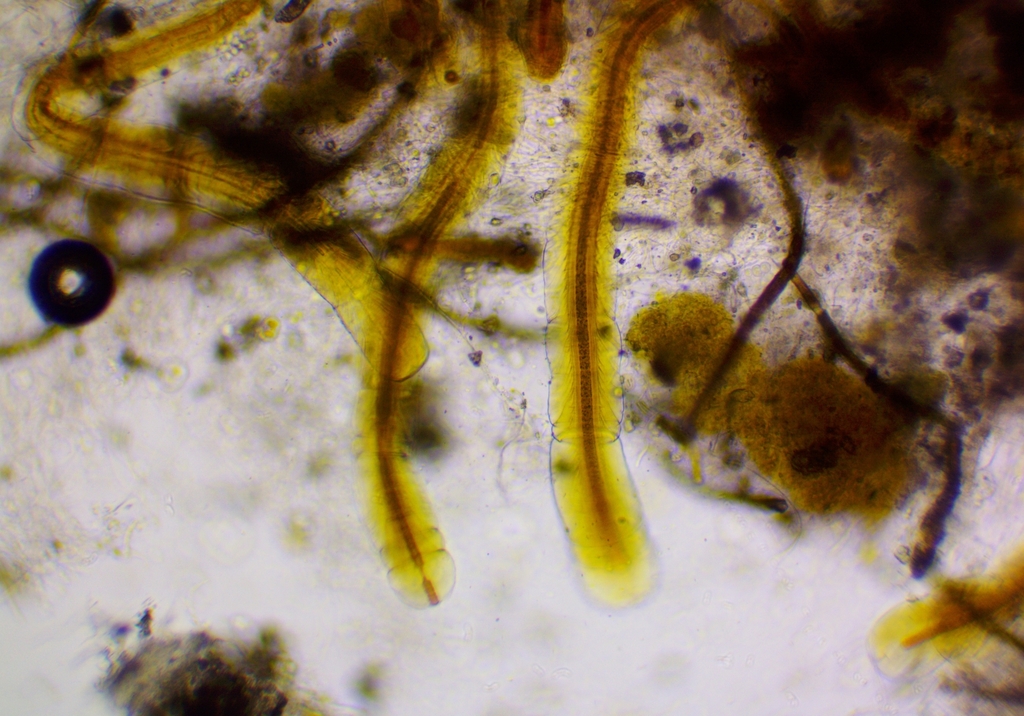
Petalonema alatum
Petalonema alatum is a cyanobacterium. It was first described and drawn by the Scottish author Dugald Carmichael under the taxonomic name Oscillatoria allata in 1826. In 1833, Miles Joseph Berkeley re-published it under its current name Petalonema alatum. P. alatum produces a slime-like mucopolysaccharide in the form of interlocking slime funnels. The structure looks like a quill under the light microscope, which is where the species gets its name "alatum", meaning quill. These slime envelopes are up to 270 μm wide in diameter and are therefore visible by the naked eye as filiform formations ("nema" = floss). The habitats for this filamentous cyanobacterium are mainly wet limestone walls and create together with other bacteria, microalgae, bryophytes and micromycets gray or gray-brown biofilms. Populations of P. alatum have specialized cells - yellow heterocytes to bind atmospheric nitrogen which are in colour contrast to vegetative blue-green/turquoise cells in filamentous thallus.
== References ==
Where it lives
Recorded sightings
—
geo-referenced records in GBIF, from museums, herbaria and field observers.
Drag the globe to turn it. Dots are where records exist, not a range map; darker means more records.
In the stacks
Searching the stacks…
Every page naming Petalonema alatum in the Biodiversity Heritage Library →
This page is assembled live from iNaturalist, GBIF, Wikipedia, the Source Library and the Internet Archive. It is not yet part of the hand-edited codex. iNaturalist taxon 1569009.