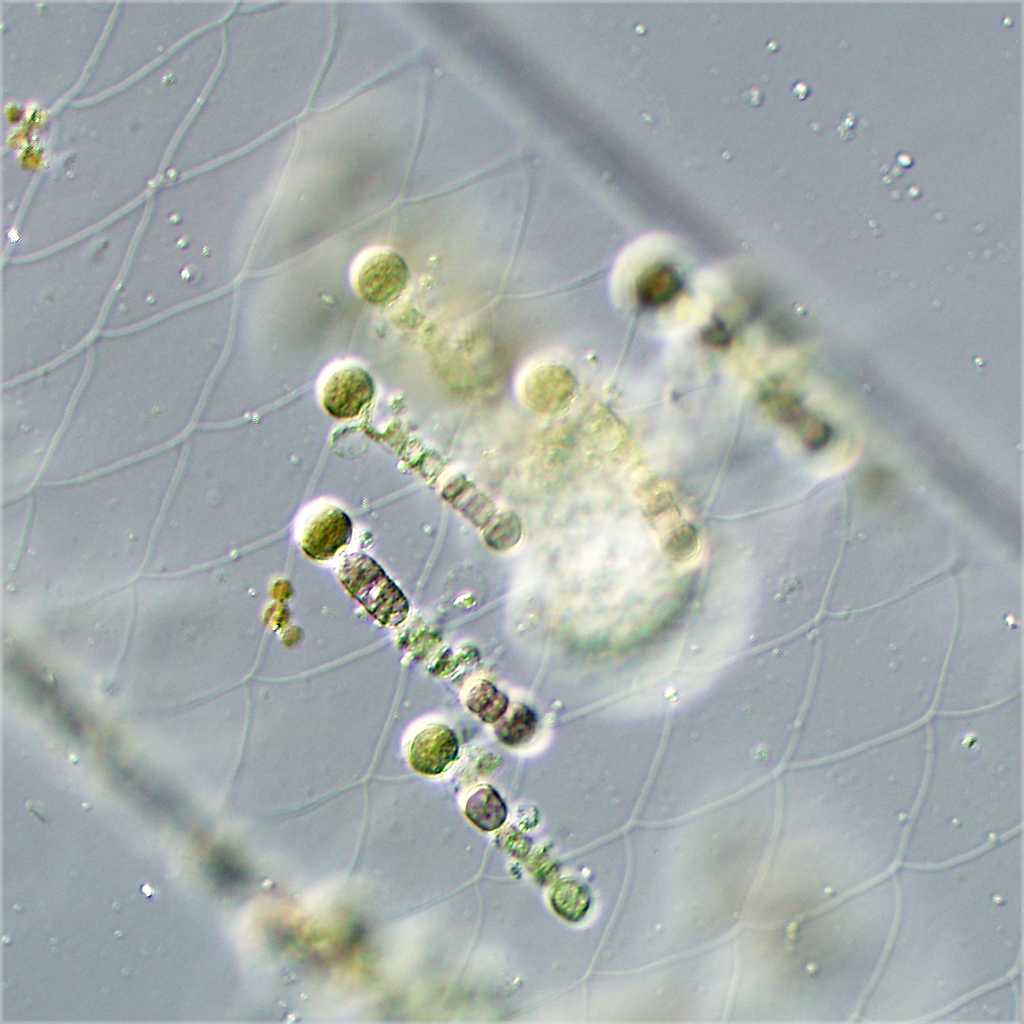
Richelia intracellularis
Richelia is a genus of nitrogen-fixing, filamentous, heterocystous and cyanobacteria. They exist as both free-living organisms as well as symbionts within potentially up to 13 diatoms distributed throughout the global ocean. As a symbiont, Richelia can associate epiphytically and as endosymbionts within the periplasmic space between the cell membrane and cell wall of diatoms.
Richelia has been divided into several species on a genomic basis. Despite not being recognized by the LPSN, they remain useful in talking about the differences in genomic content and lifestyle of the groups they refer to.
From the article Richelia on Wikipedia (CC BY-SA), quoted section by section
Description
Richelia are made up of filaments called trichomes, which are fine hair-like structures that grow out of a myriad of plant species, though their presence as free-living organisms in the marine environment is rare. The number of trichomes Richelia have in each diatom host varies. The trichomes serve the purpose of nitrogen fixation as well as nutrient exchange with host diatoms. The location of Richelia within their various diatom symbionts is not fully known, though it is commonly assumed to be within the diatom's periplasmic space between the plasmalemma and the frustule. Richelia's trichomes are made up of two cell types: heterocyst and vegetative. The heterocyst is a terminal single cell within which nitrogen fixation occurs, while the rest of the trichome is made up of vegetative cells within which photosynthesis occurs. Some Richelia are made up of many vegetative cells and a terminal heterocyst, while others only contain a terminal heterocyst. The heterocyst is characterized by a thick glycolipid layer which minimizes oxygen's ability to interfere with nitrogen fixation. This is important to Richelia's function as oxygen can bind to nitrogenase and inhibit the cyanobacteria's nitrogen fixing abilities. The heterocyst does not divide, while the vegetative cells do. …
Wikipedia: “Morphology”
Range & habitat
Cyanobacteria in the genus Richelia are primarily found in symbiotic association with diatoms in nitrogen-limited regions of the ocean. This distribution pattern is attributed to the symbiotic relationship that Richelia forms with different species of diatoms in which they provide diatoms with nitrogen that is otherwise limiting for growth. Similar to other diazotrophs, Richelia cells are in low abundances in productive equatorial regions due to nutrient upwelling and in high abundances in non-productive subtropical areas where low concentrations of nitrate limit the growth of diatoms. Quantitative analyses of the distribution of Richelia is an emerging field of study. Thus far, many observations have been subject to criticism due to issues of misidentifying hosts and the associated diazotrophs, and demonstrating symbiotic relationships overall.
Global ocean. Richelia are found throughout the Pacific Ocean, the Atlantic Ocean, the Amazon River plume, and the Mediterranean Sea. They follow similar distributions to other diazotrophs including cyanobacteria in the genus Trichodesmium, Candidatus Atelocyanobacterium thalassa (formerly known as UCYN-A), and UCYN-B, which are in high abundance throughout much of the tropical oceans, although the relative abundances of the different taxa varies. …
Wikipedia: “Distribution”
What it does
Nitrogen fixation is an important biological process in marine ecosystems. In many regions of the world's oceans the availability of inorganic nitrogen such as nitrate and ammonium limits the rate of photosynthesis (primary productivity). Hence, organisms that form symbiotic relationships with other organisms, often cyanobacteria, to fix nitrogen can be at an advantage. In many cyanobacteria, nitrogen fixation is carried out in specialized cells called heterocysts. Cyanobacteria in the genus Richelia are an example of cyanobacteria are capable of fixing nitrogen gas into organic forms of nitrogen. The organic nitrogen can then be transferred from the cyanobacteria to the diatoms with which they have a symbiotic relationship. Evidence of this nitrogen transfer has been observed multiple times, and this relationship has benefits for both the Richelia cells, which exist inside the diatom, and the diatom itself. For example, the growth of cyanobacteria inside the diatom is increased as they receive fixed carbon from the host (about a quarter of the host's carbon-fixation capacity). The diatom benefits from enhanced growth as a result of the nitrogen fixed by the cyanobacteria. The presence of this mutualism can allow diatoms to persist through nitrogen limiting conditions.
Wikipedia: “Nitrogen fixation and symbiosis”
Where it lives
Recorded sightings
—
geo-referenced records in GBIF, from museums, herbaria and field observers.
Drag the globe to turn it. Dots are where records exist, not a range map; darker means more records.
In the stacks
Searching the stacks…
Every page naming Richelia intracellularis in the Biodiversity Heritage Library →
This page is assembled live from iNaturalist, GBIF, Wikipedia, the Source Library and the Internet Archive. It is not yet part of the hand-edited codex. iNaturalist taxon 1571569.