- Animals
- ›Arthropods
- ›Hexapods
- ›Insects
- ›Winged and Once-winged Insects
- ›Dragonflies and Damselflies
- ›Damselflies
- ›Coenagrionoid Damselflies
- ›Narrow-winged Damselflies
- ›Xanthagrion
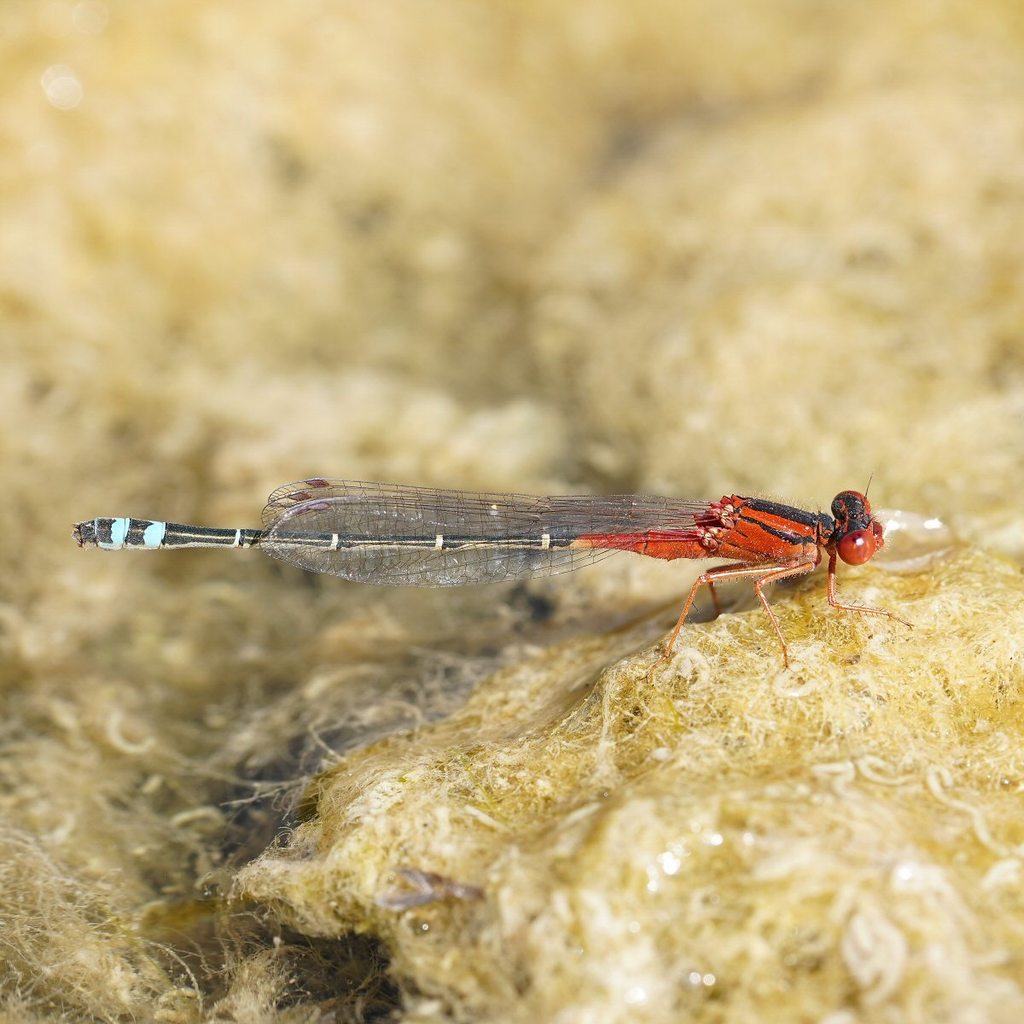
Red and Blue Damsel
Xanthagrion erythroneurum
The red and blue damsel, (Xanthagrion erythroneurum) is a damselfly in the family Coenagrionidae.
It is the only member of the monotypic genus Xanthagrion.
From the article Red and blue damsel on Wikipedia (CC BY-SA), quoted section by section
Description
A red and blue damsel has a bright red face and thorax. Its abdomen is pale in colour and 2.2-2.4 cm long. Females and males are similar in colour.
Range & habitat
The red and blue damsel is widespread across all Australian states, as well as Fiji, New Caledonia, and other islands in the Pacific. It is found in north and eastern Tasmania. It is typically found near dams, marshes and slow watercourses.
Wikipedia: “Distribution and habitat”
In human culture
The genus name Xanthagrion is derived from the Greek ξανθός (xanthos, "yellow") and Agrion, a genus name derived from the Greek ἄγριος (agrios, "wild"). Agrion was the name applied by Johan Christian Fabricius in 1775 to all damselflies. The species name erythroneurum is derived from the Greek ἐρυθρός (erythros, "red") and νεῦρον (neuron, "nerve" or "sinew"), referring to the colour of the major wing veins.
Wikipedia: “Etymology”
Listen
Looking for field recordings…
Where it lives
Recorded sightings
—
geo-referenced records in GBIF, from museums, herbaria and field observers.
Drag the globe to turn it. Dots are where records exist, not a range map; darker means more records.
In the stacks
Searching the stacks…
Every page naming Xanthagrion erythroneurum in the Biodiversity Heritage Library →
This page is assembled live from iNaturalist, GBIF, Wikipedia, the Source Library and the Internet Archive. It is not yet part of the hand-edited codex. iNaturalist taxon 157753.