- Animals
- ›Arthropods
- ›Hexapods
- ›Insects
- ›Winged and Once-winged Insects
- ›Stick Insects
- ›Verophasmatodea
- ›Areolatae
- ›Bacilloidea
- ›Heteropterygidae
- ›Obriminae
- ›Obrimini
- ›Eubulides
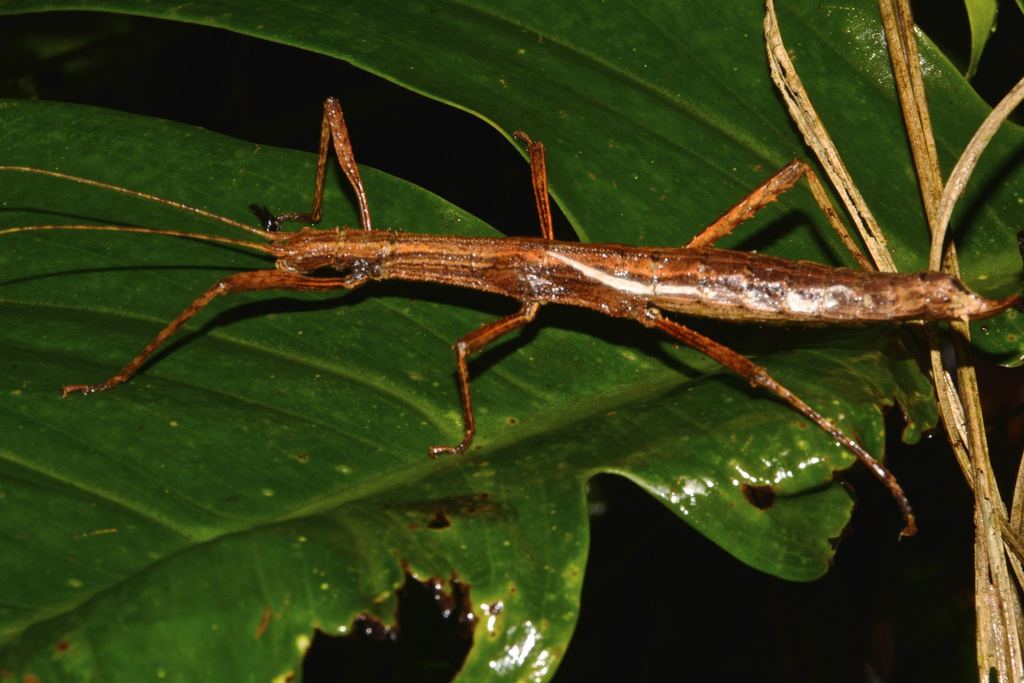
Eubulides timog
Eubulides timog is a stick insect species from the family of the Heteropterygidae. Although only described in 2023, this species, native to the south and east of the Philippine island Luzón, has been kept and bred in the terrariums of enthusiasts since 2009.
From the article Eubulides timog on Wikipedia (CC BY-SA), quoted section by section
Description
The females of this medium-sized Eubulides species reach a length of 64 to 76 millimetres (2.5 to 3.0 in). At the end of the abdomen is the beak-shaped secondary ovipositor typical of species of the Obriminae, as in all species of the genus, is characteristically curved upwards in a sickle shape. The coloration and pattern of the females are very variable. In addition to uniformly light to dark brown animals, there are occasionally those with brown, light beige to white patterns, as well as those with almost black and white coloration. Animals with a thin, dark longitudinal stripe extending from the head to the end of the abdomen also occur. Males are more slender and remain significantly smaller, with a length of 49 to 54 millimetres (1.9 to 2.1 in). They are usually uniformly light or medium brown in color and only rarely show brown or beige patterns in the area of the lateral meso- and metanotum. In their habit the species is very similar to the slightly larger Eubulides lumawigi native to northern Luzon. E. timog can be distinguished from this by the shape of the ventral anal segment, which in the males of E. lumawigi is clearly two-lobed at the posterior edge, while in those of E. timog it is hexagonal and shows only a slight bulge at the posterior edge. In the females of E. …
What it does
In the wild, the species has been found in shady to semi-shady biotopes on various Araceae. The projectile-shaped eggs, which are laid in the soil using the curved ovipositor, are typical for the genus. They are about 5.3 millimetres (0.21 in) long, 3.4 to 3.5 millimetres (0.13 to 0.14 in) 1.9 millimetres (0.075 in) wide and 2.2 millimetres (0.087 in) high and brown. The lid (operculum) is somewhat darker and sits on the egg at an angle sloping towards the ventral side, creating an opercular angle of about 15 degrees. The micropylar plate is broad, almost rectangular in the upper part and inverted V-shaped at the lower pole in the direction of the micropyle and 3.8 millimetres (0.15 in) long. After three to four months, the nymphs hatch, which are about 10 millimetres (0.39 in) long and uniformly brown in color when they hatch.
Wikipedia: “Lifestyle and reproduction”
Listen
Looking for field recordings…
Where it lives
Recorded sightings
—
geo-referenced records in GBIF, from museums, herbaria and field observers.
Drag the globe to turn it. Dots are where records exist, not a range map; darker means more records.
In the stacks
Searching the stacks…
Every page naming Eubulides timog in the Biodiversity Heritage Library →
This page is assembled live from iNaturalist, GBIF, Wikipedia, the Source Library and the Internet Archive. It is not yet part of the hand-edited codex. iNaturalist taxon 1600936.