- Plants
- ›Vascular Plants
- ›flowering plants
- ›Dicots
- ›Sunflowers, Bellflowers, Fanflowers, and Allies
- ›bellflower family
- ›Lobelia subfamily
- ›Clermontia
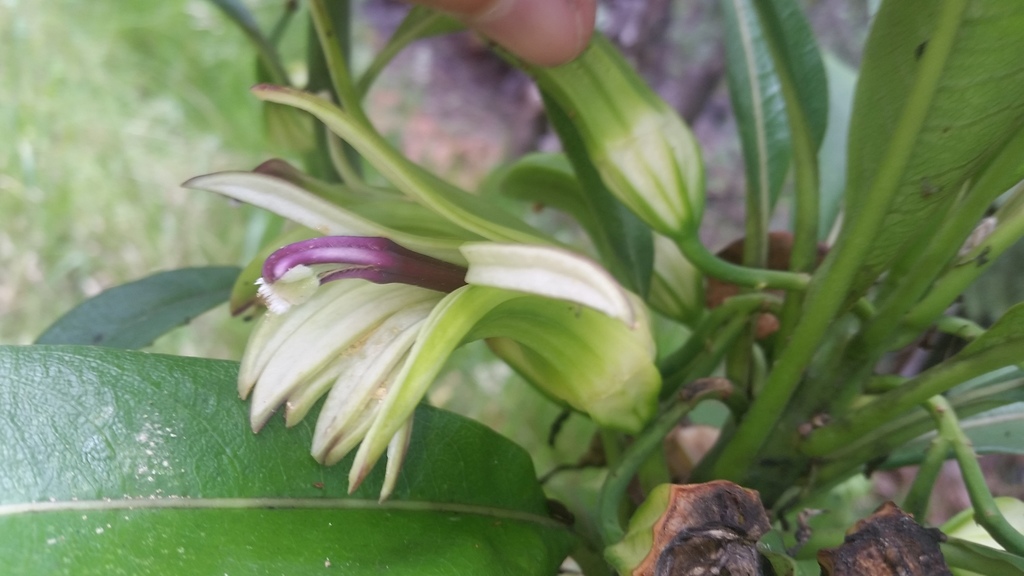
‘ōhā kēpau
Clermontia hawaiiensis
Clermontia hawaiiensis, the ʻŌhā kēpau, is a species of Hawaiian lobelioid endemic to Hawaiʻi island, where it grows in Hawaiian tropical rainforests. Like other Hawaiian lobelioids, it is highly susceptible to damage from invasive grazing mammals such as feral pigs.
From the article Clermontia hawaiiensis on Wikipedia (CC BY-SA), quoted section by section
Description
Clermontia hawaiiensis grows as a small tree, usually a few meters in height but potentially reaching up to 9 m (30 ft). It has leaves that grow up to 24 cm (9.4 in), white and purple flowers, and orange fruits approximately 30 mm (1.2 in) across.
Flower. The flowers grow in an inflorescence grouping of 2-4. They are bisexual and have bilaterally symmetric with the sepals mimicking the shape and texture of the tubular petals. The 5–6.5 cm (2.0–2.6 in) perianth displays colors of greenish white, purples, and magentas.
Seed and fruit. C. hawaiiensis produces a compact and bright orange in color fruit with horizontal ridges. The fruits’ endocarp contains an abundance of seeds.
Range & habitat
Clermontia hawaiiensis is endemic to the windward eastern side of Hawaiʻi island, where it grows only in wet rainforests near the town of Volcano, Hawaii and the Kīlauea Caldera between elevations of 550–1,760 m (1,800–5,770 ft). However, Its common in certain portions of the protected Hawaiʻi Volcanoes National Park in present day. Historically documented as far north as the east slopes of Mauna Kea by the Bernice Pauahi Bishop Musesum. The symbiotic relationships between the endemic Hawaiian honeycreeper, with its long curved beak, and the ʻŌhā kēpau has been impacted by many of the native birds’ extinction. Furthermore, like other Hawaiian labelloids, it is also highly susceptible to damage from invasive grazing mammals, like the feral pig.
Wikipedia: “Habitat and distribution”
Where it lives
Recorded sightings
—
geo-referenced records in GBIF, from museums, herbaria and field observers.
Drag the globe to turn it. Dots are where records exist, not a range map; darker means more records.
In the stacks
Searching the stacks…
Every page naming Clermontia hawaiiensis in the Biodiversity Heritage Library →
This page is assembled live from iNaturalist, GBIF, Wikipedia, the Source Library and the Internet Archive. It is not yet part of the hand-edited codex. iNaturalist taxon 160722.