- Plants
- ›Vascular Plants
- ›flowering plants
- ›Dicots
- ›Sunflowers, Bellflowers, Fanflowers, and Allies
- ›bellflower family
- ›Lobelia subfamily
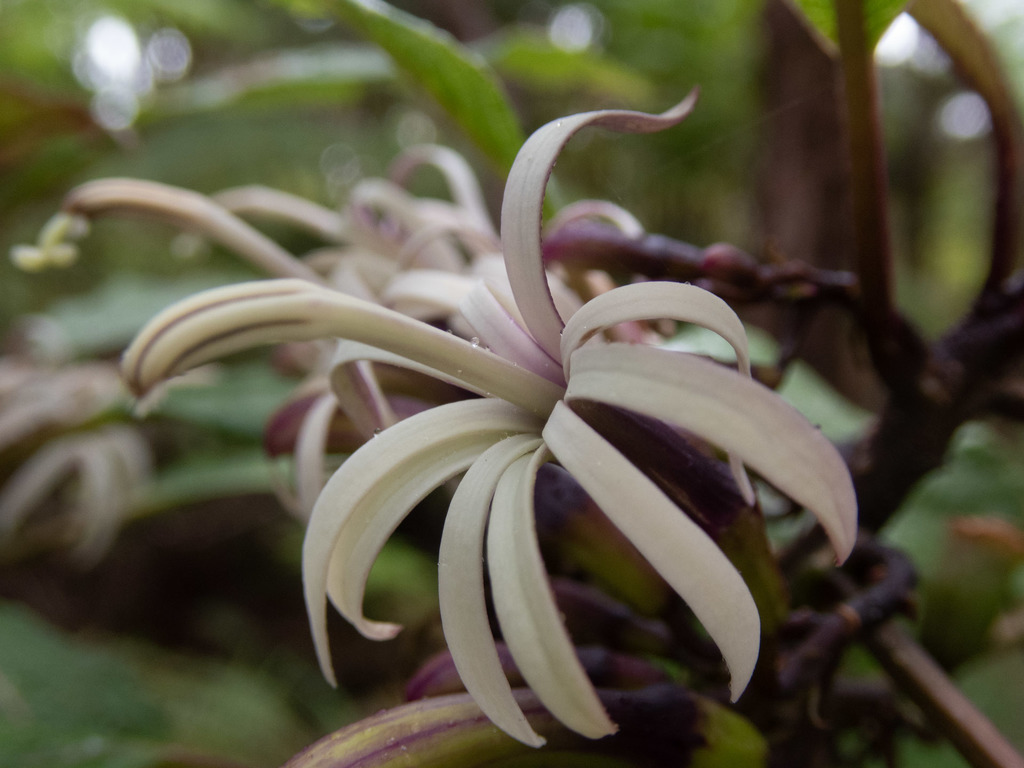
'ōhā wai
Clermontia
The Hawaiian lobelioids are a group of flowering plants in the bellflower family, Campanulaceae, subfamily Lobelioideae, all of which are endemic to the Hawaiian Islands. This is the largest plant radiation in the Hawaiian Islands, and indeed the largest on any island archipelago, with over 125 species. The six genera involved can be broadly separated by growth habit: Clermontia are typically branched shrubs or small trees, up to 7 metres (23 ft) tall, with fleshy fruits; Cyanea and Delissea are typically unbranched or branching only at the base, with a cluster of relatively broad leaves at the apex and fleshy fruits; Lobelia and Trematolobelia have long thin leaves down a single, non-woody stem and capsular fruits with wind-dispersed seeds; and the peculiar Brighamia have a short, thick stem with a dense cluster of broad leaves, elongate white flowers, and capsular fruits. The relationships among the genera and sections remains unsettled as of April 2022.
Many species have beautiful and spectacular flowers, especially those in Lobelia and Trematolobelia. They are also highly vulnerable to feeding by feral ungulates such as feral pigs; the stems are only partly woody, and contain few defenses against herbivory. The bark contains a milky (but apparently non-poisonous) latex, and is often chewed by rats and pigs. Seedlings are also vulnerable to disturbance by pig digging, and in areas with high densities of pigs it is not uncommon to find the only lobelioids being epiphytic on larger trees or on fallen logs.
24 branches of this genus, most-observed first

'ōhā wai
speciesClermontia parviflora

hāhā'aiakamanu
speciesClermontia fauriei

‘ōhā kēpau
speciesClermontia hawaiiensis

Clermontia kakeana
speciesClermontia kakeana

Pele Clermontia
speciesClermontia peleana

Clermontia oblongifolia
speciesClermontia oblongifolia

'ōhā wai nui
speciesClermontia arborescens

Clermontia pyrularia
speciesClermontia pyrularia

Clermontia lindseyana
speciesClermontia lindseyana

Clermontia montis-loa
speciesClermontia montis-loa

Clermontia grandiflora
speciesClermontia grandiflora

hāhā 'ai a kamanu
speciesClermontia clermontioides

Clermontia tuberculata
speciesClermontia tuberculata

Clermontia micrantha
speciesClermontia micrantha

Kohala oha wai
speciesClermontia kohalae

Clermontia samuelii
speciesClermontia samuelii

Clermontia persicifolia
speciesClermontia persicifolia

Clermontia calophylla
speciesClermontia calophylla

Clermontia drepanomorpha
speciesClermontia drepanomorpha

Clermontia pallida
speciesClermontia pallida

Clermontia waimeae
speciesClermontia waimeae
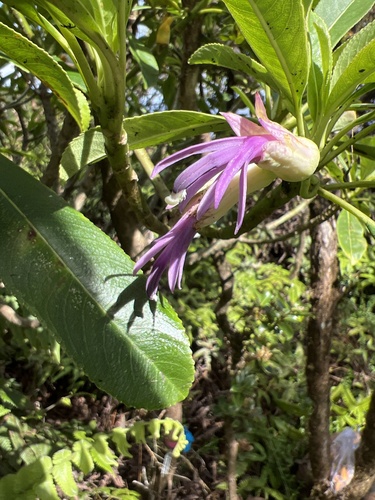
Clermontia hanaulaensis
speciesClermontia hanaulaensis
Clermontia multiflora
speciesClermontia multiflora
Clermontia × leptoclada
hybridClermontia × leptoclada
Where it lives
Recorded sightings
—
geo-referenced records in GBIF, from museums, herbaria and field observers.
Drag the globe to turn it. Dots are where records exist, not a range map; darker means more records.
In the stacks
Searching the stacks…
Every page naming Clermontia in the Biodiversity Heritage Library →
This page is assembled live from iNaturalist, GBIF, Wikipedia, the Source Library and the Internet Archive. It is not yet part of the hand-edited codex. iNaturalist taxon 67940.