- Plants
- ›Vascular Plants
- ›flowering plants
- ›Dicots
- ›Nances, Willows, and Allies
- ›Flax Family
- ›Linoideae
- ›Linum
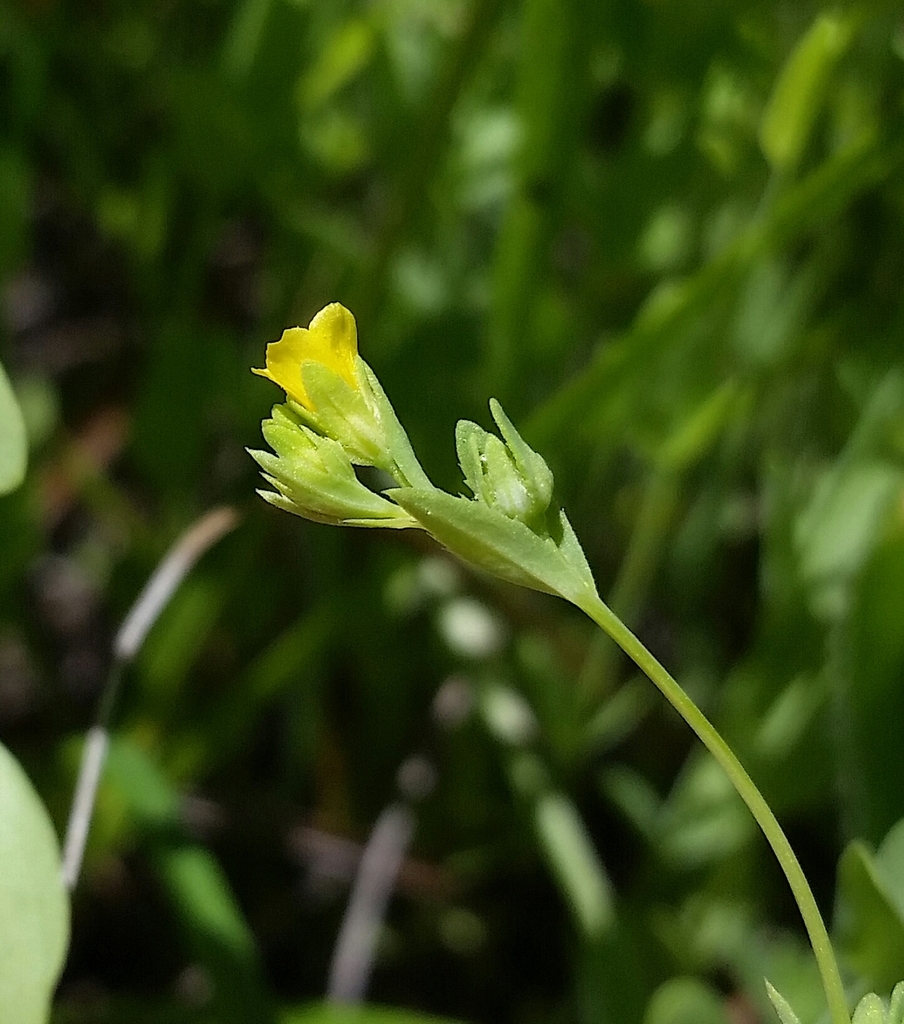
digynum flax
Linum digynum
Sclerolinon is a monotypic genus of flowering plants in the flax family (Linaceae) containing the single species Sclerolinon digynum, which is known by the common names northwestern yellowflax and yellow hard flax. It is native to the western United States, where it has been recorded in Washington, Idaho, Oregon, and as far south as central California. It grows in seasonally wet habitats, such as mountain meadows and vernal pools.
It is an annual herb producing a hairless, erect stem up to 20 cm (7.9 inches) tall. The leaves are oval in shape, and the upper leaves have serrated edges. They are oppositely arranged about the stem and grow erect instead of spreading away from the stem. The inflorescence is a cyme of flowers surrounded by serrated, leaflike bracts. The flower has five yellow petals in a calyx of toothed sepals.
From the article Sclerolinon on Wikipedia (CC BY-SA), quoted section by section
Range & habitat
S. digynum has historically been found in the U.S. states of Idaho, Washington, Oregon, and California. In Idaho it is considered rare, and possibly extirpated. The most recent reports of S. digynum in Idaho are from the 1800s, when it was seen in Kootenai and Nez Perce counties. In Washington, S. digynum is considered sensitive or threatened. It occurs in the Columbia Plateau ecoregion east of the Cascade Range, and has specifically been found in Spokane and Whitman counties. Here it blooms from May or June through late July. In Oregon, it has been recorded in Marion, Linn, Benton, Klamath, Jackson, and Josephine counties. In California, it has been recorded in Glenn, Siskiyou, Shasta, Plumas, Butte, Sierra, Amador, Calaveras, Tuolomne, Mariposa, Madera, and Fresno counties. It blooms from June through August.
Wikipedia: “Distribution”
Where it lives
Recorded sightings
—
geo-referenced records in GBIF, from museums, herbaria and field observers.
Drag the globe to turn it. Dots are where records exist, not a range map; darker means more records.
In the stacks
Searching the stacks…
Every page naming Linum digynum in the Biodiversity Heritage Library →
This page is assembled live from iNaturalist, GBIF, Wikipedia, the Source Library and the Internet Archive. It is not yet part of the hand-edited codex. iNaturalist taxon 1608110.