- Plants
- ›Vascular Plants
- ›flowering plants
- ›Dicots
- ›Nances, Willows, and Allies
- ›St. John's wort family
- ›St. John's worts tribe
- ›Hypericum
- ›Hypericum
- ›Hypericum
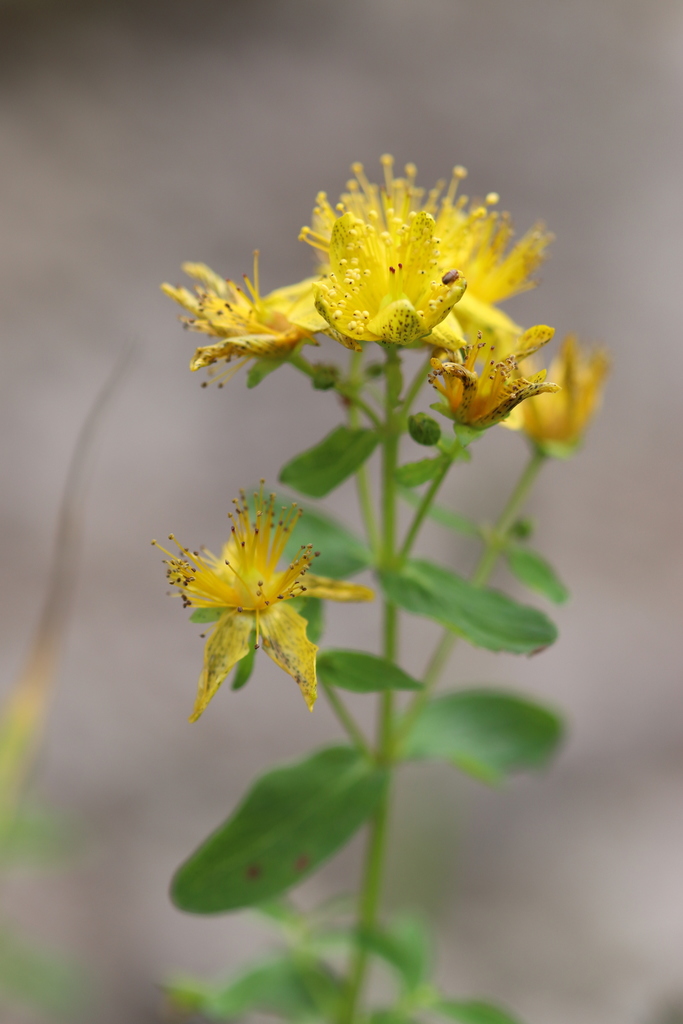
Imperforate St John's-wort
Hypericum maculatum
Hypericum maculatum Crantz (syn. H. quadrangulum L.; H. dubium Leers; imperforate St John's-wort or spotted St. Johnswort, not to be confused with H. maculatum Walter, syn. H. punctatum Lam.) is a species of perennial herbaceous plant in the genus Hypericum. It is native to Europe and Western Asia. It grows in meadows.
From the article Hypericum maculatum on Wikipedia (CC BY-SA), quoted section by section
Description
Hypericum maculatum is a hairless perennial herbaceous plant growing to about 60 cm (24 in). The stem is square in cross section, but without the wings shown in H. tetrapterum. The leaves are simple, entire (undivided) and in opposite pairs, without stipules and have few or no translucent glands. There may be black dots on the leaves, petals and sepals. The flowers are yellow, up to about 25 mm (0.98 in) across. The species hybridises with Hypericum perforatum to produce Des Etang's St John's wort, Hypericum x desetangsii.
At the table
It is considered to be a medicinal plant. Hypericum maculatum herb has been used in the traditional Austrian medicine internally as tea or oil extract, and externally as oil extract, ointment or cold maceration in ethanol for treatment of disorders of the skin, locomotor system, nervous system, gastrointestinal tract, respiratory tract, kidneys and urinary tract, cardiovascular system, infections, rheumatism and gout.
== References ==
Wikipedia: “Uses”
Where it lives
Recorded sightings
—
geo-referenced records in GBIF, from museums, herbaria and field observers.
Drag the globe to turn it. Dots are where records exist, not a range map; darker means more records.
In the stacks
Searching the stacks…
Every page naming Hypericum maculatum in the Biodiversity Heritage Library →
This page is assembled live from iNaturalist, GBIF, Wikipedia, the Source Library and the Internet Archive. It is not yet part of the hand-edited codex. iNaturalist taxon 163978.