- Plants
- ›Vascular Plants
- ›flowering plants
- ›Dicots
- ›nightshades, bindweeds, gooseweeds, and allies
- ›nightshade family
- ›nightshades and allies
- ›boxthorns and allies
- ›Lycium
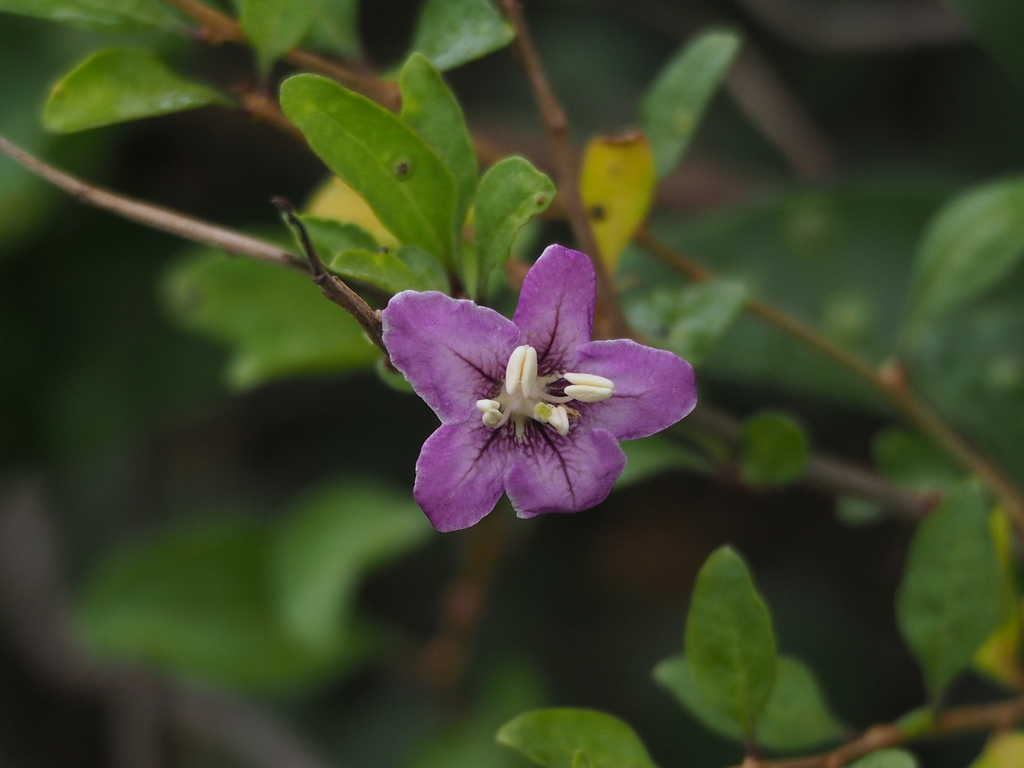
Chinese teaplant
Lycium chinense
Lycium chinense is one of two species of boxthorn shrub in the family Solanaceae. Along with Lycium barbarum, it produces the goji berry ("wolfberry"). Two varieties are recognized, L. chinense var. chinense and L. chinense var. potaninii. It is also known as Chinese boxthorn, Chinese matrimony-vine, Chinese teaplant, Chinese wolfberry, wolfberry, and Chinese desert-thorn.
From the article Lycium chinense on Wikipedia (CC BY-SA), quoted section by section
Description
Wolfberry species are deciduous woody shrubs, growing 1–3 metres (3 ft 3 in – 9 ft 10 in) high, somewhat shorter than L. barbarum. The stems are highly branched. Branches are pale gray, slender, curved or pendulous, with thorns 0.5–2 centimetres (0.20–0.79 in) long.
Leaves. Lycium chinense leaves form on the shoot either solitary in an alternating arrangement or in bundles of 2 to 4. Their shape may be ovate, rombic, lanceolate, or linear-lanceolate, usually 1.5–5 centimetres (0.59–1.97 in) long and 0.5–2.5 centimetres (0.20–0.98 in) wide (but up to 10 centimetres (3.9 in) long and 4 centimetres (1.6 in) wide in cultivated plants).
Flowers. The flowers grow in groups of one to three in the leaf axils, with pedicels 1–2 centimetres (0.39–0.79 in) long. The bell-shaped or tubular calyx (eventually ruptured by the growing berry) splits halfway into short, triangular, densely ciliate lobes. The corollae is a tube that splits into lavender or light purple petals, 9–14 mm (0.35–0.55 in) wide with five or six lobes longer than the tube, with short hairs at the edge. The stamens are structured with filaments longer than the anthers, slightly shorter or longer than the corolla, with a villous ring slightly above the base and the adjacent corolla tube. The anthers are longitudinally dehiscent.
Fruit and seeds. …
Where it lives
Recorded sightings
—
geo-referenced records in GBIF, from museums, herbaria and field observers.
Drag the globe to turn it. Dots are where records exist, not a range map; darker means more records.
In the old herbals & bestiaries


In the stacks
Searching the stacks…
Every page naming Lycium chinense in the Biodiversity Heritage Library →
This page is assembled live from iNaturalist, GBIF, Wikipedia, the Source Library and the Internet Archive. It is not yet part of the hand-edited codex. iNaturalist taxon 164955.