- Plants
- ›Vascular Plants
- ›flowering plants
- ›Dicots
- ›Nances, Willows, and Allies
- ›Leaf-flower Family
- ›Phyllanthoideae
- ›Phyllantheae
- ›Phyllanthus
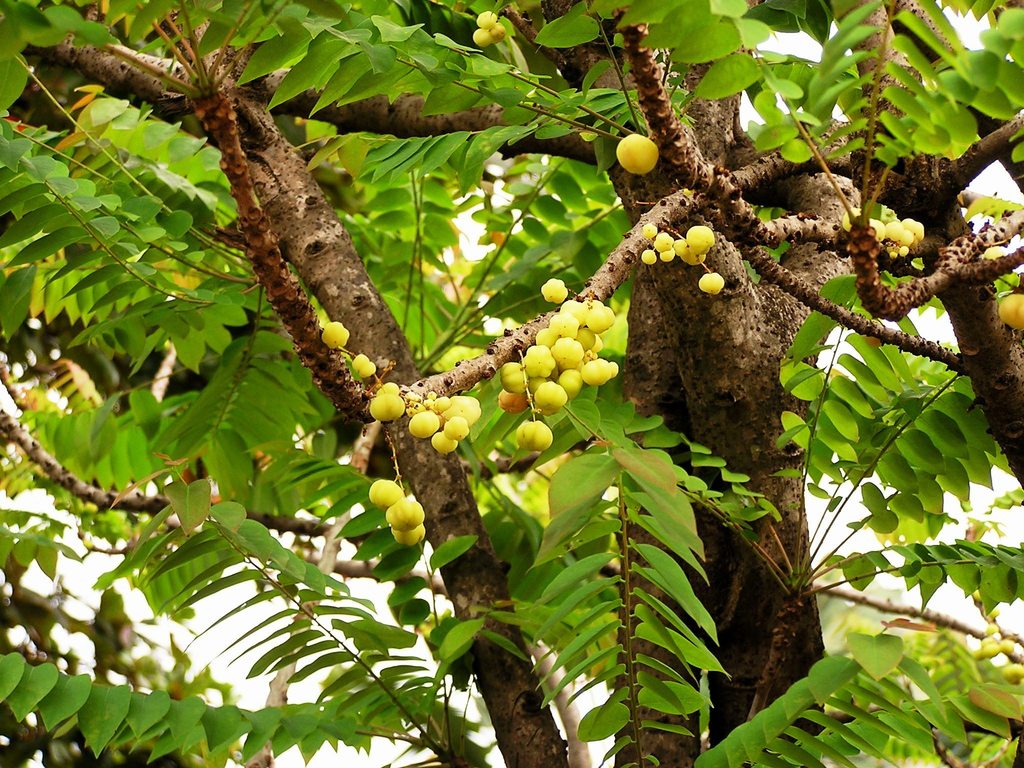
Tahitian gooseberry tree
Phyllanthus acidus
Phyllanthus acidus, known as the Otaheite gooseberry, Malay gooseberry, Tahitian gooseberry, Country gooseberry, Star gooseberry, Starberry, West India gooseberry, or simply Gooseberry tree, is one of the trees with edible small yellow berries fruit in the Phyllanthaceae family. Despite its name, the plant does not resemble the gooseberry, except for the acidity of its fruits. It is mostly cultivated for ornamentation.
From the article Phyllanthus acidus on Wikipedia (CC BY-SA), quoted section by section
Description
Phyllanthus acidus is an intermediary between a shrub and tree, reaching 2 to 9 m (6½ to 30 ft) high. The tree's dense and bushy crown is composed of thickish, tough main branches, at the end of which are clusters of deciduous, greenish, 15–30 cm long branchlets. The branchlets bear alternate leaves that are ovate or lanceolate in form, with short petioles and pointed ends. The leaves are 2–7.5 cm long and thin, they are green and smooth on the upperside and blue-green on the underside. In general, the star gooseberry tree very much looks like the bilimbi tree.
Flower clusters are formed in 5–12.5 cm long panicles from leafless parts of main branches at the upper part of the tree; they can be male, female or both. They are small and pinkish. The fruits are numerous, oblate, with 6 to 8 ribs, and densely clustered. They are pale yellow or white, waxy, crisp and juicy, and very sour. 4 to 6 seeds are contained in a stone at the center of each fruit.
Range & habitat
This tropical or subtropical species is found throughout Asia and also in the Caribbean region, Central and South America. While its origin is uncertain, the species may have originated in Madagascar. It was found in other parts of South Asia early; according to Eduardo Quisumbing, it was brought to the Philippines in prehistoric times. It spread across the Indian Ocean to Réunion and Mauritius and crossed the Pacific to Hawaii. It expanded to the Caribbean in 1793, when William Bligh carried the plant from Timor to Jamaica. The tree is common in Guam, Micronesia (where it is called ceremai or cerama), Southern Vietnam (called chùm ruột), Laos, Cambodia (called kantuot /កន្ទួត), northern Peninsular Malaysia (called cerme and cermai), India (called - (Tamil-தமிழ்-[அரை நெல்லிக்காய்], chalmeri, harpharoi), Nellikai in Kannada, Laheri (Kokborok) Harfi, Arunellikai, Abazhanga, Nellipuli (Malayalam-നെല്ലിപുളി), Usiri(in Telugu-ఉసిరి), Khatamada, Arinelli, Bimbool, Arinellika, Kiru Nerle, Mara Nelli, Amla, Gihori (Manipuri), Nōṛa (Bengali-নোড়) in West Bengal and Bangladesh and rosavale (in Konkani) in Goa) and RayAwala रायआवळा in Marathi and Goanbili ގޯނބިލި Divehi Maldives. It is still found in the Philippines (called iba in Tagalog and karmay in Ilokano), and if not widely, in Cambodia (called kantuet) and Thailand (called mayom). In Grenada, the fruit is called a damsel. In St. …
Wikipedia: “Origin and distribution”
At the table
P. acidus contains 4-hydroxybenzoic acid, caffeic acid, adenosine, kaempferol and hypogallic acid.
Wikipedia: “Nutrition”
In medicine
The plant is also used medicinally. The peppered leaves are used to make a poultice to treat sciatica, lumbago and rheumatism (but have been observed to cause low blood pressure when combined with nitrates); the seeds are used as a cathartic; the root, is a purgative if prepared with care. The syrup is used to medicate the stomach, and in India the fruit is eaten as a blood-enhancer for the liver; a lehyam, nellikai lekiyam, for which the salient ingredient is gooseberry fruit, is offered to children to boost their immunity.
Wikipedia: “Medical”
How it is grown
The star gooseberry prefers moist soil. It can be cultivated in a variety of ways—budding, cutting and air-layering—in addition to the usual seed growth. The tree is cultivated for its ornamental value, but also for food and medicinal purposes. While it produces some fruit throughout the year, it is mainly harvested in January except in South India, where it bears crops in April–May and again in August–September. As the fruit does not soften when ripe, it is harvested when the fruit begins to drop.
Wikipedia: “Cultivation”
Where it lives
Recorded sightings
—
geo-referenced records in GBIF, from museums, herbaria and field observers.
Drag the globe to turn it. Dots are where records exist, not a range map; darker means more records.
In the stacks
Searching the stacks…
Every page naming Phyllanthus acidus in the Biodiversity Heritage Library →
This page is assembled live from iNaturalist, GBIF, Wikipedia, the Source Library and the Internet Archive. It is not yet part of the hand-edited codex. iNaturalist taxon 166746.