- Plants
- ›Vascular Plants
- ›flowering plants
- ›monocots
- ›grasses, sedges, cattails, and allies
- ›grasses
- ›bamboos, canes, and allies
- ›Arundinarieae
- ›Phyllostachys
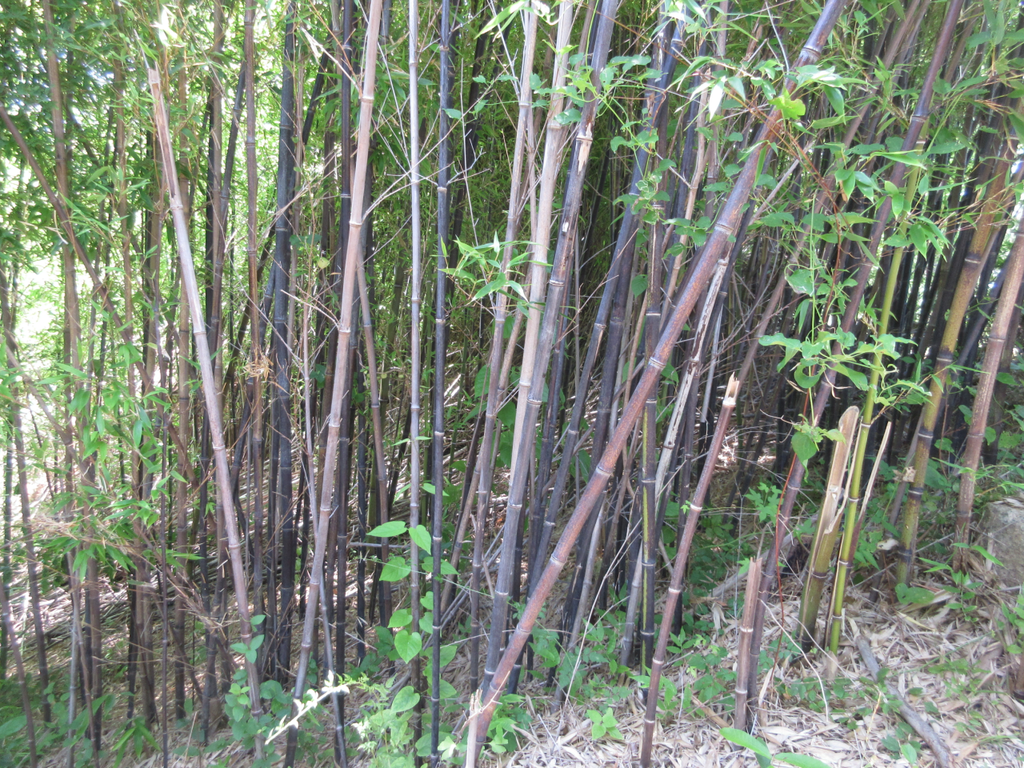
Black Bamboo
Phyllostachys nigra
Phyllostachys nigra, commonly known as black bamboo or purple bamboo (Chinese: 紫竹), is a species of bamboo, native to Hunan Province of China, and is widely cultivated elsewhere.
Growing up to 10 meters (35 ft) tall by 5cm (2 in) wide, it forms clumps of slender arching canes which turn black after two or three seasons. The abundant lance-shaped leaves are 4–13 cm (2–5 in) long.
From the article Phyllostachys nigra on Wikipedia (CC BY-SA), quoted section by section
What it does
Like many species of bamboo, black bamboo synchronizes its flowering, with flowering events happening every 40-120 years. According to one source, it has bloomed every 120 years "since records have been kept". It is monocarpic, that is, after flowering, the plants die. Henon bamboo flowers every 120 years and is predicted to flower in the 2020s. Since it is widely distributed in Japan, dieback of its stands may cause serious social and environmental problems. Moreover, Henon bamboo rarely sets fertile seeds, so it is not clear how this species has survived over long periods in Japan.
Wikipedia: “Life cycle”
At the table
It is used for lumber (timber), food, and musical instruments, among other things, in areas of China where it is native and also worldwide.
Wikipedia: “Uses”
In medicine
A 2008 study from Zhejiang University, in China, isolated several flavone C-glycosides on black bamboo leaves, including orientin, homoorientin, vitexin and isovitexin.
Wikipedia: “Phytochemistry”
Where it lives
Recorded sightings
—
geo-referenced records in GBIF, from museums, herbaria and field observers.
Drag the globe to turn it. Dots are where records exist, not a range map; darker means more records.
In the stacks
Searching the stacks…
Every page naming Phyllostachys nigra in the Biodiversity Heritage Library →
This page is assembled live from iNaturalist, GBIF, Wikipedia, the Source Library and the Internet Archive. It is not yet part of the hand-edited codex. iNaturalist taxon 166766.