- Animals
- ›Arthropods
- ›Hexapods
- ›Insects
- ›Winged and Once-winged Insects
- ›Butterflies and Moths
- ›Owlet Moths and Allies
- ›Cutworm Moths and Allies
- ›Cutworms and Dart Moths
- ›Wainscot Moths
- ›Pseudaletia
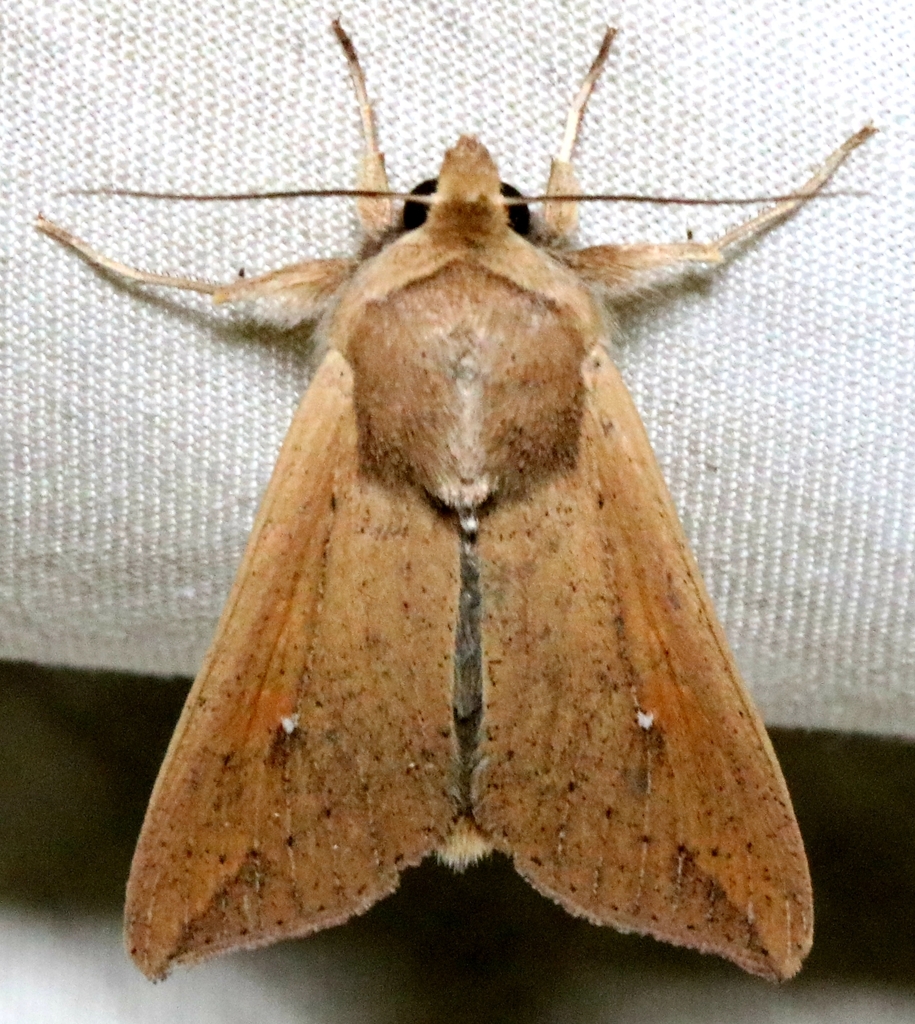
Armyworm Moth
Pseudaletia unipuncta
Mythimna unipuncta, the true armyworm moth, white-speck moth, common armyworm, or rice armyworm, is a species of moth in the family Noctuidae. The species was first described by Adrian Hardy Haworth in 1809. Mythimna unipuncta occurs in most of North America south of the Arctic, as well as parts of South America, Europe, Africa, and Asia. Although thought to be Neotropical in origin, it has been introduced elsewhere, and is often regarded as an agricultural pest. They are known as armyworms because the caterpillars move in lines as a massive group, like an army, from field to field, damaging crops.
The true armyworm has a distinct migration pattern in which they travel north in the spring and south in the fall to ensure that mating occurs in a favorable environment in the summer. While progressing through the life cycle stages of egg, larva, pupa, and adult, this species must avoid attack from predatory bugs, birds, wasp and fly parasitoids, and bacterial and fungal diseases. As polygamous insects, females release sex pheromones and choose multiple males as mates. The production and release of the pheromones are influenced by temperature, photoperiod, and the juvenile hormone. Hearing is an important sense for the true armyworm, necessary for mating and evading bat predation.
From the article Mythimna unipuncta on Wikipedia (CC BY-SA), quoted section by section
Range & habitat
M. unipuncta are commonly found around the world including the Americas, southern Europe, central Africa, and western Asia. In North America, they inhabit areas east of the Rocky Mountains and in northern Canada.
Wikipedia: “Geographic range”
What it does
In a given year, there can be two to three generations, each generation requiring 30–50 days to complete.
Wikipedia: “Life cycle”
Listen
Looking for field recordings…
Where it lives
Recorded sightings
—
geo-referenced records in GBIF, from museums, herbaria and field observers.
Drag the globe to turn it. Dots are where records exist, not a range map; darker means more records.
In the stacks
Searching the stacks…
Every page naming Pseudaletia unipuncta in the Biodiversity Heritage Library →
This page is assembled live from iNaturalist, GBIF, Wikipedia, the Source Library and the Internet Archive. It is not yet part of the hand-edited codex. iNaturalist taxon 1671287.