- Plants
- ›Vascular Plants
- ›flowering plants
- ›Dicots
- ›Roses, Elms, Figs, and Allies
- ›rose family
- ›Amygdaloideae
- ›Amygdaleae
- ›Prunus
- ›Padus
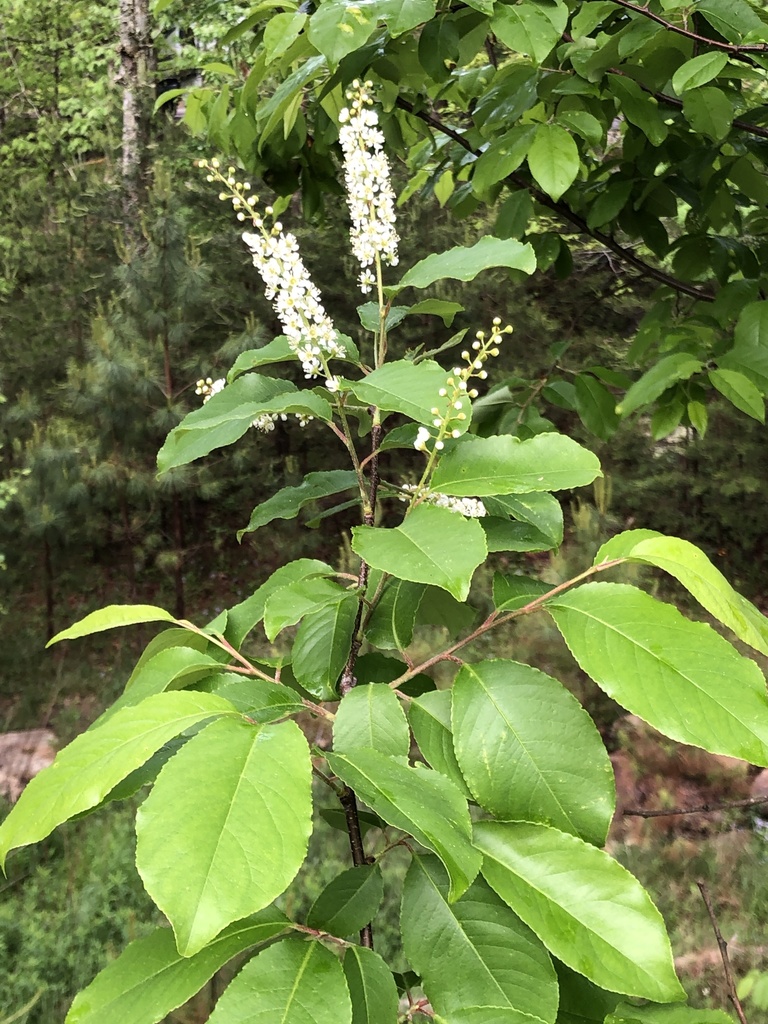
Alabama Cherry
Prunus alabamensis
Prunus alabamensis, the Alabama cherry or Alabama black cherry, is an uncommon to rare species of tree in the rose family endemic to parts of the Southeastern United States. It is closely related to and found wholly within the range of Prunus serotina (black cherry), a more common and widespread species also native to the region. Alabama cherry is sometimes considered to be a variety of P. serotina (i.e. Prunus serotina var. alabamensis), but most authors treat it as a distinct species.
From the article Prunus alabamensis on Wikipedia (CC BY-SA), quoted section by section
Description
Alabama cherry is a deciduous species. It forms a small or medium-sized tree growing to heights of 6–12 meters (20–40 feet) and a diameter of about 15 centimeters (6 inches), scarcely exceeding 7.5–9 m (25–30 ft) in height. The immature bark is gray and smooth; mature bark is rough and becomes broken into plates that are dark-gray to black in color. Young shoots or twigs are green and pubescent, often densely so, with rusty-brown hairs. The leaves are alternate, ovate to elliptic in shape, and rounded or slightly narrowed at the base. They are usually obtuse, rounded, or emarginate at the apex, but sometimes short acuminate, abruptly acute, or acutish. They are 3–12.5 cm (1+1⁄4–5 in) long and 2–6.5 cm (3⁄4–2+1⁄2 in) wide, with petioles that are 2–12 millimeters (1⁄16–1⁄2 in) long. The margins are bluntly serrated with appressed teeth that have glandular tips. The upper surface of the leaf is dark green and the lower surface is a lighter green. The lower surface is uniformly but sparsely pubescent with rusty-colored hairs that are longer and more dense along the midrib but not conspicuous. The axils of veins lack tufts of hair entirely, while veinlets are prominent. The texture of the leaves is leathery. In autumn, they turn a red or orange color. Flowers grow from the axils of leaves on elongated racemes that are 10–15 cm (4–6 in) long. …
Range & habitat
Alabama cherry is known to occur in the Southeastern US states of Alabama, Florida, Georgia, Mississippi, and South Carolina. It is rare to uncommon in its range. It grows in mixed oak-pine-hickory forests in sandy or rocky dry woodlands, on rocky slopes and sandhills, and on the summits of low mountains, often associated with longleaf pine (Pinus palustris). It grows at elevations of 20–700 m (66–2,297 ft).
Wikipedia: “Distribution and habitat”
At the table
The fruit and seed are edible and can be eaten raw or cooked, but caution should be taken when consuming the seed as this plant belongs to a genus where most or all species produce the volatile toxin hydrogen cyanide, mostly in their leaves and seeds. The levels are usually too small to do any harm, but especially bitter fruits or seeds should not be eaten.
Wikipedia: “Edibility”
Where it lives
Recorded sightings
—
geo-referenced records in GBIF, from museums, herbaria and field observers.
Drag the globe to turn it. Dots are where records exist, not a range map; darker means more records.
In the stacks
Searching the stacks…
Every page naming Prunus alabamensis in the Biodiversity Heritage Library →
This page is assembled live from iNaturalist, GBIF, Wikipedia, the Source Library and the Internet Archive. It is not yet part of the hand-edited codex. iNaturalist taxon 167458.