- Animals
- ›Molluscs
- ›Cephalopods
- ›Octopuses, Squids, and Cuttlefishes
- ›Octopuses and Vampire Squids
- ›Octopuses
- ›Incirrate Octopuses
- ›Typical Octopuses, Giant Octopuses, and Allies
- ›Typical Octopuses
- ›Pinnoctopus
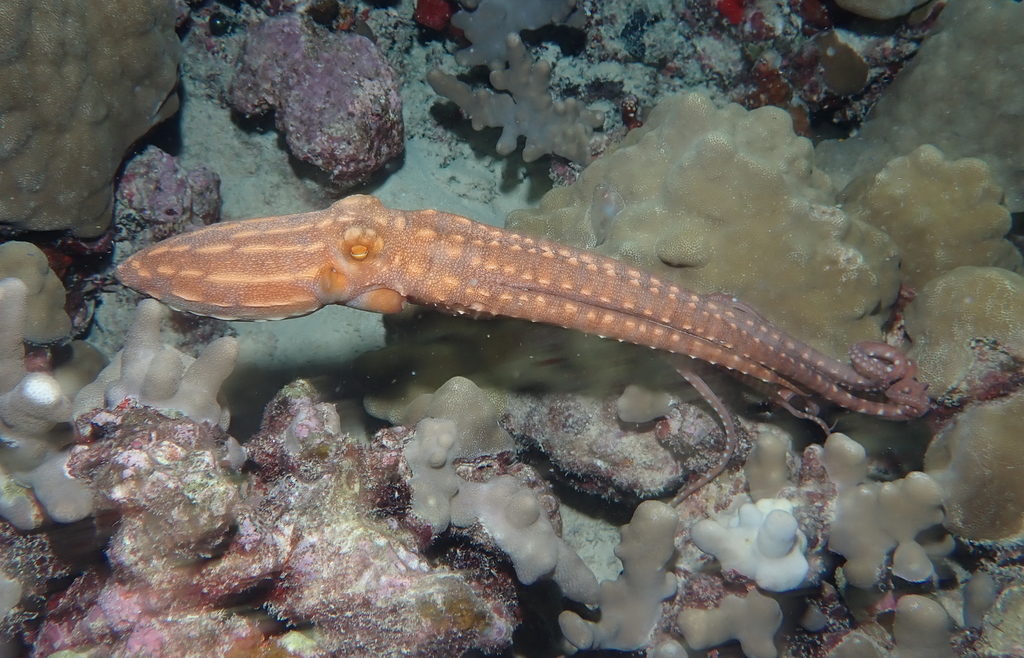
Ornate Night Octopus
Pinnoctopus ornatus
Pinnoctopus ornatus, the ornate octopus, is a tropical species of octopus native to the Indo-Pacific region. Other common names include white-striped octopus and night octopus, in reference to its nocturnal habits. It was previously known as Polypus ornatus. C. ornatus is edible and was recorded in a Hawaiian market in 1914 by S. S. Berry.
From the article Pinnoctopus ornatus on Wikipedia (CC BY-SA), quoted section by section
Description
The upper arms of Pinnoctopus ornatus are much longer and thicker than the other arms. They are pink to red in colour with paired white spots down the arms and short longitudinal white stripes on their mantle. This species can weigh several kilograms, and can reach an armspan of up to 2 metres (6 ft 7 in). The body is oval-shaped to elongate and the eyes are large. The arms are about six times the length of the body with the front pair being the longest. Each arm has two rows of suckers. The webs are shallow. The skin is fairly smooth with long flaps able to be raised in the white stripes on the sides of the body.
Range & habitat
This species has one of the widest distributions of all octopus, because of the planktonic life stage of the hatchlings. It is found throughout tropical waters in the Indo-Pacific, from Hawaii and Easter Island to South Africa. In Australian waters it is found from northern New South Wales around the northern coastline to Perth in Western Australia. The distribution of this octopus appears to be limited to tropical waters within the 20 °C (68 °F) isotherm. However, specimens collected in the warm temperate waters of New South Wales are probably a result of the planktonic juveniles being carried south by the warm East Australian Current.
Wikipedia: “Distribution”
What it does
These octopus eat mainly fish and crustaceans. They hunt at night and can be observed foraging over reef flats or on sand and gravel substrate during nightly low tides. Hunting consists of probing long arms down holes or enveloping small coral heads within the webs and using the arm tips to flush prey into the waiting suckers. The stomach contents also regularly contain the beaks of other octopus species. Other night-active octopuses in the same habitat flee in an explosion of ink if a single arm of this octopus touches them.
Wikipedia: “Diet”
Where it lives
Recorded sightings
—
geo-referenced records in GBIF, from museums, herbaria and field observers.
Drag the globe to turn it. Dots are where records exist, not a range map; darker means more records.
In the stacks
Searching the stacks…
Every page naming Pinnoctopus ornatus in the Biodiversity Heritage Library →
This page is assembled live from iNaturalist, GBIF, Wikipedia, the Source Library and the Internet Archive. It is not yet part of the hand-edited codex. iNaturalist taxon 1678342.