- Animals
- ›Arthropods
- ›Hexapods
- ›Insects
- ›Winged and Once-winged Insects
- ›Butterflies and Moths
- ›Owlet Moths and Allies
- ›Underwing, Tiger, Tussock, and Allied Moths
- ›Scoliopteryginae
- ›Anomini
- ›Alabama
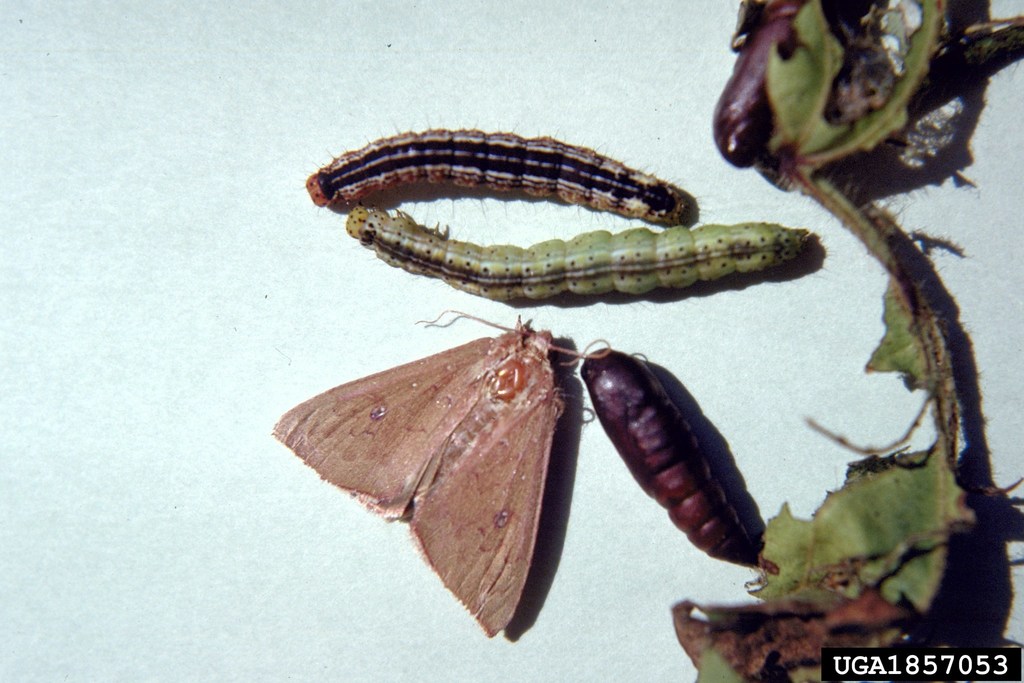
Alabama argillacea
Alabama argillacea, the cotton leafworm or cotton worm, is a moth of the family Erebidae. It is native to the New World, but has been extirpated from the United States and Canada, having not been recorded since 1998. In the Neotropics, it can be found from Mexico to northern Argentina. The larva is considered a pest of cotton. They feed on the leaves, twigs, and buds.
From the article Alabama argillacea on Wikipedia (CC BY-SA), quoted section by section
Description
The adult moth has light brown to orange wings. It wingspan varies from 25 to 35 mm. The larvae are up to 40 mm long, green or brownish with black and white stripes. They have a characteristic pattern of black dots on each segment.
What it does
Alabama argillacea is a specialist feeder on Gossypieae, which includes cotton and its close relatives. Like other anomine erebids, its distribution is primarily tropical and only migrates north in the summer and fall under favorable conditions. Its eggs are sensitive and cannot tolerate any amount of frost in the winter, restricting the adults to historically spend the winter in Florida and Texas. However, its eggs may have never overwintered at all in the United States. Any adults which found themselves up north in the fall would have died by the first frost. Females lay an average of 400 eggs, which is unusually high for a noctuoid. The entirety of the damage done to cotton is done by the larvae. Young instars feed primarily the underside of the leaves, skeletonizing them as they feed. Older instars move vertically and feed on the younger, fresher foliage near the bolls and sometimes on the bolls themselves. Depending on latitude, two to eight generations could have occurred in the United States each year. This made them an especially dangerous pest, as they fed year-round in some locations. In especially bad years, the larvae destroyed over a third of cotton crops. This resulted in the United States losing almost $30 million a year in lost profits (over $700 million in today's terms). …
Wikipedia: “Life cycle”
Listen
Looking for field recordings…
Where it lives
Recorded sightings
—
geo-referenced records in GBIF, from museums, herbaria and field observers.
Drag the globe to turn it. Dots are where records exist, not a range map; darker means more records.
In the stacks
Searching the stacks…
Every page naming Alabama argillacea in the Biodiversity Heritage Library →
This page is assembled live from iNaturalist, GBIF, Wikipedia, the Source Library and the Internet Archive. It is not yet part of the hand-edited codex. iNaturalist taxon 172847.